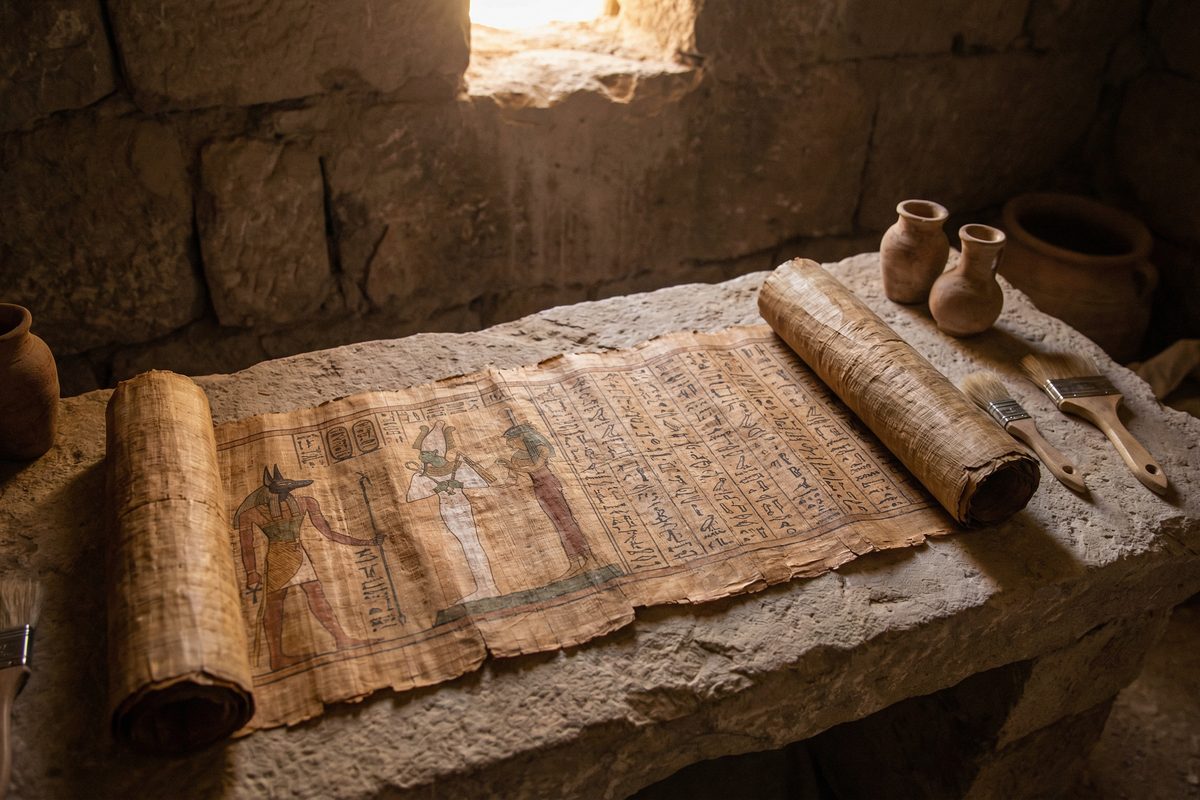
Egyptian · 1550 BC
The Ancient Egyptian Book of the Dead Spells
6 min read
Last updated April 8, 2026
Disclosure: This article contains affiliate links. If you purchase through these links, we may earn a small commission at no additional cost to you. This helps support The Forbidden Archive and allows us to continue our research. See our Privacy Policy for details.
Choose your reading style:
By Marcus Hale
Independent Researcher & Archive Curator
The veil between life and death has always captivated humanity, but few civilizations explored its mysteries with the same meticulous devotion as the ancient Egyptians. Their elaborate funerary practices, monumental tombs, and the enigmatic texts they left behind speak volumes of their profound belief in an eternal journey. At the heart of this spiritual quest lies one of the most famous and misunderstood artifacts of antiquity: the Book of the Dead. Far from being a single, cohesive book, this collection of spells, incantations, and prayers was a vital guide for the deceased, ensuring safe passage through the perilous Egyptian underworld spells.
Unveiling the Book of the Dead: A Guide to Eternity
The term "Book of the Dead" is a modern invention, coined by Egyptologist Karl Richard Lepsius in the 19th century. The ancient Egyptians knew it as Rau nu pert em hru, or "Spells for Coming Forth by Day." This collection of funerary texts, evolving over millennia, was not a static scripture but a personalized anthology designed to equip the deceased for the ultimate transition. Its purpose was clear: to protect the soul (Ba), spirit (Ka), and body in the afterlife, ensuring resurrection and eternal life in the Field of Reeds.
Historical Context: From Pyramid Texts to Papyrus Scrolls
The origins of the Book of the Dead can be traced back to the Old Kingdom (c. 2686–2181 BC) with the Pyramid Texts, inscribed on the walls of royal tombs. These early spells were exclusive to pharaohs, guiding them through the celestial realm. During the Middle Kingdom (c. 2055–1650 BC), these texts evolved into the Coffin Texts, painted on sarcophagi and accessible to a wider, though still elite, segment of society. By the New Kingdom (c. 1550–1070 BC), the Book of the Dead emerged in its most recognizable form, written on papyrus scrolls and often lavishly illustrated with vignettes. This period, particularly around 1550 BC, saw the widespread use of these Egyptian afterlife spells, reflecting a democratization of access to funerary magic.
The Ani Papyrus: A Masterpiece of Ancient Egyptian Magic
Perhaps the most famous and complete example of the Book of the Dead is the Ani Papyrus. Discovered in Thebes and dating to the 19th Dynasty (c. 1250 BC), this exquisite scroll belonged to a royal scribe named Ani and his wife, Tutu. Measuring an astonishing 23.6 meters (78 feet) long, it is a testament to the artistry and spiritual devotion of the time. The Ani Papyrus is renowned for its vibrant illustrations and meticulously written hieroglyphs, depicting Ani's journey through the underworld, his encounter with the gods, and the pivotal Weighing of the Heart ceremony. It offers an unparalleled glimpse into the beliefs surrounding ancient Egyptian magic and the intricate path to eternal bliss.
Navigating the Duat: The Purpose of the Spells
The Book of the Dead was essentially a cheat sheet for the afterlife, a collection of Egyptian underworld spells designed to overcome the myriad dangers and challenges awaiting the deceased in the Duat (the underworld). These spells served several crucial functions:
- Protection from Demons and Obstacles: Numerous spells were dedicated to warding off malevolent entities, serpents, and other monstrous creatures that sought to devour the deceased's spiritual essence.
- Transformation and Rebirth: Spells allowed the deceased to transform into various animals or divine beings, granting them power and mobility within the underworld.
- Access to Divine Knowledge: Some spells provided secret names of gods and gates, allowing the deceased to pass through guarded portals and gain favor with the deities.
- Ensuring Sustenance: Spells ensured the deceased would have food, drink, and comfort in the afterlife, preventing them from suffering hunger or thirst.
- The Weighing of the Heart: This was perhaps the most critical spell (Spell 30B), designed to prevent the heart (the seat of consciousness and morality) from testifying against the deceased during judgment before Osiris. The heart was weighed against the feather of Ma'at (truth and justice). If found pure, the deceased achieved eternal life; if not, it was devoured by Ammit, the "Devourer of the Dead."
Scholarly Theories and Interpretations
Modern Egyptologists continue to unravel the complexities of the Book of the Dead. One prevailing theory suggests that the spells were not merely recited but were believed to possess inherent magical power, literally shaping the reality of the deceased's journey. The act of writing them down, often by skilled scribes and priests, was itself a ritualistic act. Another perspective highlights the psychological comfort these texts offered; knowing that one possessed the means to navigate the afterlife would have provided immense solace to the living and the dying.
There's also debate about the accessibility and understanding of these texts. While the New Kingdom saw a wider distribution, it's unlikely that every individual could fully comprehend the intricate hieroglyphs and esoteric meanings. It's more probable that priests and family members would have guided the deceased, or that the mere presence of the spells was deemed sufficient protection. The Book of the Dead was not a single, canonical text, but a personalized anthology, reflecting the wealth and spiritual needs of the individual. This explains the variations in length, content, and artistic quality found across different papyri.
The Enduring Mystery of Ancient Egyptian Magic
The Book of the Dead stands as a monumental testament to the ancient Egyptian worldview, a civilization utterly consumed by the pursuit of eternity. These Egyptian afterlife spells offer us a window into their hopes, fears, and profound understanding of the cosmos. The intricate blend of religious belief, magical practice, and artistic expression within these scrolls continues to fascinate and challenge researchers today. The sheer volume of these texts, the consistency of their themes over centuries, and the meticulous effort invested in their creation underscore the centrality of the afterlife in ancient Egyptian society.
Even with extensive research, the full extent of the psychological and spiritual impact of the Book of the Dead on the ancient Egyptians remains a mystery. How deeply did they believe in the literal efficacy of every spell? Did the vivid descriptions of the Duat inspire fear or comfort? The Ani Papyrus and countless other fragments continue to whisper secrets from a time when death was not an end, but merely a transition, guided by the powerful words of ancient Egyptian magic. The journey through the Egyptian underworld spells was a perilous one, but with the right guidance, eternal life was within reach.
As we gaze upon these ancient scrolls, we are left to ponder: what secrets of existence did the Egyptians truly unlock, and what profound truths about life and death do these enduring texts still hold for us today?
Marcus Hale
Independent Researcher & Archive Curator
Marcus Hale is an independent researcher and the curator of The Forbidden Archive. He has spent over a decade studying anomalous ancient technologies, cross-referencing primary excavation reports, museum catalogues, and peer-reviewed journals to document artifacts that mainstream history struggles to explain.
📖 Take the Archive With You
Enjoyed this mystery? The full ebook covers 50 Ancient Mysteries in depth — lost technologies, suppressed histories, and artifacts that shouldn't exist. 300+ pages, instant PDF download.
Archive Record
Civilization
Egyptian
Time Period
1550 BC
Approximate Date
1550 BC
Further Research
The Oxford History of Ancient Egypt
The authoritative academic history of ancient Egyptian civilization.
Amazon
Temples, Tombs and Hieroglyphs: A Popular History of Ancient Egypt
Accessible guide to the wonders of ancient Egyptian civilization.
Amazon
Affiliate links — we may earn a commission at no cost to you.