Maltese Prehistoric · 3300–3000 BC
The Hypogeum of Hal Saflieni Acoustics
5 min read
Last updated February 2, 2026
Disclosure: This article contains affiliate links. If you purchase through these links, we may earn a small commission at no additional cost to you. This helps support The Forbidden Archive and allows us to continue our research. See our Privacy Policy for details.
Choose your reading style:

By Marcus Hale
Independent Researcher & Archive Curator
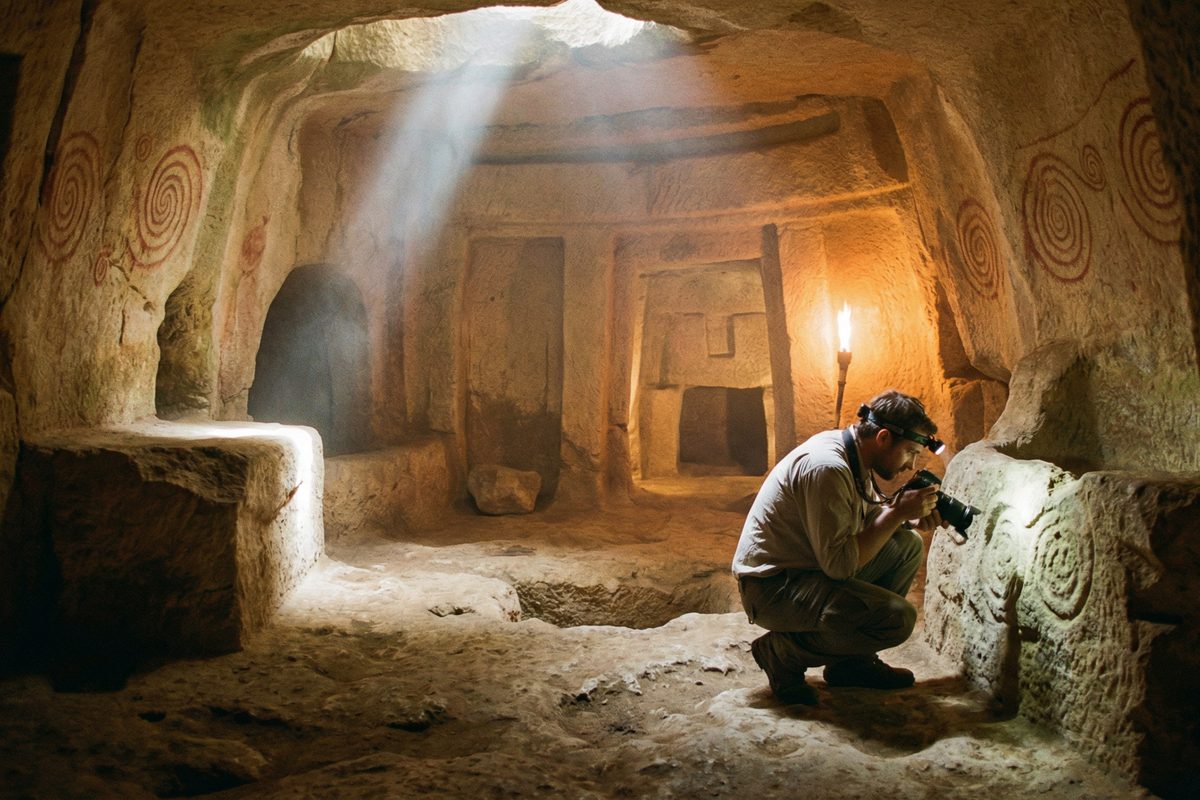
Deep beneath the sun-drenched island of Malta lies a labyrinthine marvel carved from solid rock: the Hypogeum of Hal Saflieni. This extraordinary subterranean complex, dating back to the Maltese Prehistoric period (3300–3000 BC), is not merely an architectural wonder but a testament to an advanced understanding of sound and space. Beyond its primary function as a necropolis and sanctuary, the Hypogeum of Hal Saflieni acoustics present a captivating enigma that continues to baffle and inspire researchers today.
The Echoes of a Lost Civilization: Discovering Hal Saflieni
The Hypogeum's existence remained a secret for millennia until its accidental discovery in 1902 by workmen digging foundations for new housing. What they unearthed was a three-level subterranean complex spanning approximately 500 square meters, meticulously carved from limestone using only flint and stone tools. Its intricate design, featuring chambers, passages, and ritual spaces, immediately marked it as a site of immense archaeological significance. The sheer scale and precision of the carving, especially considering the tools available to its builders, speak volumes about the ingenuity of the ancient Maltese civilization.
Initially, archaeologists believed the Hypogeum served primarily as a burial ground, housing the remains of an estimated 7,000 individuals. However, the presence of unique architectural features, such as the Oracle Room and the Holy of Holies, alongside evidence of ritualistic practices, strongly suggests a dual purpose as a temple or sanctuary. It is within these sacred spaces that the most compelling mystery of the Hypogeum of Hal Saflieni acoustics truly begins to resonate.
The Oracle Room: A Symphony in Stone
Among the Hypogeum's many wonders, the "Oracle Room" stands out. This small, roughly circular chamber, accessible via a narrow passage, possesses an extraordinary acoustic property. When a low-frequency sound, particularly a male voice, is uttered within this room, the sound reverberates and amplifies in a way that is both powerful and disorienting. The entire structure seems to hum, and the vibrations can be felt throughout the Hypogeum, creating an immersive and almost otherworldly experience. This phenomenon is central to understanding the ancient resonance chambers of prehistoric Malta.
Early experiments in the 1960s and 70s hinted at these unusual properties, but it wasn't until more recent scientific investigations that the true extent of the Hal Saflieni acoustics was understood. Researchers from the University of Malta and other institutions have conducted detailed acoustic analyses, revealing that the Oracle Room, and indeed other parts of the Hypogeum, are specifically tuned to certain frequencies.
Unveiling the Acoustic Secrets: Scientific Investigations
Modern acoustic studies have confirmed that the Hypogeum of Hal Saflieni exhibits remarkable resonance at specific frequencies, most notably around 110 Hz. This frequency falls within the range of a deep male voice and is also close to the fundamental frequency of many ancient musical instruments, such as drums and horns. When sounds at this frequency are introduced into the Oracle Room, they create a standing wave that amplifies the sound and causes it to reverberate throughout the entire complex, even in distant chambers.
The "Brainwave" Connection and Altered States
One of the most intriguing theories surrounding the hypogeum sound relates to its potential impact on human consciousness. The 110 Hz frequency is remarkably close to the alpha brainwave state (8-12 Hz) and theta brainwave state (4-8 Hz), which are associated with deep relaxation, meditation, and altered states of consciousness. Some researchers propose that the ancient priests or shamans of prehistoric Malta deliberately engineered these acoustic properties to induce a trance-like state in participants during rituals.
Imagine a ritual taking place within the Hypogeum: the rhythmic chanting of priests, the beating of drums, all resonating at 110 Hz. The participants, enveloped by the amplified sound and feeling the vibrations throughout their bodies, could have experienced profound psychological effects, including heightened suggestibility, visions, and a sense of connection to the divine. This deliberate manipulation of sound to achieve spiritual or ritualistic goals would place the builders of the underground temple Malta far ahead of their time.
Architectural Intent or Happy Accident?
The question remains: were these acoustic properties intentionally designed, or are they a fortuitous byproduct of the Hypogeum's architecture? While some argue for the latter, the precision of the carving, the specific dimensions of the Oracle Room, and the consistent resonance across different parts of the complex strongly suggest deliberate engineering. The builders of the Hypogeum were not merely excavating; they were sculpting space with an acute awareness of its acoustic potential.
Furthermore, the absence of similar acoustic phenomena in other contemporary structures, or even in other parts of the Hal Saflieni complex that likely served different purposes, points towards a specific design intent for the Oracle Room. The ancient Maltese civilization, though seemingly primitive in their tools, possessed a sophisticated understanding of their environment and the properties of sound.
Beyond the Oracle Room: Wider Acoustic Implications
While the Oracle Room is the most famous example of the Hal Saflieni acoustics, other chambers within the Hypogeum also exhibit unique sound properties. Some passages amplify whispers, while others create a sense of disorientation. This suggests a holistic approach to sound design, where different areas of the underground temple Malta were intended to evoke specific sensory and psychological responses.
The study of these ancient resonance chambers provides invaluable insights into the spiritual and social practices of prehistoric Malta. It challenges our preconceived notions about the capabilities of ancient civilizations and highlights the profound connection between sound, architecture, and human experience. The hypogeum sound is not just an archaeological curiosity; it is a window into the minds of a people who understood the power of vibration and its potential to transcend the ordinary.
A Timeless Mystery Echoing Through the Ages
The Hypogeum of Hal Saflieni stands as a silent testament to a lost civilization's ingenuity and spiritual depth. Its remarkable acoustics, particularly the resonant properties of the Oracle Room, continue to fascinate and challenge researchers. Was it a tool for healing, a means of communication with the divine, or a sophisticated method for inducing altered states of consciousness during sacred rituals? While definitive answers may remain elusive, the ongoing study of the Hal Saflieni acoustics offers tantalizing glimpses into the advanced knowledge possessed by the builders of this extraordinary underground temple Malta.
As we delve deeper into the mysteries of prehistoric Malta, the echoes from the Hypogeum remind us that our ancestors, far from being primitive, possessed a profound understanding of the world around them, capable of crafting experiences that resonate across millennia. The hypogeum sound is a whisper from the past, inviting us to listen closely and ponder the secrets it still holds.
Marcus Hale
Independent Researcher & Archive Curator
Marcus Hale is an independent researcher and the curator of The Forbidden Archive. He has spent over a decade studying anomalous ancient technologies, cross-referencing primary excavation reports, museum catalogues, and peer-reviewed journals to document artifacts that mainstream history struggles to explain.
📖 Take the Archive With You
Enjoyed this mystery? The full ebook covers 50 Ancient Mysteries in depth — lost technologies, suppressed histories, and artifacts that shouldn't exist. 300+ pages, instant PDF download.
Archive Record
Civilization
Maltese Prehistoric
Time Period
3300–3000 BC
Approximate Date
3300–3000 BC
Further Research
Ancient Engineers: An Amazing Look at the Incredible Builders
How ancient civilizations achieved seemingly impossible feats of engineering.
Amazon
Lost Technologies of Ancient Egyptian Builders
Investigation into the construction methods of the ancient world.
Amazon
Affiliate links — we may earn a commission at no cost to you.