Aztec/Borgia Group · pre-Columbian
The Mayan Codex Borgia
6 min read
Last updated February 21, 2026
Disclosure: This article contains affiliate links. If you purchase through these links, we may earn a small commission at no additional cost to you. This helps support The Forbidden Archive and allows us to continue our research. See our Privacy Policy for details.
Choose your reading style:

By Marcus Hale
Independent Researcher & Archive Curator
Welcome, seekers of ancient truths, to The Forbidden Archive. Today, we delve into the vibrant, enigmatic pages of one of Mesoamerica's most captivating pre-Columbian treasures: the Codex Borgia. Far from being a mere historical document, this intricately painted manuscript offers a profound window into the spiritual and calendrical complexities of ancient Mexican civilizations, particularly those within the Borgia Group, a cultural sphere closely related to the later Aztec empire.
Unveiling the Codex Borgia: A Masterpiece of Pre-Columbian Art and Knowledge
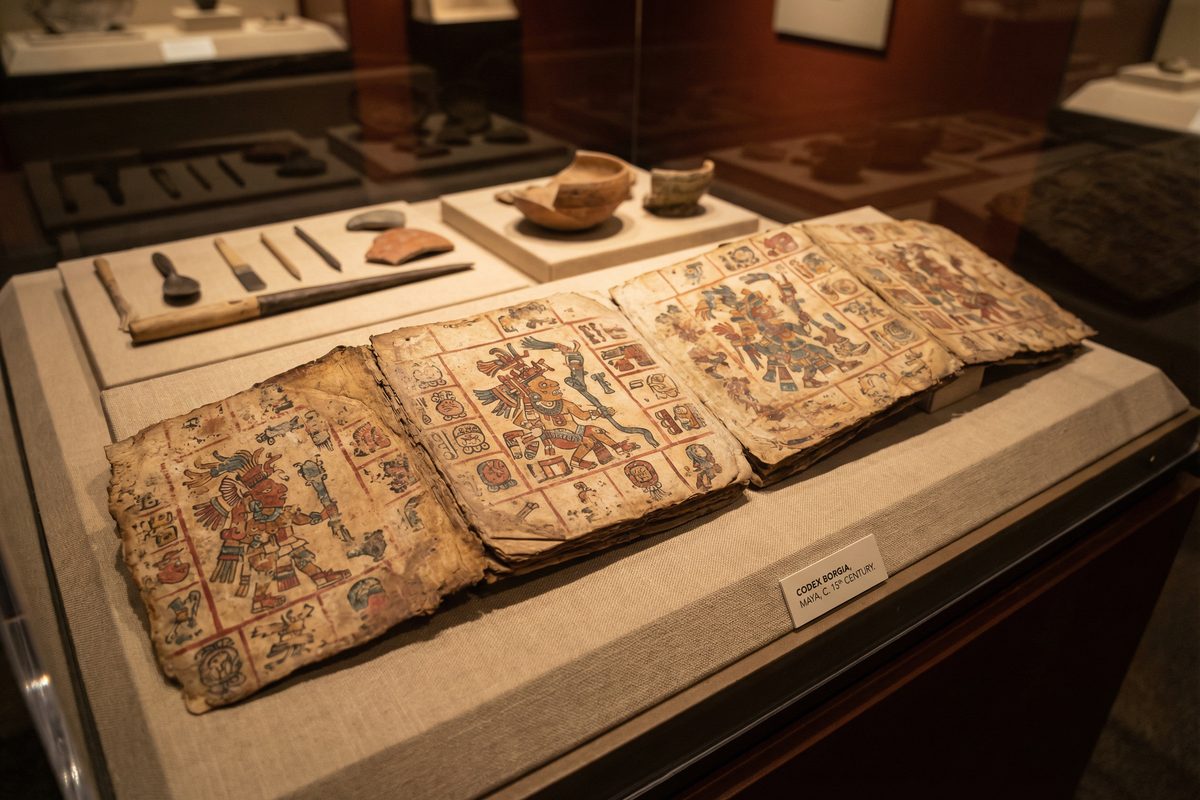
The Codex Borgia is not just a book; it is a visual symphony, a sacred almanac, and a guide to the cosmos as understood by its creators. This astonishing Codex Borgia, named after Cardinal Stefano Borgia who acquired it in the late 18th century, stands as a testament to the sophisticated intellectual and artistic achievements of pre-Columbian Mesoamerica. Its pages, made from animal hide (likely deer skin) coated with gesso and folded into an accordion-like screenfold, burst with vivid colors and intricate iconography.
Historical Context: The Borgia Group and the Aztec World
While often referred to as an "Aztec codex" due to its stylistic and thematic similarities with later Aztec art and religion, the Codex Borgia actually predates the height of the Aztec Empire. Scholars generally attribute its creation to a culture within the "Borgia Group" of central Mexican highlands, likely during the Postclassic period, roughly between 1250 and 1521 CE. This group shared a common artistic style and religious iconography that influenced, and was in turn influenced by, the burgeoning Aztec civilization. Therefore, while not strictly an Aztec document, it offers invaluable insights into the shared spiritual landscape that underpinned much of ancient central Mexico.
The codex was likely produced in the Puebla-Tlaxcala Valley region, an area known for its rich artistic traditions and religious centers. Its survival through the Spanish Conquest, which saw the destruction of countless native manuscripts, is nothing short of miraculous, adding another layer of intrigue to its story.
The Discovery and Journey of a Sacred Text
The precise circumstances of the Codex Borgia's discovery remain shrouded in mystery. It emerged into European consciousness relatively late, unlike some other codices. Cardinal Stefano Borgia, a passionate collector of antiquities, acquired the manuscript in Rome. How it traveled from the heart of Mesoamerica to an Italian cardinal's collection is a tale lost to time, though it likely passed through various hands after the Conquest, perhaps as a curiosity or a war trophy, before its true significance began to be understood.
For centuries, the ancient Mexican codex remained largely unstudied, its complex imagery a baffling puzzle to European scholars. It wasn't until the late 19th and early 20th centuries, with the pioneering work of scholars like Eduard Seler, that the intricate layers of meaning within the Codex Borgia began to be deciphered. Seler's monumental commentaries laid the groundwork for all subsequent research, transforming the codex from an exotic artifact into a vital historical and religious document.
Deciphering the Sacred Canvas: Themes and Content
The Codex Borgia is primarily a divinatory and ritualistic text. Unlike historical narratives or tribute lists, its pages are dedicated to predicting fortunes, guiding rituals, and understanding the cosmic forces that governed human life. It is a prime example of Mesoamerican divination practices, reflecting a worldview where every day, every action, and every natural phenomenon was imbued with sacred meaning.
Key Sections and Their Meanings:
- The Tonalpohualli: A significant portion of the codex is dedicated to the 260-day ritual calendar, known as the Tonalpohualli. This sacred calendar, fundamental to Mesoamerican life, dictated auspicious and inauspicious days for various activities, from planting crops to warfare and marriage. Each day sign and number combination is depicted with its associated deities, omens, and ritual instructions.
- Deity Cycles and Offerings: The codex illustrates numerous deities, often in elaborate ritual scenes. These sections detail the attributes of gods like Tezcatlipoca, Quetzalcoatl, Tlaloc, and Xipe Totec, showing their roles in cosmic cycles and the offerings required to appease or honor them.
- Cosmological Maps: Some pages present complex cosmological diagrams, depicting the structure of the universe, the cardinal directions, and the pathways of celestial bodies. These maps reveal a sophisticated understanding of astronomy and a deep connection between the earthly and divine realms.
- Ritual Sequences: The manuscript also contains sequences depicting specific rituals, including sacrifices, purification rites, and ceremonies related to agricultural cycles. These visual narratives provide invaluable clues about the religious practices of the Borgia Group.
The artistic style is characterized by its bold outlines, vibrant color palette (dominated by red, blue, yellow, and black), and highly symbolic imagery. Every feather, every gesture, every color holds specific meaning, making the Codex Borgia a complex iconographic puzzle.
Scholarly Theories and Enduring Mysteries
Despite centuries of study, the Codex Borgia continues to present fascinating challenges to scholars. One ongoing debate revolves around its exact purpose and audience. Was it a priestly handbook, used by trained diviners to guide their consultations? Or was it a more general ritual guide, accessible to a wider religious elite?
Another area of intense research concerns the specific regional variations within the Borgia Group. While sharing a common style, subtle differences in iconography and calendrical emphasis can help pinpoint the codex's precise origin within the diverse cultural landscape of pre-Columbian Mexico. The intricate symbolism of certain pages still eludes complete interpretation, leaving tantalizing gaps in our understanding of this ancient pre-Columbian manuscript.
The very act of its creation – the painstaking preparation of the animal hide, the meticulous application of pigments, and the profound knowledge embedded within its designs – speaks volumes about the value placed on such sacred texts. It was not merely a record; it was a living embodiment of cosmic order.
The Enduring Legacy of the Codex Borgia
Today, the Codex Borgia resides in the Apostolic Library of the Vatican, a testament to its enduring historical and cultural significance. It remains one of the most complete and visually stunning examples of a Aztec codex (or rather, a Borgia Group codex) to survive the ravages of time and conquest. Its pages continue to inspire awe and offer unparalleled insights into the spiritual heart of ancient Mesoamerica.
As we gaze upon the intricate designs and vibrant colors of the Codex Borgia, we are transported back to a time when the cosmos was alive with gods and omens, and human destiny was intricately woven into the fabric of the universe. This ancient Mexican codex reminds us that knowledge, art, and spirituality were deeply intertwined, forming a sophisticated worldview that continues to challenge and fascinate us today. What other secrets might these ancient pages still hold, waiting for a new generation of scholars to unlock?
Marcus Hale
Independent Researcher & Archive Curator
Marcus Hale is an independent researcher and the curator of The Forbidden Archive. He has spent over a decade studying anomalous ancient technologies, cross-referencing primary excavation reports, museum catalogues, and peer-reviewed journals to document artifacts that mainstream history struggles to explain.
📖 Take the Archive With You
Enjoyed this mystery? The full ebook covers 50 Ancient Mysteries in depth — lost technologies, suppressed histories, and artifacts that shouldn't exist. 300+ pages, instant PDF download.
Archive Record
Civilization
Aztec/Borgia Group
Time Period
pre-Columbian
Approximate Date
pre-Columbian
Further Research
The Ancient Maya
The definitive academic text on Maya civilization and achievements.
Amazon
1491: New Revelations of the Americas Before Columbus
Groundbreaking account of pre-Columbian civilizations in the Americas.
Amazon
Affiliate links — we may earn a commission at no cost to you.