Maltese Prehistoric · 3600–2500 BC
The Megalithic Temples of Malta
5 min read
Last updated March 15, 2026
Disclosure: This article contains affiliate links. If you purchase through these links, we may earn a small commission at no additional cost to you. This helps support The Forbidden Archive and allows us to continue our research. See our Privacy Policy for details.
Choose your reading style:

By Marcus Hale
Independent Researcher & Archive Curator
Welcome, seekers of forgotten knowledge, to The Forbidden Archive. Today, we delve into a profound enigma etched in stone, a testament to human ingenuity that predates the pyramids and Stonehenge. We journey to the sun-kissed islands of Malta, home to some of the world's most breathtaking and perplexing ancient structures: the Megalithic Temples of Malta.
The Dawn of Giants: Malta's Prehistoric Legacy
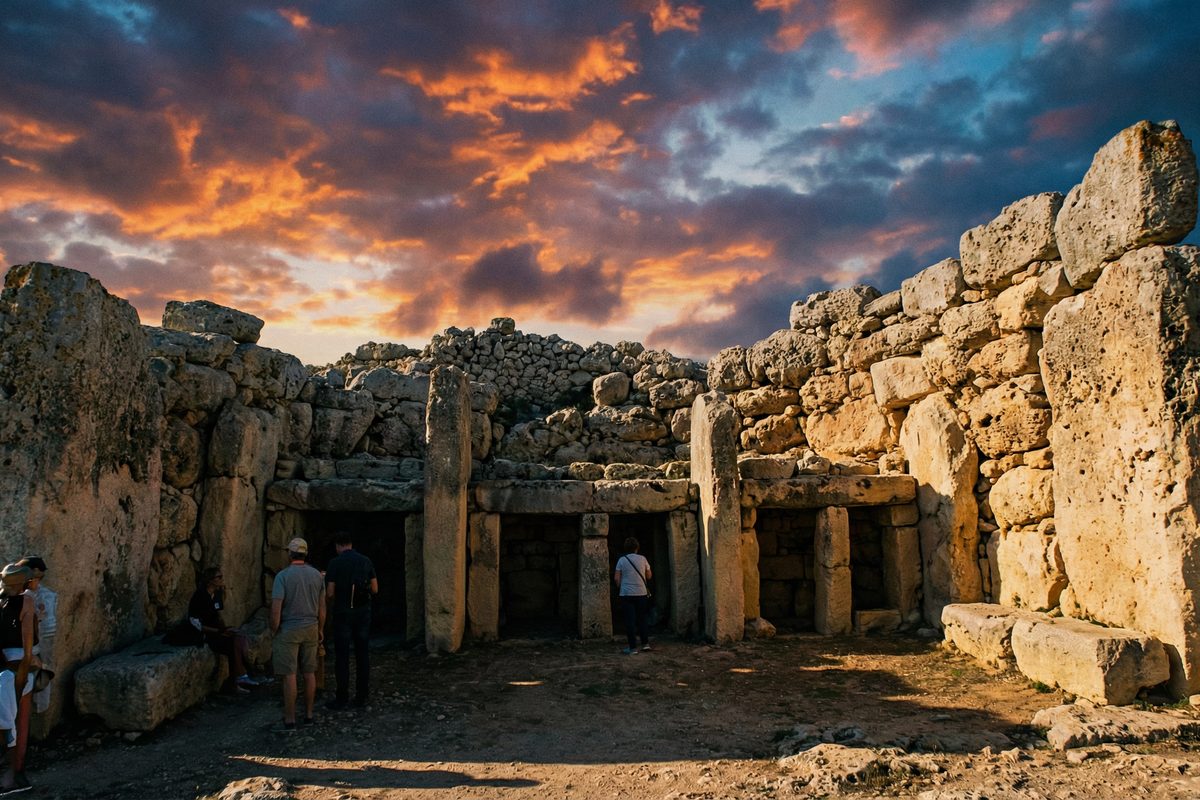
Imagine a time before written history, before the rise of great empires in Egypt or Mesopotamia. On a small archipelago in the heart of the Mediterranean, an extraordinary civilization flourished, leaving behind monuments that defy easy explanation. From approximately 3600 to 2500 BC, a sophisticated culture, known as the Maltese Prehistoric, embarked on an ambitious building program, culminating in the construction of massive stone temples that stand as the oldest freestanding structures on Earth. These aren't mere piles of rocks; they are architectural marvels, meticulously planned and expertly crafted, hinting at a society with advanced organizational skills and a profound spiritual connection to their world.
The sheer scale of these constructions is staggering. Imagine communities, without metal tools or the wheel, quarrying enormous limestone blocks, some weighing many tons, and then transporting and erecting them with astonishing precision. The dedication and collective effort required for such feats speak volumes about the beliefs and social structures of these ancient islanders. The Malta megalithic temples represent a pinnacle of prehistoric engineering.
Unveiling the Mystery: Key Discoveries and Sites
The discovery and ongoing study of the Malta megalithic temples have captivated archaeologists and historians for centuries. While local legends often spoke of giants building these structures (hence the name of one prominent site), serious archaeological investigation began in the 19th century, slowly peeling back layers of time to reveal their true significance.
Ggantija: The Temple of Giants
Perhaps the most iconic of these sites is Ggantija, located on the island of Gozo. Its name, derived from the Maltese word "ġgant" (giant), reflects the awe-inspiring size of its megaliths, some reaching over five meters in height and weighing more than fifty tons. Dating back to around 3600 BC, Ggantija is not only one of the oldest but also one of the best-preserved temple complexes. Its distinctive trefoil (three-lobed) plan, a common feature in many Malta megalithic temples, is immediately apparent. The outer walls, constructed from massive coralline limestone, enclose inner chambers built from softer globigerina limestone, often adorned with intricate carvings.
Tarxien Temples: A Glimpse into Ritual Life
On the main island of Malta, the Tarxien temples offer a fascinating window into the ritualistic practices of the prehistoric Maltese. Discovered in 1913, these four interconnected temples, dating from approximately 3100 to 2500 BC, are renowned for their elaborate decorations. Here, archaeologists unearthed evidence of animal sacrifices, ritualistic fires, and richly carved altars. Spiral motifs, animal reliefs (including pigs, goats, and cattle), and depictions of what appear to be fertility goddesses or priestesses adorn the stone blocks, providing tantalizing clues about their belief system. The Tarxien temples are a treasure trove of prehistoric art and religious symbolism.
Other Notable Sites
Beyond Ggantija and Tarxien, numerous other sites contribute to the rich tapestry of prehistoric Malta. Hagar Qim and Mnajdra, dramatically situated overlooking the sea, showcase sophisticated astronomical alignments, particularly during the solstices and equinoxes. Skorba and Ta’ Hagrat offer insights into the earlier phases of temple building, demonstrating the evolution of architectural styles and techniques. Each site, though unique, shares common threads of monumental construction and a clear dedication to sacred spaces.
Scholarly Theories: What Purpose Did They Serve?
The primary function of the Malta megalithic temples remains a subject of intense scholarly debate. While their religious significance is widely accepted, the specifics of their rituals and the nature of the deities worshipped are still largely speculative.
- Fertility Cults: One prominent theory suggests that the temples were centers for fertility cults. The numerous figurines of corpulent female figures, often referred to as "fat ladies" or "mother goddesses," found at various sites, support this idea. These figures, some remarkably detailed, may represent deities associated with agricultural abundance, human fertility, and the cyclical nature of life and death.
- Astronomical Observatories: The precise alignments of certain temples, particularly Hagar Qim and Mnajdra, with celestial events like the solstices and equinoxes, lead many to believe they also served as astronomical observatories. This would have been crucial for an agrarian society dependent on understanding seasonal changes for planting and harvesting.
- Community Hubs and Ritual Centers: Beyond specific cults, the temples likely functioned as central gathering places for communities, serving as focal points for religious ceremonies, social cohesion, and perhaps even economic exchange. The monumental effort required to build them would have fostered a strong sense of collective identity.
- Oracular Sites: The unique acoustic properties of some temple chambers, particularly the Hypogeum (a subterranean temple complex not covered in detail here but equally fascinating), suggest they might have been used for oracular purposes, where priests or priestesses communicated with the divine through amplified voices or altered states of consciousness.
The lack of written records from this period means that interpretations are based on archaeological evidence, comparative studies with other ancient cultures, and careful inference. The absence of defensive structures around the temples also suggests a relatively peaceful society, at least during the peak of their construction.
The Enigma Endures
Around 2500 BC, the temple-building culture of prehistoric Malta mysteriously vanished. The reasons for this abrupt decline are unknown, though theories range from environmental degradation and resource depletion to internal strife or external invasion. The islands lay largely uninhabited for centuries before new settlers arrived, leaving behind a profound silence where once grand rituals unfolded.
The Malta megalithic temples stand as a powerful reminder of humanity's enduring quest for meaning and connection to the cosmos. They challenge our perceptions of early human capabilities and force us to reconsider what we define as "primitive." How did these ancient islanders achieve such architectural feats without advanced technology? What beliefs drove them to dedicate such immense resources to these sacred spaces? The answers remain elusive, shrouded in the mists of time, yet the stones themselves continue to whisper tales of a forgotten civilization, inviting us to ponder the depths of human ingenuity and spiritual devotion. The mystery of prehistoric Malta continues to beckon, a testament to the enduring power of the unknown.
Marcus Hale
Independent Researcher & Archive Curator
Marcus Hale is an independent researcher and the curator of The Forbidden Archive. He has spent over a decade studying anomalous ancient technologies, cross-referencing primary excavation reports, museum catalogues, and peer-reviewed journals to document artifacts that mainstream history struggles to explain.
📖 Take the Archive With You
Enjoyed this mystery? The full ebook covers 50 Ancient Mysteries in depth — lost technologies, suppressed histories, and artifacts that shouldn't exist. 300+ pages, instant PDF download.
Archive Record
Civilization
Maltese Prehistoric
Time Period
3600–2500 BC
Approximate Date
3600–2500 BC
Further Research
Ancient Engineers: An Amazing Look at the Incredible Builders
How ancient civilizations achieved seemingly impossible feats of engineering.
Amazon
Lost Technologies of Ancient Egyptian Builders
Investigation into the construction methods of the ancient world.
Amazon
Affiliate links — we may earn a commission at no cost to you.