Minoan · 1700–1500 BC
The Minoan Akrotiri Frescoes
6 min read
Last updated March 19, 2026
Disclosure: This article contains affiliate links. If you purchase through these links, we may earn a small commission at no additional cost to you. This helps support The Forbidden Archive and allows us to continue our research. See our Privacy Policy for details.
Choose your reading style:

By Marcus Hale
Independent Researcher & Archive Curator
Welcome, seekers of ancient truths, to The Forbidden Archive. Today, we delve into a vibrant, enigmatic world buried beneath millennia of volcanic ash: the Minoan Akrotiri frescoes. These breathtaking works of art offer an unparalleled window into a sophisticated Bronze Age civilization, frozen in time by one of history's most cataclysmic natural disasters.
The Buried City of Akrotiri: A Bronze Age Pompeii
Imagine a bustling port city, vibrant with trade, adorned with elaborate multi-story buildings, and teeming with life. This was Akrotiri, a thriving settlement on the island of Thera (modern-day Santorini), a jewel of the Bronze Age Aegean. Flourishing between approximately 2000 and 1600 BC, Akrotiri was a significant urban center, deeply influenced by the powerful Minoan civilization centered on Crete. Its strategic location made it a crucial hub for maritime trade, connecting the Eastern Mediterranean with mainland Greece.
The city met its dramatic end around 1600 BC (though some scholarly debates place it closer to 1620 BC or even 1500 BC), not by conquest, but by the devastating eruption of the Thera volcano. Unlike Pompeii, where inhabitants were caught unawares, evidence suggests the people of Akrotiri had time to evacuate, perhaps due to precursor earthquakes. They left behind their homes, their possessions, and crucially, their magnificent art, preserved beneath meters of volcanic ash and pumice for over 3,500 years.
The Discovery: Unearthing a Lost World
The systematic excavation of Akrotiri began in 1967, led by the Greek archaeologist Spyridon Marinatos. What he and his team uncovered was nothing short of miraculous. Beneath the layers of volcanic debris lay an incredibly well-preserved city, often dubbed the "Minoan Pompeii." Buildings stood several stories high, complete with staircases, drainage systems, and intricate plumbing. But it was the vibrant Akrotiri frescoes that truly captivated the world, offering an unprecedented glimpse into the daily life, beliefs, and artistic prowess of this lost civilization.
The preservation of these frescoes is astonishing. The volcanic ash, while destructive, also acted as a protective blanket, shielding the delicate plaster from the elements. When unearthed, some frescoes were still adhering to the walls, while others had collapsed in fragments, requiring painstaking reconstruction by conservators.
The Akrotiri Frescoes: A Symphony of Color and Life
The Minoan Akrotiri frescoes are characterized by their vivid colors, dynamic compositions, and naturalistic depictions. Unlike the more rigid art of contemporary Egypt or Mesopotamia, Minoan art, particularly the frescoes from Akrotiri, exudes a sense of freedom and movement. The artists employed a true fresco technique, painting on wet plaster, which allowed the pigments to bind permanently with the wall surface, ensuring their remarkable longevity.
Key Frescoes and Their Interpretations
Among the hundreds of fragments and reconstructed panels, several frescoes stand out for their artistic merit and the insights they provide:
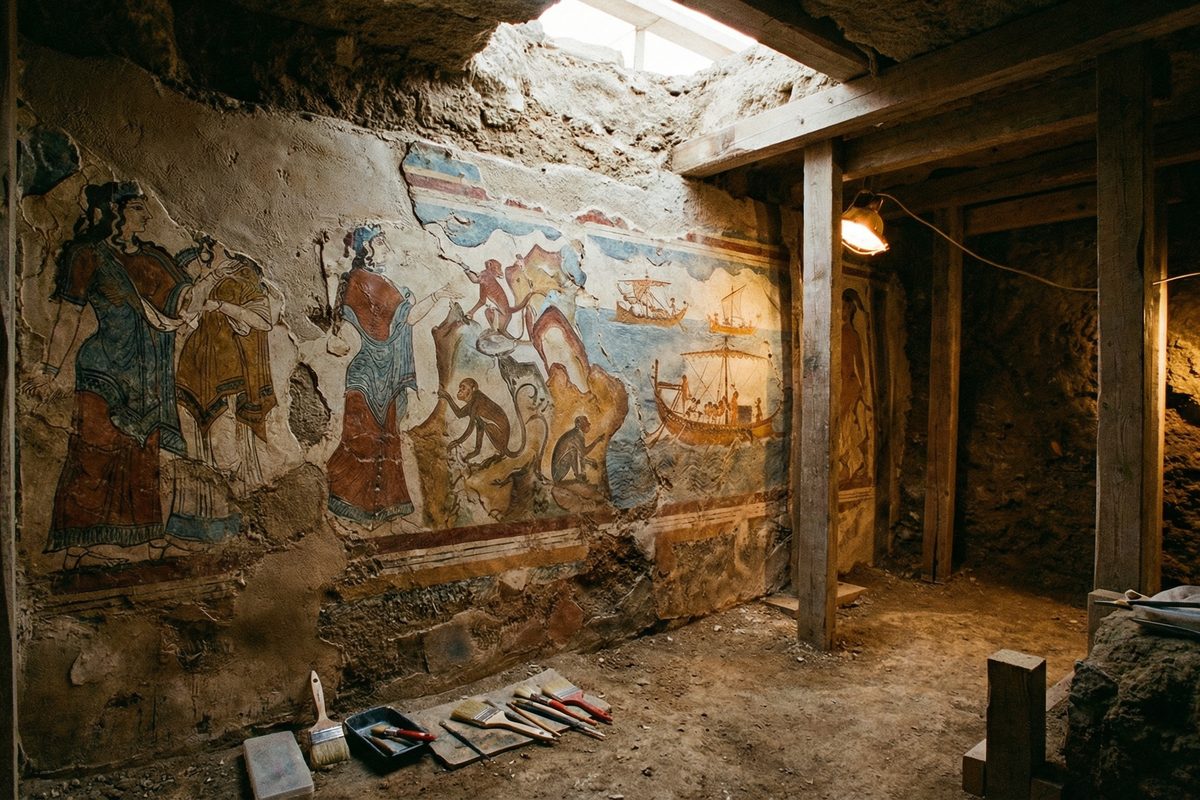
- The Fishermen Fresco: Found in the West House, this iconic fresco depicts two young men, almost identical, proudly holding strings of fish. Their youthful vigor and the simple, naturalistic portrayal of their catch suggest a society deeply connected to the sea.
- The Boxing Boys Fresco: Also from the West House, this scene shows two bare-chested boys, adorned with jewelry, engaged in a boxing match. The dynamic poses and muscular definition highlight the Minoans' interest in athletic prowess and perhaps ritualistic combat.
- The Antelopes Fresco: From the same room as the Boxing Boys, this fresco features graceful antelopes leaping across the wall, rendered with remarkable fluidity and anatomical accuracy. It speaks to the Minoans' appreciation for the natural world.
- The Ship Procession Fresco (Flotilla Fresco): This masterpiece, also from the West House, is a panoramic frieze depicting a grand naval procession. It shows several large ships, adorned with banners and filled with passengers, sailing between two coastal towns. This fresco is invaluable for understanding Minoan shipbuilding, maritime activities, and perhaps even religious or ceremonial voyages. The detailed depiction of architecture and landscapes also provides crucial insights into Bronze Age Aegean settlements.
- The Ladies Fresco (or "The Priestess"): From the House of the Ladies, this fresco features elegant female figures, elaborately dressed and adorned with jewelry. Their sophisticated attire and confident postures suggest a prominent role for women in Minoan society, possibly as priestesses or members of the elite.
- The Blue Monkeys Fresco: Found in the House of the Frescoes, these playful blue monkeys climbing among rocks and plants are a testament to the Minoans' keen observation of nature and their artistic whimsy. The presence of monkeys, not native to Thera, suggests trade connections with Egypt or the Near East.
Scholarly Debates and Enduring Mysteries
While the Akrotiri frescoes offer a wealth of information, they also raise numerous questions that continue to fuel scholarly debate:
Minoan Influence vs. Local Identity
The strong stylistic similarities between the Akrotiri frescoes and those found on Crete, particularly at Knossos, highlight the significant influence of the Minoan civilization. However, some scholars argue for a distinct Theran identity, pointing to unique iconographic elements and architectural styles. Was Akrotiri a Minoan colony, a vassal state, or an independent city-state with strong cultural ties to Crete?
The Purpose of the Frescoes
Were these frescoes purely decorative, or did they serve a deeper purpose? Many scholars believe they held religious or ritualistic significance. The presence of figures often interpreted as deities or priestesses, and scenes that seem to depict ceremonies, suggest that art was deeply intertwined with Minoan spirituality. The "Ship Procession" fresco, for instance, could represent a religious festival, a trade expedition, or even a mythical journey.
The Absence of Palaces and Writing
Unlike Crete, Akrotiri lacks a central palatial complex, a hallmark of Minoan civilization. While impressive, the buildings at Akrotiri appear to be private residences or public buildings rather than a grand administrative or religious center. Furthermore, very little Linear A script, the undeciphered Minoan writing system, has been found at Akrotiri. This absence fuels speculation about Akrotiri's exact relationship with the Minoan heartland.
The Legacy of Akrotiri
The Akrotiri frescoes, preserved for millennia by the very force that destroyed their city, stand as a testament to the artistic brilliance and sophisticated culture of the Bronze Age Aegean. They offer invaluable insights into a world that predates classical Greece, a world of vibrant colors, maritime prowess, and perhaps, a matriarchal society. The Thera eruption Minoan connection is undeniable, showcasing a civilization deeply impacted by geological forces.
As we gaze upon the reconstructed panels, we are transported back to a time when gods and mortals mingled, when art was an integral part of daily life, and when a thriving civilization flourished on a volcanic island. The Akrotiri frescoes continue to challenge our perceptions of ancient history, reminding us that even in destruction, beauty and knowledge can be preserved for future generations to uncover and ponder.
What other secrets lie buried beneath the sands of time, waiting for their moment to re-emerge and rewrite our understanding of the ancient world?
Marcus Hale
Independent Researcher & Archive Curator
Marcus Hale is an independent researcher and the curator of The Forbidden Archive. He has spent over a decade studying anomalous ancient technologies, cross-referencing primary excavation reports, museum catalogues, and peer-reviewed journals to document artifacts that mainstream history struggles to explain.
📖 Take the Archive With You
Enjoyed this mystery? The full ebook covers 50 Ancient Mysteries in depth — lost technologies, suppressed histories, and artifacts that shouldn't exist. 300+ pages, instant PDF download.
Archive Record
Civilization
Minoan
Time Period
1700–1500 BC
Approximate Date
1700–1500 BC
Further Research
Ancient Metals: Microstructure and Metallurgy
Technical analysis of ancient metalworking achievements.
Amazon
The Sword and the Crucible: A History of the Metallurgy of European Swords
How ancient metallurgists created legendary blades.
Amazon
Affiliate links — we may earn a commission at no cost to you.