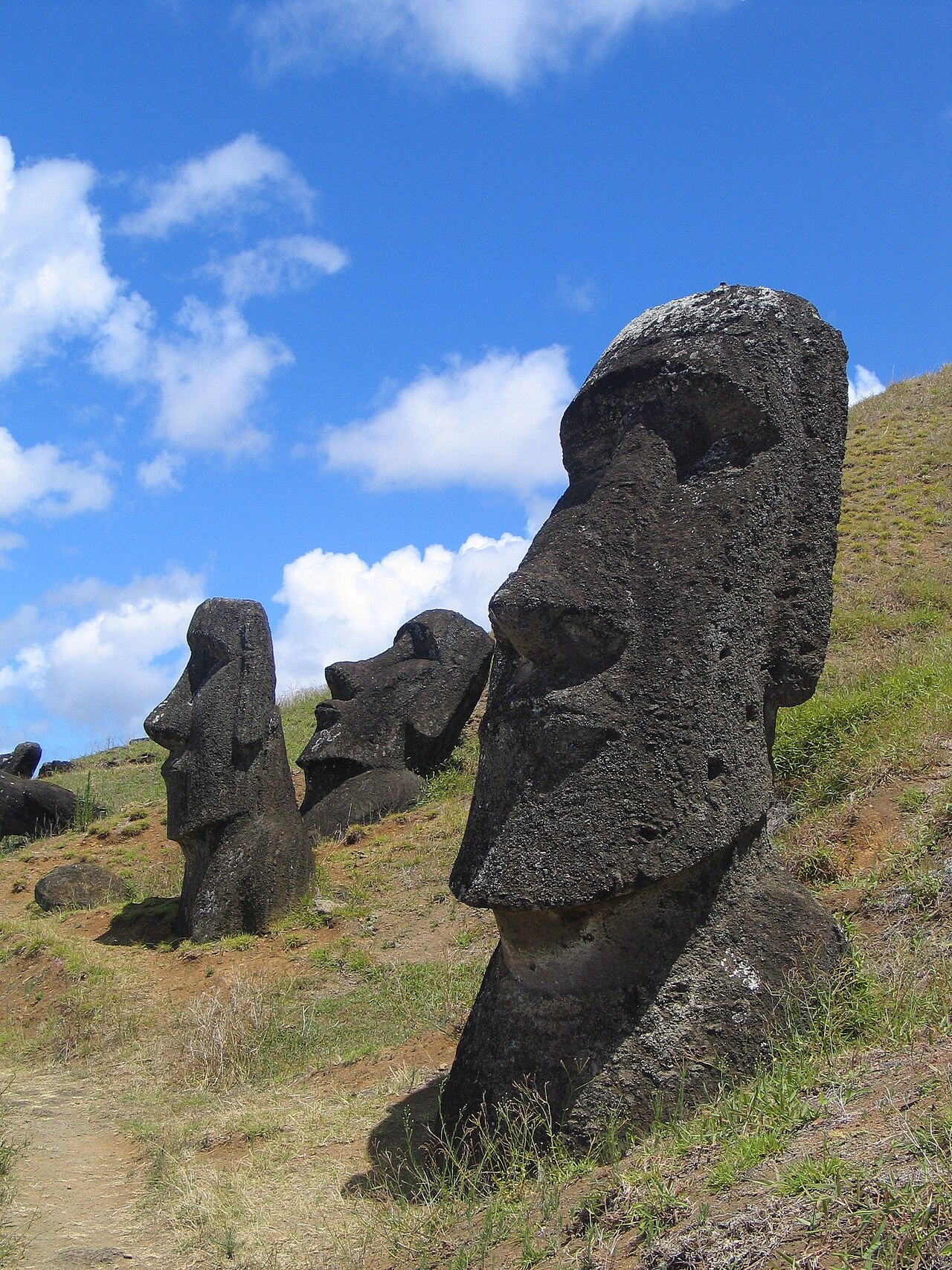
Rapa Nui · 1250–1500 AD
The Moai of Easter Island Transport
6 min read
Last updated March 8, 2026
Choose your reading style:

By Marcus Hale
Independent Researcher & Archive Curator
The remote speck of land in the vast Pacific, known as Rapa Nui or Easter Island, holds one of ancient history's most enduring and captivating enigmas: the Moai. These colossal stone figures, with their stoic gazes and imposing presence, stand as silent sentinels to a lost civilization. But beyond their sheer artistic and engineering marvel, the question of their transport has fueled centuries of speculation and scientific inquiry. How did the Rapa Nui people, using only Stone Age tools and ingenuity, manage the seemingly impossible task of moving these multi-ton giants across challenging terrain? The mystery of Easter Island moai transport continues to intrigue and inspire.
The Silent Sentinels: An Introduction to the Moai
Carved primarily from the volcanic tuff of Rano Raraku, the quarry that served as their birthplace, the Moai are more than just statues; they are a profound expression of Rapa Nui culture and belief. Dating back to approximately 1250–1500 AD, these monolithic figures represent deified ancestors, chiefs, or important lineage figures, imbued with spiritual power or 'mana.' Over 900 Moai were carved, ranging in size from a few feet to the colossal "Paro," standing over 33 feet tall and weighing an estimated 82 tons. Their sheer scale, coupled with the island's isolation and limited resources, makes their movement one of the most remarkable feats of ancient engineering.
The Challenge of the Journey
The journey from Rano Raraku to the various ahu (ceremonial platforms) scattered across the island was no small undertaking. Some Moai traveled distances of up to 11 miles. The terrain was often uneven, with hills, valleys, and rocky outcrops. The sheer weight and fragile nature of the statues, particularly their elongated necks and delicate features, presented immense logistical challenges. Early European explorers, witnessing the remnants of this monumental effort, could only marvel at the ingenuity of the Rapa Nui people, leading to the enduring question: how moai moved?
Unraveling the Rapa Nui Statues' Journey: Early Theories and Misconceptions
For centuries, the lack of definitive historical records and the sheer scale of the task led to a flurry of theories, some bordering on the fantastical. Many early accounts suggested supernatural intervention or even alien involvement, highlighting the perceived impossibility of the feat for a Stone Age society. However, archaeological and ethnographic research has steadily chipped away at these myths, revealing the remarkable capabilities of the Rapa Nui. The core of the Easter Island mystery lies in understanding the practical methods employed.
The "Rolling" Hypothesis
One of the earliest and most intuitive theories proposed that the Moai were rolled on logs. This method, while plausible for smaller objects, presents significant difficulties for the Moai's immense weight and irregular shape. The statues are not cylindrical, making a smooth rolling motion incredibly challenging. Furthermore, the extensive deforestation of Easter Island, often attributed to the very act of Moai transport, suggests a heavy reliance on wood. While logs may have been used for leverage or as rollers for smaller segments of the journey, it's unlikely to have been the sole or primary method for the largest statues.
The "Sledding" Method
Another popular theory involved dragging the Moai on wooden sleds over greased tracks or rollers. This method would require a substantial workforce to pull the sleds and a continuous supply of logs for the tracks. While more feasible than simple rolling, it still presents challenges regarding friction, the stability of the sled, and the immense force required to move such heavy objects over varied terrain.
The "Walking" Moai: A Paradigm Shift in Understanding
In recent decades, a revolutionary theory has gained significant traction, supported by compelling archaeological evidence and experimental archaeology: the "walking" Moai hypothesis. This theory suggests that the Moai were moved upright, or nearly upright, by a team of people using ropes and a rocking motion. This is the central tenet of the moai walking theory.
The Jo Anne Van Tilburg and Terry Hunt/Carl Lipo Hypothesis
The most prominent proponents of the "walking" theory are archaeologist Jo Anne Van Tilburg and the team of Terry Hunt and Carl Lipo. Their independent research, though with slightly different interpretations, converges on the idea of the Moai being "walked" from the quarry. They point to several key pieces of evidence:
- The Shape of the Moai: The Moai have a distinct D-shaped base and a forward-leaning posture, making them inherently unstable when stood upright but ideal for a rocking motion. Their center of gravity is positioned in a way that facilitates this movement.
- Broken Moai Along Roads: Numerous broken Moai are found along ancient roads, often face down or face up. This pattern is consistent with statues toppling during an upright transport, rather than breaking while being dragged horizontally.
- Experimental Archaeology: Hunt, Lipo, and their team conducted highly publicized experiments using replicas of Moai. With a relatively small team of individuals and ropes, they successfully "walked" a 10-ton replica, demonstrating the feasibility of the method. The process involved attaching ropes to the top and sides of the statue, then rocking it side to side, inching it forward with each sway.
- Oral Traditions: Rapa Nui oral traditions speak of the Moai "walking" themselves to their platforms, a seemingly mythical account that now finds a scientific explanation.
The Role of Ropes and Manpower
The "walking" method would have required a significant amount of strong rope, likely made from the fibers of the native toromiro tree or other plant materials. It also demanded a coordinated effort from a substantial workforce. Estimates suggest that dozens, if not hundreds, of individuals would have been needed to move the largest Moai, highlighting the highly organized and collaborative nature of Rapa Nui society. This intricate process of how moai moved underscores the advanced social structures present on the island.
Beyond Transport: The Broader Context of the Rapa Nui Statues
Understanding the Moai transport methods is crucial, but it also opens a window into the broader cultural and environmental history of Rapa Nui. The monumental effort involved in carving and moving these statues speaks to a society with a strong hierarchical structure, specialized labor, and a deep spiritual connection to their ancestors. The resources required, particularly for ropes and potentially wooden rollers for specific maneuvers, likely contributed to the island's deforestation, a factor often cited in its ecological collapse.
The Unfinished Moai and the Collapse
The quarry at Rano Raraku is littered with hundreds of unfinished Moai, some partially carved into the rock face, others abandoned mid-transport. This abrupt halt in production and movement is often linked to the societal collapse that occurred on Easter Island around the 17th and 18th centuries. Factors such as deforestation, resource depletion, inter-tribal warfare, and the introduction of European diseases are believed to have contributed to the decline, leaving the Moai project unfinished and the secrets of their transport largely unwritten.
Conclusion: The Enduring Legacy of the Rapa Nui Statues
The mystery of Easter Island moai transport is a testament to the ingenuity and perseverance of ancient civilizations. While the "walking" theory offers a compelling and scientifically supported explanation for how moai moved, the full story of the Rapa Nui people and their monumental achievements continues to unfold. The silent sentinels of Easter Island stand as a powerful reminder of human ambition, cultural expression, and the delicate balance between human activity and environmental sustainability. Their enduring presence invites us to ponder not just the mechanics of their journey, but the complex society that brought them to life, leaving us with a profound appreciation for one of history's most captivating enigmas.
Marcus Hale
Independent Researcher & Archive Curator
Marcus Hale is an independent researcher and the curator of The Forbidden Archive. He has spent over a decade studying anomalous ancient technologies, cross-referencing primary excavation reports, museum catalogues, and peer-reviewed journals to document artifacts that mainstream history struggles to explain.
📖 Take the Archive With You
Enjoyed this mystery? The full ebook covers 50 Ancient Mysteries in depth — lost technologies, suppressed histories, and artifacts that shouldn't exist. 300+ pages, instant PDF download.
Archive Record
Civilization
Rapa Nui
Time Period
1250–1500 AD
Approximate Date
1250–1500 AD