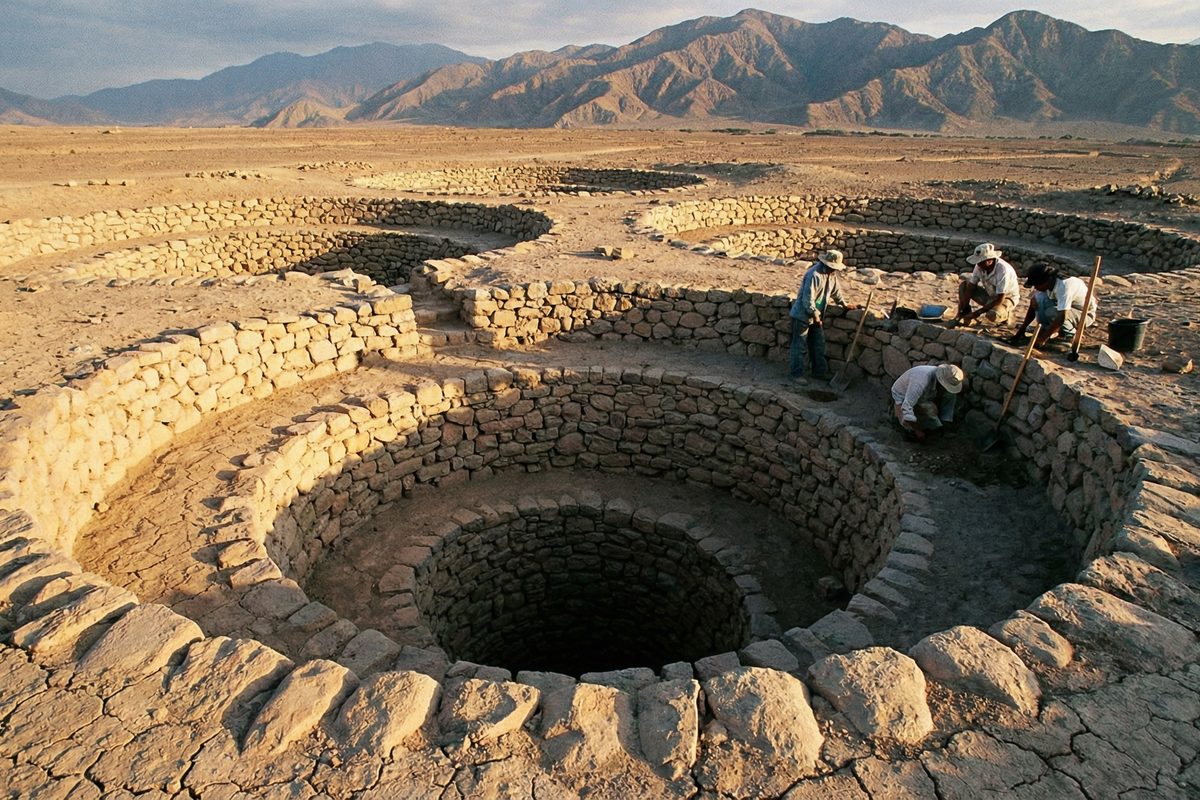
Nazca · 500 BC–500 AD
The Nazca Puquios Water System
6 min read
Last updated April 8, 2026
Choose your reading style:

By Marcus Hale
Independent Researcher & Archive Curator
The arid plains of the Nazca Desert in southern Peru are famously etched with colossal geoglyphs, the enigmatic Nazca Lines, which have captivated imaginations for centuries. Yet, beneath this monumental artistry lies another, equally astonishing feat of ancient engineering: the Nazca Puquios. These ancient underground aqueducts, a sophisticated water system, allowed the Nazca civilization to flourish in one of the driest regions on Earth, providing a compelling testament to their ingenuity and resilience. At The Forbidden Archive, we delve into the mysteries of this remarkable hydraulic network, exploring its construction, purpose, and the enduring questions it poses.
Unearthing an Ancient Lifeline: The Nazca Puquios
The Nazca civilization, thriving between approximately 500 BC and 500 AD, faced immense environmental challenges. The region receives an average of only 20 millimeters of rainfall annually, making sustained agriculture seemingly impossible. Despite this, the Nazca people developed a complex society, complete with intricate pottery, textiles, and, of course, the Nazca Lines. Their secret to survival lay in their mastery of water management, specifically through the construction of the Nazca Puquios.
The term "puquios" (from the Quechua word for "spring" or "well") refers to a series of subterranean channels designed to tap into underground aquifers and transport water to agricultural fields and settlements. Unlike open canals, which would suffer from rapid evaporation in the intense desert sun, the Nazca Puquios kept their precious cargo protected and cool. This ancient aqueduct system represents one of the most remarkable hydraulic engineering achievements of the pre-Columbian Americas.
The Discovery and the Enduring Mystery
While local communities have long been aware of these ancient structures, their true scale and sophistication were not fully appreciated until relatively recently. Early archaeological investigations in the Nazca region focused primarily on the geoglyphs and burial sites. It was the advent of aerial photography and satellite imagery that truly revealed the extent of the Nazca Puquios, showcasing their intricate network spreading across the landscape.
The primary mystery surrounding the Nazca Puquios isn't just *how* they were built, but *why* such an elaborate system was necessary, and *who* possessed the knowledge and organizational capacity to construct them. The sheer effort involved, digging miles of underground tunnels through often unstable soil and rock, points to a highly organized society with a deep understanding of hydrogeology.
Anatomy of a Masterpiece: How the Nazca Puquios Worked
The Nazca Puquios are not a single, monolithic structure but a network of interconnected components, each playing a vital role in the water system:
- Filtration Galleries (Galerías de Filtración): These are the subterranean tunnels themselves, often several kilometers long, dug horizontally into the ground to intercept the water table. They are typically lined with stones to prevent collapse and maintain the channel's integrity.
- Ventilation Shafts (Ojos): Perhaps the most distinctive feature of the Nazca Puquios are the spiral-shaped or zigzagging shafts that descend into the underground channels. These "eyes" served multiple crucial functions: providing access for maintenance and cleaning, allowing fresh air to circulate, and facilitating the flow of water by preventing stagnation and providing pressure relief. Their unique spiral design is particularly striking and hints at advanced architectural planning.
- Open Canals (Acequias): Once the water emerged from the underground channels, it flowed into open-air canals, often stone-lined, which distributed it to agricultural fields and reservoirs.
- Reservoirs (Cochas): Small, open-air reservoirs or cisterns were sometimes used to store water for later use, especially during periods of lower water availability.
The engineering involved in maintaining a consistent gradient over long distances, often through varying geological strata, is truly astounding. The Nazca people had to possess an intimate understanding of the local hydrology, including the location and depth of aquifers, and the principles of gravity flow.
Scholarly Theories and Debates
Numerous theories attempt to explain the construction and purpose of the Nazca Puquios, highlighting the ongoing academic debate:
Theory 1: Climate Change Adaptation
One prominent theory suggests that the Nazca Puquios were a direct response to a period of increasing aridity. As surface water sources became less reliable, the Nazca people were forced to tap into deeper, more stable underground water reserves. This adaptation allowed them to sustain their agricultural practices, primarily growing cotton, maize, beans, and squash, which were essential for their economy and survival. This theory emphasizes the resilience and innovative spirit of the Nazca in the face of environmental challenges.
Theory 2: Advanced Hydrogeological Knowledge
Another perspective posits that the Nazca possessed an advanced, perhaps even empirical, understanding of hydrogeology. Without modern tools, they somehow managed to locate underground water sources and design complex systems to extract and distribute it. This level of technical expertise suggests a sophisticated society with specialized knowledge passed down through generations. The precise alignment and consistent gradients of the underground channels are strong evidence for this theory.
Theory 3: Social and Political Control
Some scholars argue that the construction and control of the Nazca Puquios also served a social and political function. Managing such a vital resource would have conferred immense power and authority upon those who oversaw its operation. The labor required for construction and maintenance would have necessitated a highly organized social structure, potentially reinforcing existing hierarchies. This perspective adds a layer of societal complexity to the purely functional explanation of the water system.
Dating the Nazca Puquios
Pinpointing the exact construction dates of the Nazca Puquios has been challenging. Archaeological evidence, including pottery fragments found within the channels, suggests their primary use coincides with the Middle Nazca period (around 300-500 AD). However, some researchers propose earlier origins, potentially dating back to the Late Paracas period (around 200 BC), suggesting a gradual development and refinement of the technology. Recent studies using optically stimulated luminescence (OSL) dating on sediments within the puquios have provided more precise timelines, generally supporting their construction and extensive use during the peak of the Nazca civilization.
The Legacy of the Nazca Water System
The Nazca Puquios are more than just ancient aqueducts; they are a profound symbol of human ingenuity and adaptation. This sophisticated Nazca water system allowed a thriving civilization to exist in an environment that would otherwise be considered uninhabitable. Their continued functionality, with some puquios still providing water to local communities today, is a testament to the enduring quality of their engineering.
As we gaze upon the enigmatic Nazca Lines from above, we should also remember the equally remarkable, yet hidden, achievements beneath our feet. The Nazca Puquios remind us that ancient peoples possessed not only artistic vision but also an unparalleled practical intelligence, capable of solving complex environmental problems with sustainable and brilliant solutions. What other secrets lie buried beneath the sands of time, waiting to be rediscovered?
Marcus Hale
Independent Researcher & Archive Curator
Marcus Hale is an independent researcher and the curator of The Forbidden Archive. He has spent over a decade studying anomalous ancient technologies, cross-referencing primary excavation reports, museum catalogues, and peer-reviewed journals to document artifacts that mainstream history struggles to explain.
📖 Take the Archive With You
Enjoyed this mystery? The full ebook covers 50 Ancient Mysteries in depth — lost technologies, suppressed histories, and artifacts that shouldn't exist. 300+ pages, instant PDF download.
Archive Record
Civilization
Nazca
Time Period
500 BC–500 AD
Approximate Date
500 BC–500 AD