Neolithic Irish · 3200 BC
The Newgrange Winter Solstice Alignment
6 min read
Last updated March 18, 2026
Disclosure: This article contains affiliate links. If you purchase through these links, we may earn a small commission at no additional cost to you. This helps support The Forbidden Archive and allows us to continue our research. See our Privacy Policy for details.
Choose your reading style:

By Marcus Hale
Independent Researcher & Archive Curator
Deep within the emerald heart of Ireland, a silent sentinel stands, a testament to the ingenuity and spiritual depth of a people who lived millennia before the pyramids of Egypt or the rise of Mycenaean Greece. This is Newgrange, a monumental passage tomb that, for five millennia, has held a profound secret, revealed only for a fleeting moment each year: the Newgrange Winter Solstice Alignment. This ancient marvel, built by Neolithic Irish hands around 3200 BC, continues to captivate archaeologists, astronomers, and mystics alike, offering a tantalizing glimpse into the sophisticated worldview of its creators.
The Dawn of the Megalithic Builders: Historical Context of Newgrange
To truly appreciate the wonder of Newgrange, we must first transport ourselves to the Neolithic period in Ireland. This was a time of immense societal transformation, marked by the adoption of agriculture, the establishment of permanent settlements, and, most significantly, the construction of monumental architecture. The Boyne Valley, where Newgrange resides, became a focal point for this activity, boasting a cluster of extraordinary passage tombs, collectively known as Brú na Bóinne (Palace of the Boyne). Newgrange, along with Knowth and Dowth, stands as the crowning achievement of this era, predating Stonehenge by a thousand years and the Great Pyramid of Giza by five centuries.
These early Irish farmers were not primitive cave dwellers. They possessed advanced knowledge of engineering, astronomy, and social organization. The sheer scale of Newgrange – a massive mound measuring 85 meters in diameter and 13.5 meters high, constructed from an estimated 200,000 tonnes of stone – speaks volumes about their collective effort and shared vision. The stones themselves, many weighing several tons, were quarried miles away and transported to the site, a feat of immense logistical planning.
The Enigma Unveiled: The Newgrange Solstice Alignment
For centuries, Newgrange was known as a large, enigmatic mound. While locals were aware of its interior passage and chamber, the true purpose of its most remarkable feature remained hidden until a pivotal moment in 1967. Professor Michael J. O'Kelly, during his extensive excavations, made a groundbreaking discovery that would forever alter our understanding of Neolithic capabilities. He realized that a small, rectangular opening above the main entrance, previously considered a mere structural anomaly, was in fact a meticulously designed "roofbox."
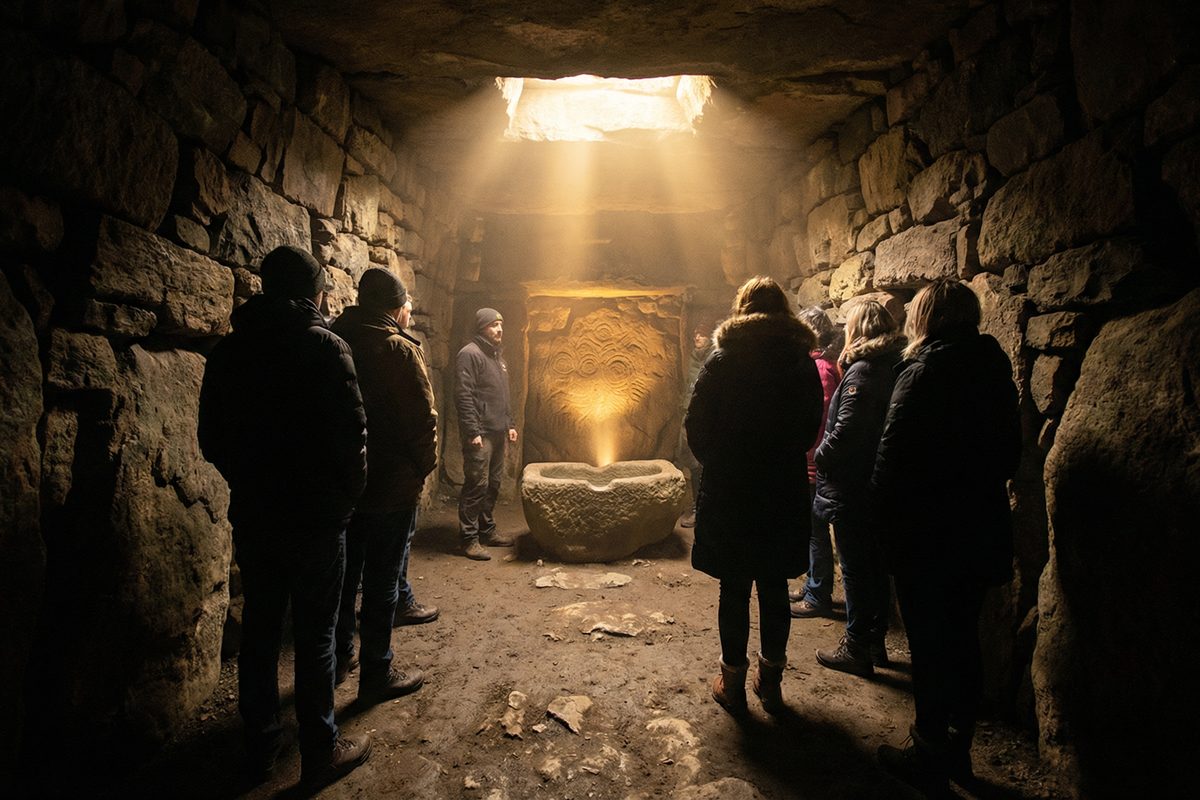
On the morning of December 21st, the winter solstice, O'Kelly was inside the chamber. As the sun rose, a narrow beam of light pierced the darkness through the roofbox, slowly extending down the 19-meter passage and illuminating the chamber's inner sanctum. This wasn't a random occurrence; it was a deliberate and precise alignment, engineered to capture the sun's weakest light at the shortest day of the year. The Newgrange alignment is a breathtaking demonstration of ancient astronomical knowledge.
The Mechanics of the Miracle
The precision of the Newgrange solstice alignment is astounding. For approximately 17 minutes on the winter solstice, the sunbeam gradually widens, bathing the chamber in a golden glow. The light then slowly recedes, plunging the chamber back into darkness. This phenomenon is not merely a happy accident; the entire structure, from the angle of the passage to the height of the roofbox, was meticulously calibrated to achieve this effect. The builders understood the sun's annual cycle with incredible accuracy, a testament to their long-term observations and sophisticated understanding of celestial mechanics. The roofbox itself is a marvel of engineering, designed to remain watertight for millennia, protecting the delicate alignment from the elements.
Scholarly Interpretations: Why the Winter Solstice?
The discovery of the Newgrange alignment immediately sparked intense academic debate about its purpose. While no definitive answer exists, several compelling theories have emerged, each offering a unique perspective on the minds of the Neolithic Irish.
Theory 1: A Calendar and Agricultural Marker
One prominent theory posits that Newgrange served as a sophisticated calendar, marking the turning point of the agricultural year. The winter solstice signifies the shortest day, after which the days begin to lengthen, promising the return of warmth and the renewal of growth. For an agrarian society, this knowledge would have been vital for planning planting and harvesting cycles. The illumination of the chamber could have been a powerful ritual, symbolizing hope and the promise of new life after the barrenness of winter.
Theory 2: A Ritualistic Passage to the Afterlife
Given its function as a passage tomb, many scholars believe the Newgrange solstice alignment held profound spiritual significance. The journey down the dark passage, culminating in the sudden burst of light, could have symbolized the passage from death to rebirth, or the soul's journey into the afterlife. The sun, a universal symbol of life and divinity, might have been seen as guiding the deceased into the spiritual realm. The central basin stone within the chamber, often interpreted as an altar, could have been the focal point of these funerary rituals.
Theory 3: A Celebration of Fertility and Regeneration
Another theory suggests the alignment was a powerful fertility ritual. The return of the sun after the longest night could have been seen as a cosmic act of regeneration, mirroring the fertility of the land and the people. The illuminated chamber might have been a sacred space for ceremonies aimed at ensuring bountiful harvests and the continuation of the community. The intricate megalithic art adorning the stones, featuring spirals, lozenges, and zigzags, often interpreted as symbols of life and fertility, further supports this idea.
Theory 4: A Display of Power and Knowledge
Beyond its spiritual or practical applications, the construction and precise alignment of Newgrange could also have served as a powerful display of the ruling elite's knowledge and authority. The ability to harness the sun's power and predict celestial events would have conferred immense prestige and legitimacy upon those who orchestrated such a monumental undertaking. It was a tangible manifestation of their connection to the cosmos and their ability to mediate between the earthly and divine realms, cementing their social hierarchy.
The Enduring Legacy of Neolithic Astronomy Ireland
The Newgrange solstice alignment is more than just an ancient architectural marvel; it is a profound window into the minds of our Neolithic ancestors. It demonstrates their advanced understanding of astronomy, their engineering prowess, and their deep spiritual connection to the natural world. The fact that this alignment continues to function perfectly after 5,200 years is a testament to their meticulous craftsmanship and enduring legacy. Each winter solstice, as the golden light pierces the darkness, we are reminded of the incredible intelligence and spiritual depth of the people who built this extraordinary monument in the heart of Ireland.
The mystery of Newgrange continues to unfold, with ongoing research and new interpretations constantly enriching our understanding. What other secrets does this ancient landscape hold? What further insights can we glean from the intricate carvings and the very stones themselves? The Newgrange Winter Solstice Alignment stands as a beacon, inviting us to ponder the profound questions of human existence, our place in the cosmos, and the enduring power of human ingenuity and belief. It is a timeless reminder that even in the deepest past, humanity reached for the stars, leaving behind an indelible mark on the fabric of time.
Marcus Hale
Independent Researcher & Archive Curator
Marcus Hale is an independent researcher and the curator of The Forbidden Archive. He has spent over a decade studying anomalous ancient technologies, cross-referencing primary excavation reports, museum catalogues, and peer-reviewed journals to document artifacts that mainstream history struggles to explain.
📖 Take the Archive With You
Enjoyed this mystery? The full ebook covers 50 Ancient Mysteries in depth — lost technologies, suppressed histories, and artifacts that shouldn't exist. 300+ pages, instant PDF download.
Archive Record
Civilization
Neolithic Irish
Time Period
3200 BC
Approximate Date
3200 BC
Further Research
The Celts: A Very Short Introduction
Concise overview of Celtic civilization and their technological achievements.
Amazon
Newgrange: Archaeology, Art and Legend
Definitive guide to Ireland's most famous ancient monument.
Amazon
Affiliate links — we may earn a commission at no cost to you.