Iron Age Laotian · 500 BC–500 AD
The Plain of Jars Laos Mystery
6 min read
Last updated April 2, 2026
Disclosure: This article contains affiliate links. If you purchase through these links, we may earn a small commission at no additional cost to you. This helps support The Forbidden Archive and allows us to continue our research. See our Privacy Policy for details.
Choose your reading style:

By Marcus Hale
Independent Researcher & Archive Curator
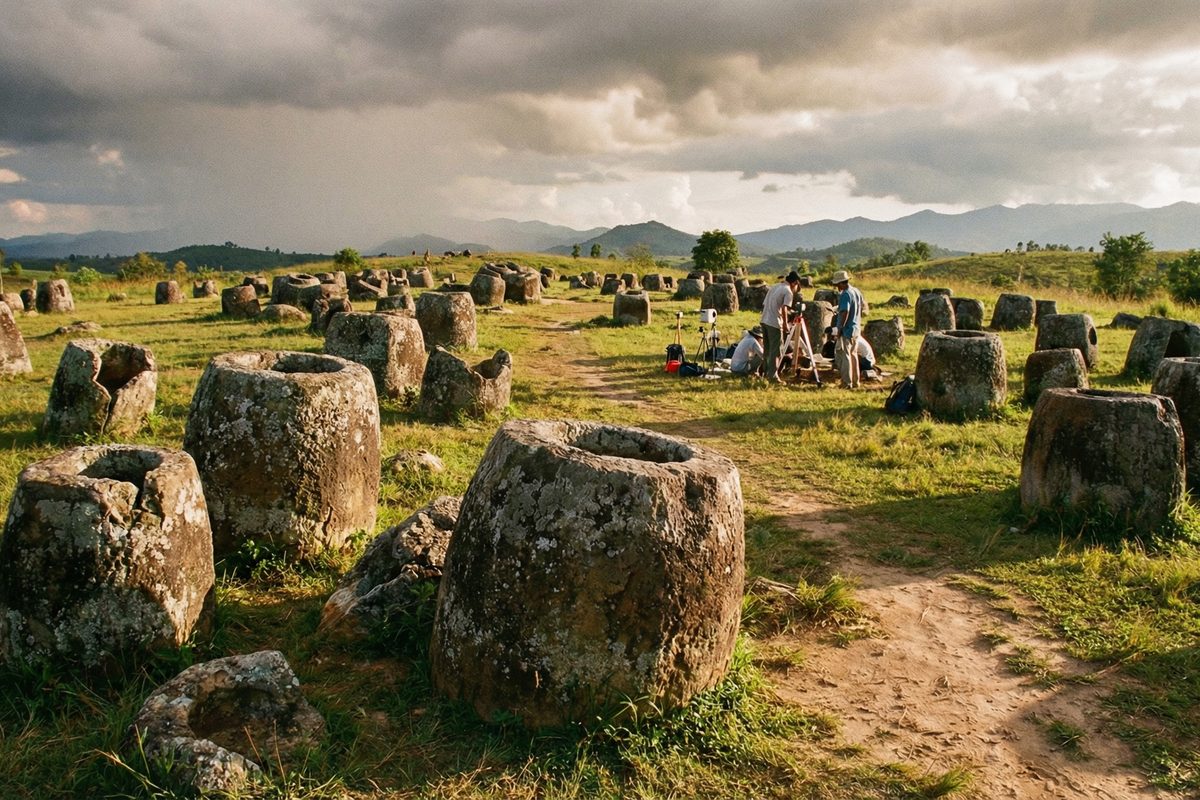
Nestled amidst the verdant hills and rice paddies of Laos lies one of Southeast Asia's most enigmatic archaeological sites: the Plain of Jars. This sprawling landscape, dotted with thousands of colossal stone jars, has captivated archaeologists, historians, and travelers for centuries. Its origins are shrouded in mystery, its purpose debated, and its very existence a testament to an ancient, sophisticated culture that thrived in this remote corner of the world.
The Enigma of the Plain of Jars: A Journey Through Time
The Plain of Jars, or Thong Hai Hin in Lao, is a collection of over 100 sites in the Xieng Khouang province, each featuring anywhere from a single jar to hundreds. These monolithic vessels, carved from sandstone, granite, or conglomerate rock, vary in size from a mere 1 meter to an imposing 3 meters in height, weighing up to 20 tons. Their sheer scale and the effort required to create and transport them speak volumes about the ingenuity and societal organization of their creators.
Historical Context: A Crossroads of Ancient Civilizations
While the exact period of their creation remains a subject of ongoing research, archaeological evidence suggests the jars were carved and placed during the Iron Age, roughly between 500 BCE and 500 CE. This era was a dynamic period in Southeast Asian history, marked by the emergence of complex societies, the development of metallurgy, and increased trade networks. Laos, situated strategically between the powerful empires of China and India, would have been a vital crossroads for cultural exchange and commerce.
The Plain of Jars itself is located along ancient land routes that would have connected the Mekong River basin with the Gulf of Tonkin. This geographical significance further fuels speculation about the purpose of the jars, suggesting they may have played a role in trade, territorial markers, or even as a symbolic representation of power and wealth for the communities that inhabited this region.
The Enduring Mystery: Who Built Them and Why?
Despite decades of research, the identity of the jar builders remains an enduring mystery. No written records or definitive oral traditions directly attribute their construction to a specific group. Local legends abound, often speaking of giants or mythical kings who used the jars to brew celebratory rice wine after victorious battles. While charming, these tales offer little in the way of concrete archaeological evidence.
Archaeologists have proposed various theories, often based on comparisons with other megalithic sites in Southeast Asia and beyond. The most widely accepted theory, supported by recent discoveries, points towards the jars being associated with ancient burial practices. This theory will be explored in more detail below.
Iron Age Theories: Unraveling the Purpose
The prevailing theory, strengthened by archaeological findings, suggests the jars were used in Iron Age funerary rituals. Excavations around and within the jars have uncovered human remains, burial goods, and associated artifacts, providing compelling evidence for this hypothesis.
- Secondary Burials: One prominent theory posits that the jars served as ossuaries for secondary burials. This practice involves exhuming the bones of the deceased after an initial burial, cleaning them, and then re-interring them in a permanent resting place. The jars, with their large capacity, would have been ideal for this purpose, perhaps holding the remains of multiple individuals from a particular family or community.
- Primary Burials: While less common, some evidence suggests that primary burials (the initial interment of the body) may have also occurred in or near the jars, particularly for individuals of high status.
- Cremation: The discovery of burnt human remains and charcoal within some jars indicates that cremation may have also been part of the funerary practices.
- Ritualistic Storage: Beyond human remains, some archaeologists suggest the jars may have also been used to store food, water, or other provisions for the deceased's journey into the afterlife, or for ritualistic offerings to ancestors.
- Trade and Water Storage: Earlier theories, now largely superseded by funerary evidence, suggested the jars were used for storing rainwater for travelers along ancient trade routes, or for fermenting rice wine. While these functions are plausible for smaller vessels, the sheer size and distribution of the jars make a primary funerary purpose more compelling.
Archaeological Discoveries: Peeling Back the Layers of Time
Archaeological investigations at the Plain of Jars have been ongoing since the 1930s, though significant progress was hampered by the Indochina Wars and the extensive unexploded ordnance (UXO) contamination in the region. However, in recent decades, renewed efforts have yielded crucial insights.
- Human Remains: Excavations by French archaeologist Madeleine Colani in the 1930s first uncovered human bones and teeth within and around the jars. More recent work by Australian and Lao teams has further confirmed the presence of human remains, often fragmented and mixed, consistent with secondary burial practices.
- Burial Goods: Alongside human remains, archaeologists have found a variety of burial goods, including pottery, bronze and iron tools, glass beads, and carnelian jewelry. These artifacts provide valuable clues about the material culture, trade networks, and social hierarchy of the Iron Age communities.
- Associated Features: Beyond the jars themselves, researchers have identified associated features such as stone discs, some with carved human or animal figures, which are believed to have served as lids for the jars or as grave markers. Other discoveries include stone quarries, suggesting the jars were carved locally, and evidence of ancient settlements in the vicinity.
- Dating Techniques: Radiocarbon dating of organic materials found within the jars and associated burials has helped to establish the Iron Age timeframe for their use.
The ongoing archaeological work, particularly with the careful clearance of UXO, promises to unlock even more secrets about the Plain of Jars and the ancient people who created this monumental landscape.
UNESCO World Heritage Status: Protecting a Global Treasure
In 2019, after decades of dedicated effort, the Plain of Jars was officially inscribed as a UNESCO World Heritage Site. This prestigious designation recognizes the site's "outstanding universal value" and its significance as a testament to the Iron Age civilization of Southeast Asia. The UNESCO status brings with it a commitment to protect and preserve the site for future generations, while also promoting sustainable tourism and research.
The inscription highlights several key aspects that contribute to its universal value:
- Exceptional Testimony: The Plain of Jars provides exceptional testimony to a distinctive cultural tradition, offering a rare glimpse into the funerary practices and social structures of Iron Age societies in Southeast Asia.
- Architectural and Technological Ensemble: The site represents a remarkable architectural and technological ensemble, showcasing the skill and ingenuity of the ancient people in quarrying, carving, and transporting these massive stone vessels.
- Landscape and Setting: The dramatic landscape of the Plain of Jars, with its rolling hills and strategic location, adds to its aesthetic and historical significance.
The UNESCO World Heritage status not only elevates the Plain of Jars on the global stage but also underscores the importance of continued archaeological research, conservation efforts, and responsible tourism to ensure its long-term preservation. As visitors wander among these ancient stone giants, they are not just observing a collection of rocks; they are stepping into a profound mystery, a silent testament to a forgotten civilization, and a powerful reminder of the enduring human quest to understand our past.
Marcus Hale
Independent Researcher & Archive Curator
Marcus Hale is an independent researcher and the curator of The Forbidden Archive. He has spent over a decade studying anomalous ancient technologies, cross-referencing primary excavation reports, museum catalogues, and peer-reviewed journals to document artifacts that mainstream history struggles to explain.
📖 Take the Archive With You
Enjoyed this mystery? The full ebook covers 50 Ancient Mysteries in depth — lost technologies, suppressed histories, and artifacts that shouldn't exist. 300+ pages, instant PDF download.
Archive Record
Civilization
Iron Age Laotian
Time Period
500 BC–500 AD
Approximate Date
500 BC
Further Research
Underworld: The Mysterious Origins of Civilization
Graham Hancock's investigation of mysterious ancient structures worldwide.
Amazon
Technology of the Gods: The Incredible Sciences of the Ancients
Exploration of unexplained ancient constructions and technologies.
Amazon
Affiliate links — we may earn a commission at no cost to you.