Rapa Nui · pre-1722 AD
The Rongorongo Undeciphered Script
6 min read
Last updated April 8, 2026
Choose your reading style:

By Marcus Hale
Independent Researcher & Archive Curator
Welcome, seekers of forgotten knowledge, to The Forbidden Archive. Today, we delve into one of humanity's most tantalizing linguistic puzzles: the Rongorongo script of Rapa Nui. This ancient writing system, born on the remote shores of Easter Island, remains stubbornly undeciphered, a silent testament to a lost civilization and a profound mystery that continues to captivate scholars and enthusiasts alike.
The Enigmatic Origins of Rongorongo Script
The story of the Rongorongo script begins on Rapa Nui, a tiny, isolated speck of land in the vast Pacific Ocean, famously known as Easter Island. Before European contact in 1722 AD, the Rapa Nui people developed a complex society, renowned for their monumental moai statues. But alongside these colossal stone figures, another, perhaps even more profound, intellectual achievement existed: a unique system of written communication.
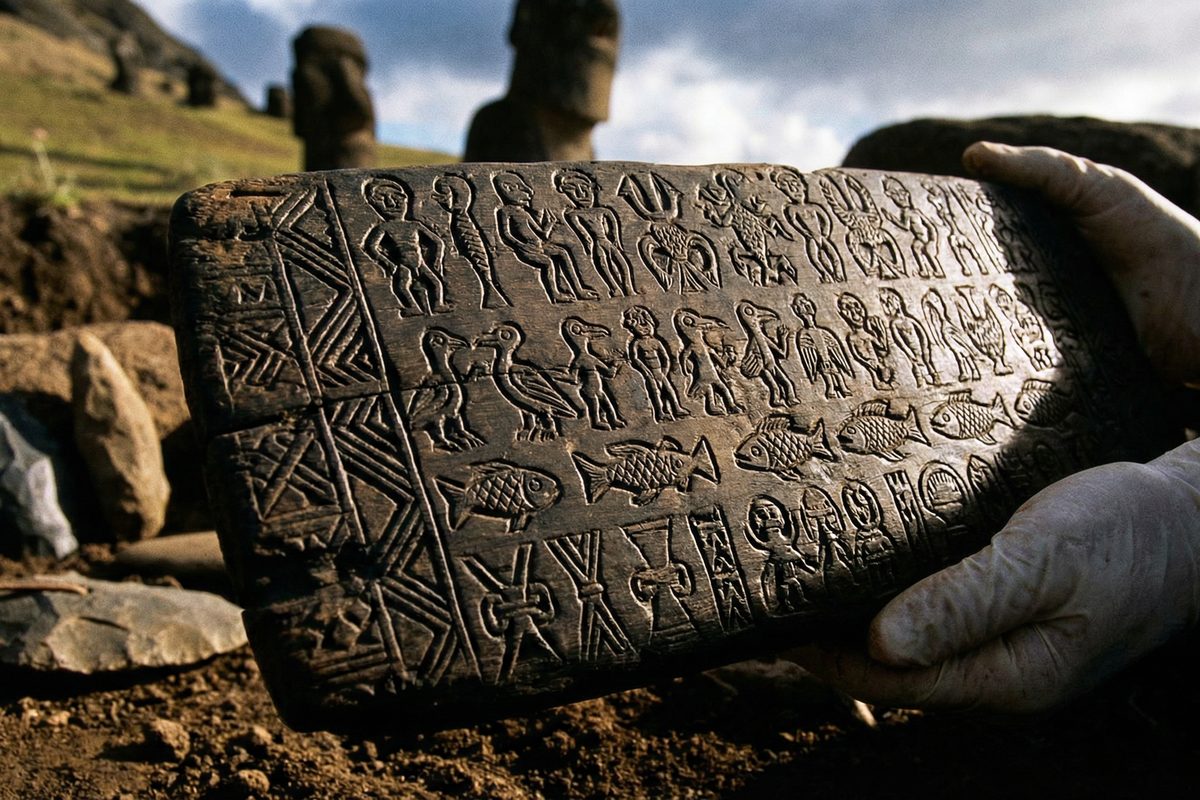
The term "Rongorongo" itself means "to recite, to chant out" in the Rapa Nui language, hinting at its potential function. The script consists of intricate glyphs carved primarily onto wooden tablets, though a few examples exist on staves and other artifacts. These glyphs depict a fascinating array of human, animal, plant, and geometric forms, often highly stylized. The writing direction is particularly unusual: it's a form of reverse boustrophedon, meaning one line reads from left to right, the next from right to left and upside down, and so on. To read a tablet, one must turn it 180 degrees at the end of each line.
Discovery and Early Encounters
The first undisputed discovery of the Rongorongo script by Westerners occurred in 1864 when Eugène Eyraud, a French missionary, encountered numerous tablets on the island. He reported that "in every hut, one finds wooden tablets or sticks covered with hieroglyphic characters." This observation suggests that the script was once widespread among the Rapa Nui people. However, by the time of his report, the knowledge of how to read the script was already in decline, largely due to devastating slave raids from Peru in the 1860s, which decimated the island's population, including many of its intellectual elite.
Subsequent expeditions and collectors managed to acquire around two dozen genuine Rongorongo texts, now scattered in museums worldwide. These precious artifacts represent the entirety of our knowledge of this unique undeciphered script. The scarcity of texts, coupled with the loss of native readers, has made the task of decipherment incredibly challenging.
The Enduring Mystery: Why is Rongorongo Undeciphered?
The central question surrounding the Rongorongo script is its stubborn resistance to decipherment. Unlike Egyptian hieroglyphs, which were cracked with the Rosetta Stone, or Linear B, which yielded to linguistic analysis, Rongorongo remains a closed book. Several factors contribute to this enduring mystery:
- Lack of a Rosetta Stone: There is no bilingual text that could provide a key to understanding the script.
- Limited Corpus: Only 26-27 undisputed texts exist, containing approximately 15,000 glyphs in total. This small sample size makes statistical analysis and pattern recognition difficult.
- Loss of Knowledge: The knowledge of how to read Rongorongo was largely lost before systematic study could begin. The last known individuals with some understanding died in the late 19th century.
- Isolation of Rapa Nui: The island's extreme isolation means there are no closely related scripts or languages to provide comparative insights.
Scholarly Theories and Attempts at Decipherment
Over the decades, numerous scholars and amateur enthusiasts have attempted to crack the Rongorongo code, leading to a fascinating array of theories. These theories often fall into broad categories:
1. A True Writing System
Many believe Rongorongo is a genuine writing system, capable of recording the Rapa Nui language. If so, it could be a logo-syllabic system (like ancient Egyptian or Mayan), where glyphs represent words or syllables. Proponents point to the structured nature of the glyphs and their repetition as evidence of linguistic content. Some attempts have tried to link specific glyphs to Rapa Nui words, but without a consistent methodology, these remain speculative.
2. Mnemonic Device or Proto-Writing
Another prominent theory suggests that Rongorongo is not a full writing system in the Western sense, but rather a mnemonic device used to aid in the recitation of chants, genealogies, or historical narratives. In this view, the glyphs would serve as prompts or symbols for specific concepts or phrases, rather than directly encoding spoken language. This would explain why a small number of glyphs could represent a vast amount of oral tradition.
3. A Unique Invention or Diffusion?
The question of whether Rongorongo was an independent invention or influenced by external sources is also hotly debated. The general consensus among scholars is that it was an indigenous invention, developed by the Rapa Nui people in isolation. However, some fringe theories propose contact with other cultures, even suggesting a connection to South American scripts, though concrete evidence for this is lacking.
4. The "Calendrical" or "Astronomical" Hypothesis
Some researchers have attempted to find calendrical or astronomical information within the Rongorongo texts, suggesting they might record cycles of the moon, stars, or seasons important for agriculture or religious practices. While some patterns have been observed, a definitive link to a calendrical system has not been established.
The "Tahua" Tablet and the "Ko hau motu mo Rongorongo"
Among the most studied Rongorongo texts is the "Tahua" tablet (also known as "Aruku Kurenga"), which contains a sequence of glyphs that some researchers believe might represent a creation chant or a genealogy. Another significant text is the "Ko hau motu mo Rongorongo" (The staffs of the island for Rongorongo), a longer text that has been the subject of intense scrutiny for its potential narrative content.
Despite decades of dedicated effort, no single theory has gained widespread acceptance within the academic community. The lack of a breakthrough means the Easter Island writing remains an enigma, a tantalizing whisper from a lost past.
The Legacy of the Rapa Nui Language and Rongorongo
The modern Rapa Nui language, while still spoken, is a Polynesian language and does not directly offer a key to the ancient script. The phonetic values of the glyphs, if they even represent sounds, are unknown. The cultural context in which the Rapa Nui language and script flourished has been irrevocably altered by historical events.
The Rongorongo script stands as a powerful symbol of the intellectual prowess of ancient civilizations, even those in the most remote corners of the world. It reminds us that literacy and complex thought are not exclusive to large continental empires. The very existence of this indigenous writing system on such an isolated island is a remarkable feat.
Conclusion: The Enduring Allure of the Easter Island Mystery
The Rongorongo script, the silent language of Easter Island, continues to be one of the most compelling Easter Island mystery. It challenges our understanding of ancient communication and the limits of decipherment. Will we ever unlock its secrets? Perhaps a new discovery, a forgotten tablet, or a novel analytical approach will one day provide the key. Until then, the Rongorongo glyphs remain a poignant reminder of the knowledge lost to time, a testament to the ingenuity of the Rapa Nui people, and an enduring invitation to explore the forbidden archives of human history.
Marcus Hale
Independent Researcher & Archive Curator
Marcus Hale is an independent researcher and the curator of The Forbidden Archive. He has spent over a decade studying anomalous ancient technologies, cross-referencing primary excavation reports, museum catalogues, and peer-reviewed journals to document artifacts that mainstream history struggles to explain.
📖 Take the Archive With You
Enjoyed this mystery? The full ebook covers 50 Ancient Mysteries in depth — lost technologies, suppressed histories, and artifacts that shouldn't exist. 300+ pages, instant PDF download.
Archive Record
Civilization
Rapa Nui
Time Period
pre-1722 AD
Approximate Date
pre-1722 AD