Egyptian · 10500 BC (disputed)
The Sphinx Water Erosion Theory
5 min read
Last updated February 27, 2026
Choose your reading style:

By Marcus Hale
Independent Researcher & Archive Curator
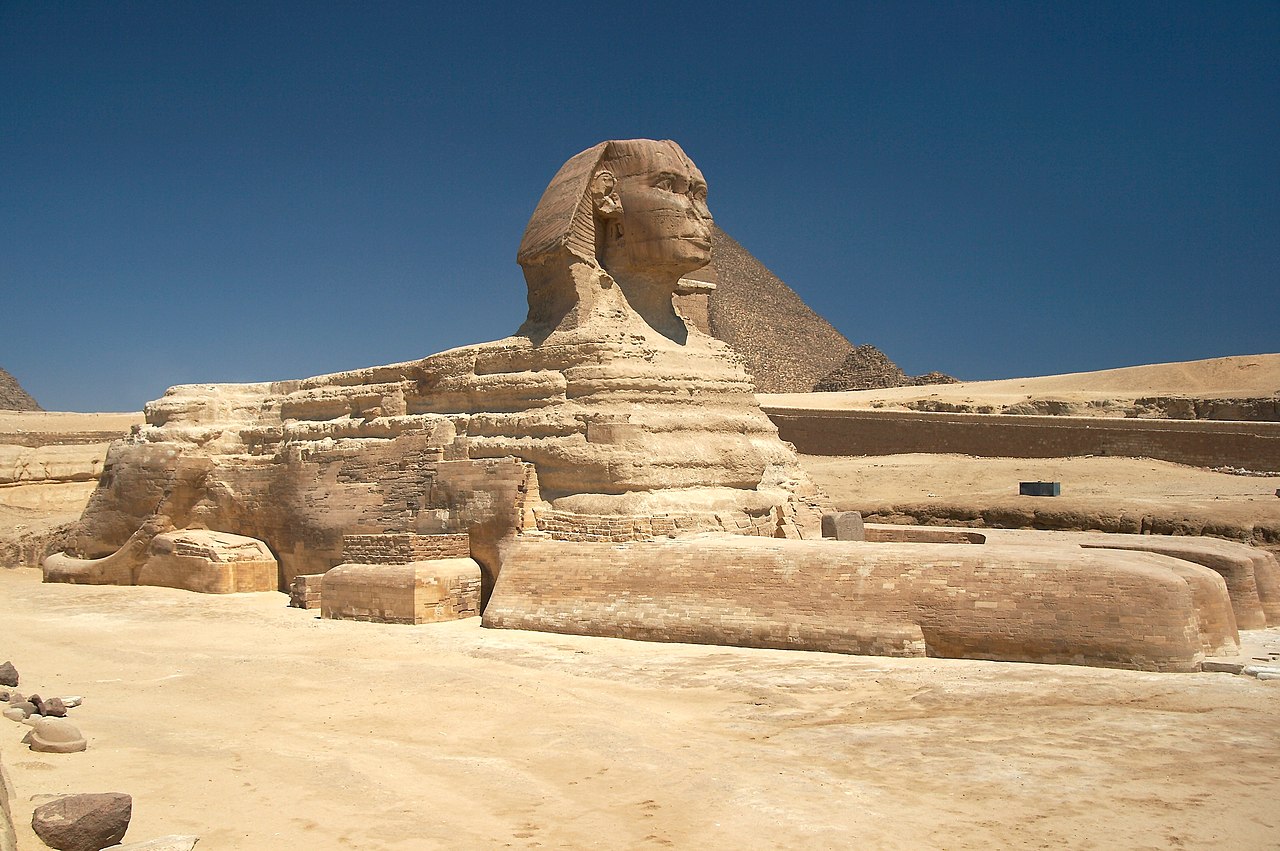
The Great Sphinx of Giza, an iconic sentinel gazing eastward across the sands of Egypt, has captivated humanity for millennia. Its colossal form, part lion and part human, is synonymous with the grandeur of ancient Egypt. Yet, beneath its familiar façade lies one of the most compelling and controversial mysteries in archaeology: the Sphinx water erosion theory. This radical hypothesis challenges conventional timelines, suggesting the Sphinx is far older than traditionally believed, potentially pushing its origins back to a time when the Sahara was a lush, rain-soaked landscape – around 10500 BC.
The Conventional View: Khufu and Khafre's Legacy
For centuries, mainstream Egyptology has attributed the construction of the Great Sphinx to the Old Kingdom pharaoh Khafre, who reigned around 2558–2532 BC. This attribution is primarily based on the Sphinx's proximity to Khafre's pyramid and temple, as well as stylistic similarities between the Sphinx's facial features and Khafre's known statues. The prevailing narrative suggests the Sphinx was carved from a natural bedrock outcrop during the construction of Khafre's mortuary complex, serving as a guardian for his tomb.
Evidence Supporting the Traditional Dating
- Proximity to Khafre's Complex: The Sphinx and its associated temples are integral parts of Khafre's funerary complex, suggesting a contemporaneous construction.
- Stylistic Similarities: Some art historians argue for a resemblance between the Sphinx's face and known depictions of Khafre.
- Lack of Earlier Evidence: No definitive archaeological evidence has been found at the Giza plateau to suggest human activity or monumental construction on such a scale prior to the Old Kingdom.
The Radical Challenge: The Sphinx Water Erosion Theory
Enter the Sphinx water erosion theory, championed most prominently by geologist Robert Schoch. In the early 1990s, Schoch, then an associate professor at Boston University, examined the weathering patterns on the Sphinx enclosure walls. His observations led him to a startling conclusion: the primary erosion visible on the Sphinx and its enclosure was not caused by wind and sand, as commonly assumed, but by prolonged and heavy rainfall.
Robert Schoch's Geological Observations
Schoch pointed to the distinctive vertical fissures and undulating, rounded profiles on the limestone bedrock of the Sphinx enclosure. He argued that such deep, undulating erosion is characteristic of precipitation runoff over a significant period, not the horizontal scouring typically produced by windblown sand. While wind and sand erosion do occur, they tend to create more angular, undercut features, which are present but superimposed over the deeper, older water erosion patterns.
His analysis suggested that the last period of significant rainfall capable of causing such extensive erosion in the Giza region ended around 10500 BC. This dramatically re-dates the Sphinx, placing its origins thousands of years before the Old Kingdom pharaohs. If Schoch is correct, the core body of the Sphinx would have to predate dynastic Egypt, making it a relic of a lost civilization.
Supporting and Opposing Arguments
- Geological Consensus (Partial): While not universally accepted, many geologists acknowledge that the erosion patterns on the Sphinx enclosure are indeed consistent with prolonged rainfall. The debate then shifts to the timing of this rainfall.
- Archaeological Counterarguments: Mainstream archaeologists argue that there's no archaeological evidence of a civilization capable of carving such a monumental structure at 10500 BC. They suggest that localized rainfall events, or even ancient attempts at flood control, could account for some of the water damage.
- The "Head Anomaly": Another intriguing aspect of the older Sphinx theory is the disproportionately small head of the Sphinx relative to its massive body. Schoch and others propose that the original head might have been that of a lion, subsequently recarved into a human visage (possibly Khafre's) by later pharaohs. This would explain the stylistic differences and the apparent disproportion.
- The "Inventory Stela": This stela, discovered near the Sphinx, mentions Khufu (Khafre's father) repairing the Sphinx, implying it was already ancient in his time. However, many Egyptologists consider the Inventory Stela a later forgery.
The Ancient Egypt Mystery Deepens
The implications of the Sphinx water erosion theory are profound. If the Sphinx truly dates to 10500 BC, it would necessitate a complete re-evaluation of early human civilization and technological capabilities. It suggests the existence of a sophisticated culture in ancient Egypt far earlier than currently recognized, a culture capable of monumental stone carving and possessing advanced astronomical or engineering knowledge.
This ancient Egypt mystery fuels the imaginations of alternative historians and researchers who posit the existence of lost civilizations or even extraterrestrial influences. While such theories often lack empirical evidence, the Sphinx's enigmatic nature and the persistent questions surrounding its age continue to inspire them.
The Role of Climate Change in the Debate
The geological timeline of the Sahara Desert plays a crucial role in the Sphinx age controversy. Paleoclimatological studies indicate that North Africa experienced a "Green Sahara" period, characterized by abundant rainfall and lush vegetation, which ended around 6,000-5,000 BC. Before this, particularly during the Younger Dryas period (c. 10,800 to 9,600 BC), the climate was highly variable, but periods of significant rainfall were certainly possible. The question is whether these periods were intense and prolonged enough to cause the observed erosion, and if so, whether a civilization existed at that time to carve the Sphinx.
Ongoing Research and the Future of the Sphinx
Despite the compelling arguments put forth by Robert Schoch and his supporters, the mainstream archaeological community largely remains unconvinced by the 10500 BC dating. The lack of corroborating archaeological evidence for such an advanced civilization at that period is a significant hurdle. However, the debate has undeniably spurred further research into the Sphinx's geology and the paleoclimate of ancient Egypt.
Modern techniques, such as micro-erosion analysis and advanced geological dating methods, continue to be applied to the Sphinx and its surroundings. The goal is to gain a more precise understanding of the erosion processes and their timelines, potentially shedding new light on this enduring enigma. The Sphinx, ever watchful, continues to guard its secrets, challenging our understanding of history and the origins of civilization.
Could the Great Sphinx be a silent witness to a forgotten epoch, a monument to a civilization lost to the mists of time? The Sphinx water erosion theory, while controversial, forces us to confront the possibility that our understanding of ancient history may be incomplete, and that profound mysteries still lie hidden beneath the sands of Egypt, waiting to be unearthed.
Marcus Hale
Independent Researcher & Archive Curator
Marcus Hale is an independent researcher and the curator of The Forbidden Archive. He has spent over a decade studying anomalous ancient technologies, cross-referencing primary excavation reports, museum catalogues, and peer-reviewed journals to document artifacts that mainstream history struggles to explain.
📖 Take the Archive With You
Enjoyed this mystery? The full ebook covers 50 Ancient Mysteries in depth — lost technologies, suppressed histories, and artifacts that shouldn't exist. 300+ pages, instant PDF download.
Archive Record
Civilization
Egyptian
Time Period
10500 BC (disputed)
Approximate Date
10500 BC (disputed)