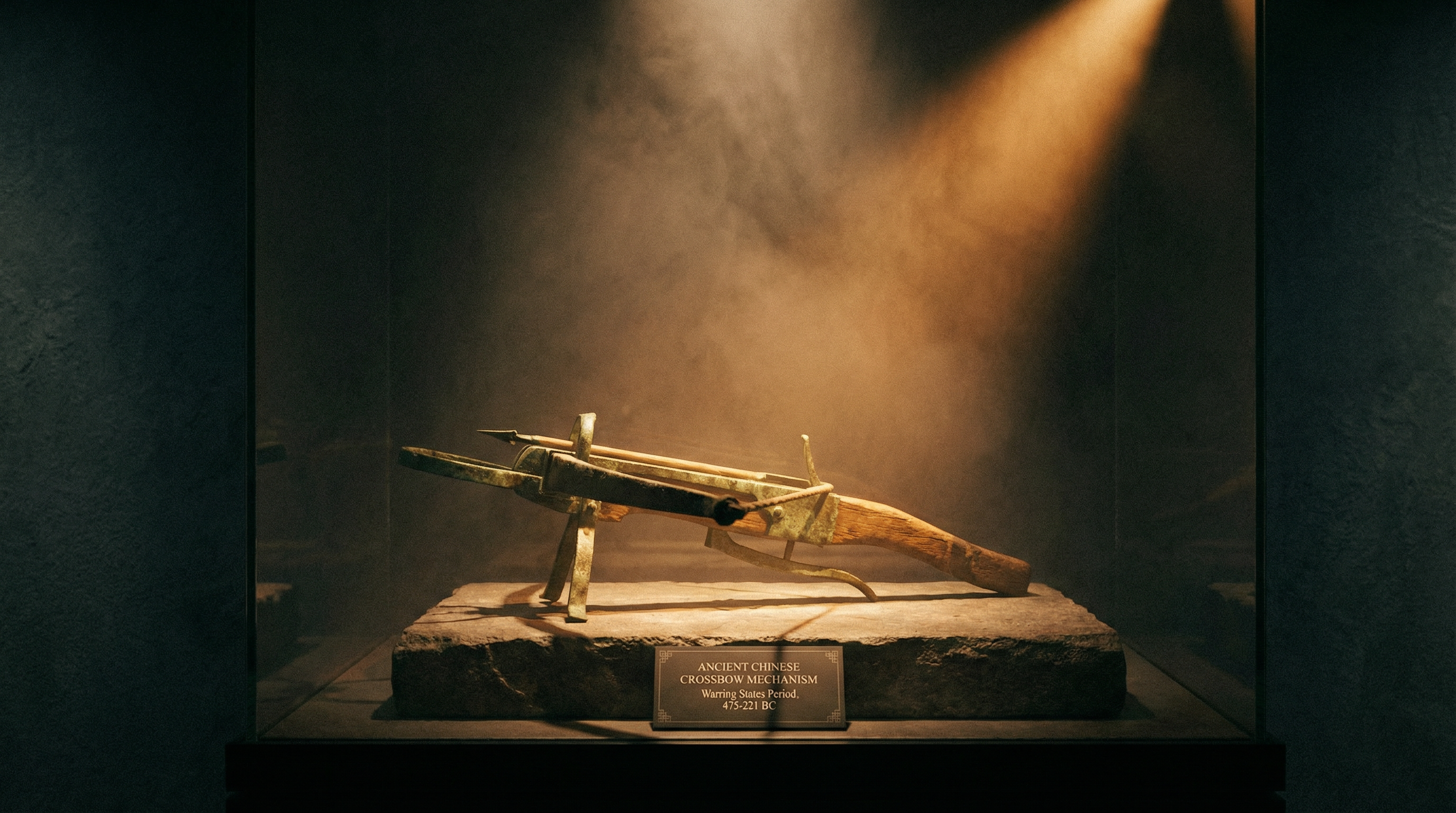
Warring States Period China · Classical Antiquity
Ancient Chinese Crossbow Mechanism
6 min read
Last updated April 4, 2026
Chinese crossbow trigger mechanisms from 400 BCE demonstrate precision casting and mechanical engineering that produced interchangeable parts to tolerances of 0.1mm — a standard not achieved in European manufacturing until the Industrial Revolution.
Choose your reading style:

By Marcus Hale
Independent Researcher & Archive Curator
The Ghost in the Machine: An Unsettling Precision from Antiquity
Imagine a world where the most advanced manufacturing techniques of the Industrial Revolution – interchangeable parts, standardized production, and tolerances measured in fractions of a millimeter – were not born in the smoky factories of 18th-century Europe, but in the bronze foundries of ancient China, over two millennia earlier. This isn't a flight of fancy, but a startling reality revealed by the humble, yet profoundly sophisticated, bronze trigger mechanisms of ancient Chinese crossbows. These artifacts, unearthed from Warring States period tombs, whisper tales of an engineering prowess that defies our conventional understanding of ancient technology. How did a civilization, centuries before the common era, achieve a level of precision that would not be replicated in the West until the age of steam and steel? The answer lies locked within these intricate bronze components, challenging our timelines and forcing us to reconsider the very definition of 'ancient' innovation.
Echoes from the Warring States: Discovery and Context
The story of the Chinese crossbow mechanism is deeply rooted in the tumultuous Warring States Period (c. 475–221 BCE), an era of relentless conflict and profound technological advancement. As rival states vied for supremacy, the demand for superior weaponry spurred unparalleled innovation. The crossbow, with its immense power and ease of use compared to the traditional bow, became a pivotal instrument of war. Its widespread adoption led to mass production, and it is within this context that archaeologists began unearthing remarkable bronze trigger assemblies from elite tombs and battle sites. These discoveries provided a tangible link to the past, offering a glimpse into the sophisticated military-industrial complex of ancient China.
Unlike earlier, simpler crossbow designs, the Chinese variant featured a complex trigger mechanism, typically made of bronze. This mechanism consisted of several interlocking parts: a sear, a catch, and a trigger lever, all housed within a sturdy bronze casing. When assembled, these components held the powerful bowstring under immense tension, releasing it with a precise pull of the trigger. The sheer number of these mechanisms found, often in excellent states of preservation, allowed for detailed study and comparison, leading to the truly astonishing revelation that would rewrite chapters of technological history.
A Microscopic Marvel: Technical Analysis and Unprecedented Accuracy
The true marvel of the ancient Chinese crossbow mechanism lies in its astonishing dimensional accuracy. Modern metallurgical and metrological analyses have revealed that individual components of these bronze trigger assemblies were manufactured to tolerances as fine as 0.1 millimeters. To put this into perspective, 0.1mm is roughly the thickness of a human hair. This level of precision is not merely impressive; it is revolutionary for its time. For centuries, historians of technology believed that the concept of interchangeable parts and the ability to manufacture them to such exacting standards were hallmarks of the First Industrial Revolution in the 18th century, epitomized by figures like Eli Whitney and his muskets.
Yet, here, 2,000 years earlier, was clear evidence of mass-produced components that were not only identical but also interchangeable. A trigger mechanism from one crossbow could be seamlessly fitted into another, regardless of its origin or specific manufacturing batch. This implies a highly standardized production process, sophisticated measurement tools, and an advanced understanding of metallurgy and casting techniques. The bronze itself was often a carefully controlled alloy, designed for strength and durability, further showcasing the technical sophistication of its creators. The intricate interlocking design of the components ensured both reliability and a smooth, consistent trigger pull, critical for accuracy in battle.
The Unanswered Questions: Competing Theories and Scholarly Debate
The existence of such precision manufacturing in ancient China has naturally sparked considerable debate among scholars. How was this achieved? Two primary theories attempt to explain this extraordinary feat:
- Sophisticated Quality Control and Skilled Artisans: One theory posits that ancient Chinese foundries employed an exceptionally rigorous quality control system. Highly skilled artisans, perhaps working with master molds and precise measuring instruments (though the nature of these instruments remains largely speculative), meticulously cast and finished each component. This would have involved painstaking manual labor, repeated measurements, and perhaps even a system of rejection for imperfect parts. The consistency, under this theory, would be a testament to the unparalleled skill and discipline of the ancient craftsmen.
- Advanced Casting Technology: A more provocative theory suggests that the Chinese possessed a casting technology far more advanced than previously imagined. Perhaps they utilized highly refined mold-making techniques, possibly involving multi-part molds or even lost-wax casting methods with unprecedented accuracy, that allowed for the direct production of near-net-shape components with minimal post-casting finishing. The ability to consistently cast bronze parts to such tight tolerances would imply a deep understanding of metal shrinkage, mold design, and temperature control, pushing the boundaries of what we thought was possible in ancient metallurgy.
The debate continues, as definitive evidence for either theory remains elusive. However, the sheer volume of interchangeable parts found across different sites and time periods leans towards a systemic approach rather than isolated instances of exceptional craftsmanship.
Rewriting the Narrative: Challenging Eurocentric Views of Innovation
The implications of the ancient Chinese crossbow mechanism are profound. For too long, the narrative of technological progress has been heavily weighted towards Western civilization, with the Industrial Revolution often cited as the singular birthplace of mass production and interchangeable parts. The Chinese crossbow mechanisms directly challenge this Eurocentric view, demonstrating that a sophisticated understanding of manufacturing principles existed independently, and indeed, centuries earlier, in East Asia.
This discovery forces us to re-evaluate our understanding of the global history of technology. It suggests that parallel paths of innovation existed, and that technological breakthroughs were not always linear or confined to specific geographical regions. The continuous manufacturing tradition, evident from the Warring States Period through the Qin Dynasty (c. 221–206 BCE) and beyond, underscores a sustained commitment to standardization and efficiency that was integral to ancient Chinese military and industrial might. This wasn't a fleeting anomaly but a deeply embedded aspect of their technological culture.
A Legacy of Precision: Lasting Significance
The bronze crossbow mechanisms of ancient China are more than just weapons; they are silent witnesses to an extraordinary chapter in human ingenuity. They stand as powerful reminders that innovation knows no boundaries of time or geography, and that the past holds secrets capable of overturning our most entrenched historical assumptions. The mystery of how such precision was achieved remains a captivating puzzle, driving ongoing research and pushing the boundaries of archaeological and metallurgical science.
As we continue to unearth and analyze these ancient marvels, we gain not only a deeper appreciation for the technical prowess of ancient Chinese civilization but also a broader, more nuanced understanding of the global tapestry of human innovation. The ghost in the machine, the unsettling precision of these ancient artifacts, continues to whisper its challenge, urging us to look beyond conventional narratives and embrace the full, astonishing complexity of our shared technological heritage.
Marcus Hale
Independent Researcher & Archive Curator
Marcus Hale is an independent researcher and the curator of The Forbidden Archive. He has spent over a decade studying anomalous ancient technologies, cross-referencing primary excavation reports, museum catalogues, and peer-reviewed journals to document artifacts that mainstream history struggles to explain.
Competing Theories
The precision of ancient Chinese crossbow mechanisms implies either a sophisticated quality control system or a casting technology capable of achieving dimensional accuracy beyond what modern researchers expected from ancient foundries.
Archive Record
Civilization
Warring States Period China
Time Period
Classical Antiquity
Approximate Date
c. 400 BCE
Origin
China
Current Location
Various museum collections
Materials
Bronze, wood, bone