Song Dynasty China · Medieval
Song Dynasty Gunpowder Weapons
6 min read
Last updated April 4, 2026
The Song Dynasty developed fire arrows, bombs, flamethrowers, and proto-guns centuries before gunpowder weapons appeared in Europe, including the world's first cannon in 1132 CE.
Choose your reading style:

By Marcus Hale
Independent Researcher & Archive Curator
The Fiery Dawn: Song Dynasty Gunpowder Weapons and the Reshaping of Warfare
Imagine a battlefield, not of clashing swords and thundering hooves, but one illuminated by flashes of fire, choked with acrid smoke, and punctuated by deafening explosions. This wasn't a scene from a 17th-century European conflict, but a reality for soldiers of the Song Dynasty in China, centuries earlier. While popular imagination often places the genesis of gunpowder warfare firmly in the European Renaissance, the Forbidden Archive uncovers a far more ancient and sophisticated truth. The Song Dynasty, a period of immense cultural and scientific flourishing (960-1279 CE), didn't just invent gunpowder; they weaponized it with an ingenuity that would redefine the very nature of conflict, developing a terrifying arsenal that included the world's first cannon and proto-guns, long before their Western counterparts even conceived of such destructive power.
A Spark Ignites: Historical Background and Discovery Context
The story of gunpowder in China begins not with warfare, but with alchemy. Taoist alchemists, in their quest for elixirs of immortality, stumbled upon the volatile mixture of saltpetre, charcoal, and sulphur as early as the 9th century CE. Initially dubbed "fire chemical" (huoyao), its explosive potential was quickly recognized. However, it was during the tumultuous Song Dynasty, constantly under threat from northern nomadic empires like the Khitans, Jurchens, and later the Mongols, that this alchemical curiosity was transformed into a military imperative. The need for innovative defenses spurred unprecedented investment in military technology, leading to the rapid development and deployment of gunpowder weapons on a scale unseen anywhere else in the world at the time.
Our understanding of these weapons comes not from archaeological finds alone, which are often scarce due to the perishable nature of many components, but primarily from detailed military treatises. Texts like the Wujing Zongyao (Collection of the Most Important Military Techniques), compiled in 1044 CE, provide chillingly precise recipes for gunpowder and descriptions of early incendiary devices. Later works, such as the Huolongjing (Fire Dragon Manual) from the Ming Dynasty, though compiled later, draw heavily on Song-era knowledge, illustrating the continuous evolution and refinement of these technologies. These texts reveal a society grappling with the awesome power of explosives, meticulously documenting their construction, deployment, and devastating effects.
Technical Analysis: The Remarkable Arsenal of the Song
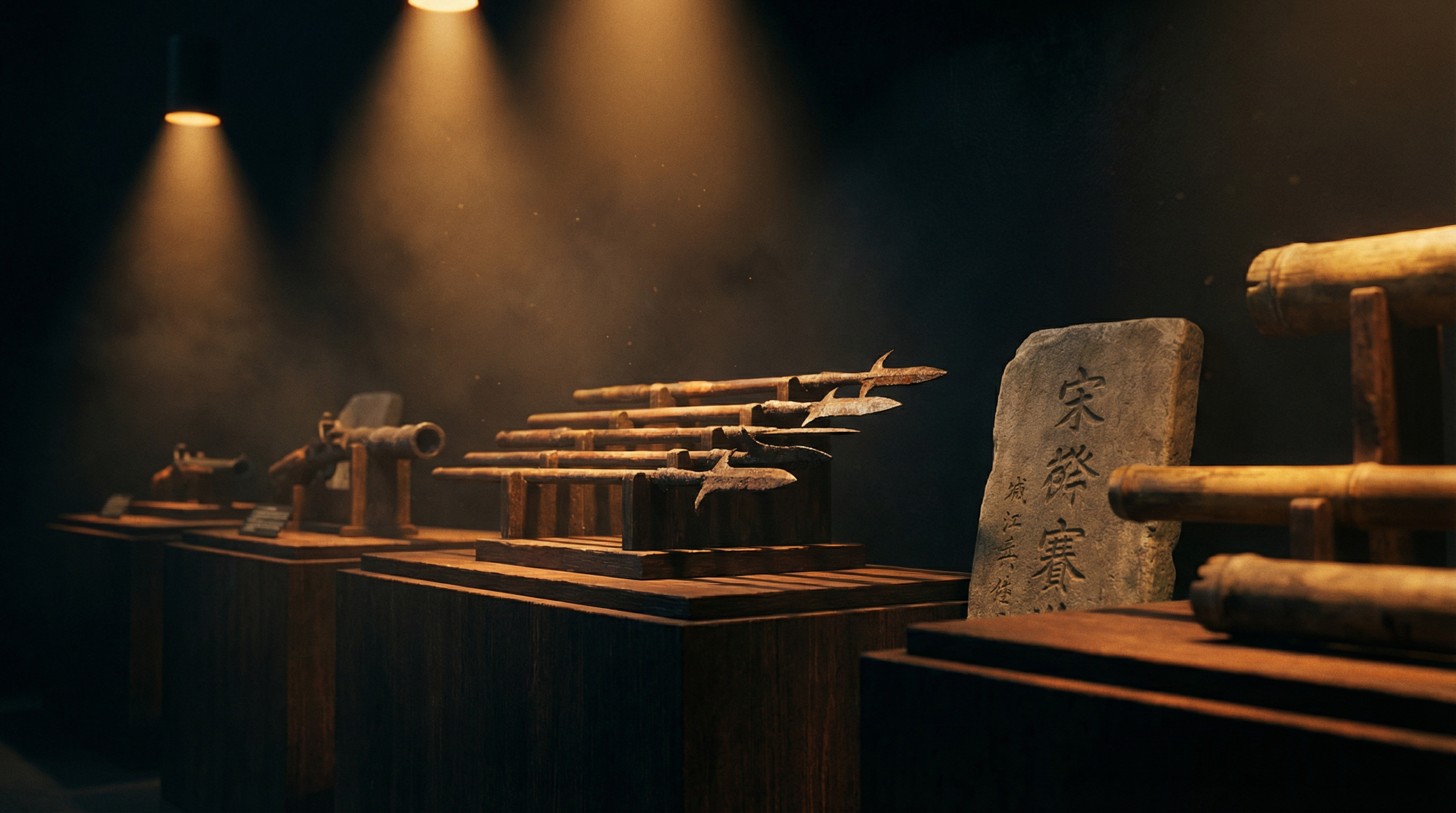
The Song Dynasty's gunpowder arsenal was astonishingly diverse and sophisticated. Early applications included "fire arrows" (huo jian), where small packets of gunpowder were attached to arrows, turning them into incendiary projectiles. These evolved into more complex "fire balls" (huo pao), essentially primitive hand grenades or catapult-launched bombs, designed to explode upon impact, showering enemies with flames and shrapnel. The materials used were simple yet effective: saltpetre for oxygen, charcoal for fuel, and sulphur to lower the ignition temperature and increase volatility, all contained within bamboo, paper, or iron casings.
But the true marvels emerged in the 12th and 13th centuries. The "fire lance" (huo qiang) stands as a direct precursor to the modern gun. Initially, it was a bamboo tube filled with gunpowder and projectiles, strapped to a spear. When ignited, it would blast flames and shrapnel, acting as a terrifying short-range flamethrower and shotgun. Over time, the bamboo was replaced by metal, and the projectiles became more defined, leading to the development of the "eruptor" (tu huo qiang), a true proto-gun capable of firing pellets or even small stones. The earliest known depiction of a fire lance dates to a mural from Dunhuang from the 10th century, but its widespread military application blossomed under the Song.
Perhaps the most revolutionary invention was the cannon. In 1132 CE, during the siege of De'an, Song forces reportedly used a "fire-spitting lance" (huo pao) that was essentially a bronze cannon, firing large projectiles. Later, in 1232 CE, during the Jurchen siege of Kaifeng, the Song employed "thunderclap bombs" (zhen tian lei) – cast-iron bombs filled with gunpowder, which exploded with immense force, shattering armor and causing widespread panic. These were not mere fireworks; they were weapons of mass destruction for their time, demonstrating an advanced understanding of metallurgy and explosive power. The complexity of these devices – from controlled ignition to projectile velocity – speaks to a long period of experimental development and empirical knowledge accumulation.
Competing Theories: Suppression and Transmission
The sheer sophistication of Song Dynasty gunpowder weapons raises intriguing questions. Why did Europe not see similar developments until centuries later? One compelling theory suggests that the technology was deliberately suppressed or its development slowed after the Mongol conquest of China in 1279 CE. The Mongols, masters of cavalry and siege warfare, quickly adopted Chinese gunpowder technology, integrating it into their own formidable war machine. However, some historians argue that the Mongols, while effective users, may not have had the same cultural impetus for continuous innovation in this specific area, focusing instead on consolidating their vast empire. The meticulous records of the Song, which could have accelerated further development, might have been lost or deliberately obscured by the new regime, which sought to establish its own narrative of power.
Another perspective highlights the role of the Mongol conquests in the *transmission* of this technology. As the Mongol Empire stretched across Eurasia, it acted as a conduit, carrying Chinese innovations westward. The thunderclap bombs and fire lances used by the Mongols during their campaigns in the Middle East and Eastern Europe would have been a terrifying introduction to gunpowder for those civilizations. This exposure, rather than a direct transfer of detailed knowledge, likely sparked independent experimentation and development in the West, eventually leading to the European cannon and firearm. The idea of deliberate suppression remains a captivating, though difficult to prove, aspect of this historical narrative.
Challenging Conventional Narratives: The True Dawn of Gunpowder
The story of Song Dynasty gunpowder weapons fundamentally challenges the Eurocentric view of military history. For too long, the invention and widespread use of firearms have been attributed primarily to European ingenuity, often starting with the Battle of Crécy in 1346. However, the evidence from Song China unequivocally demonstrates that sophisticated gunpowder weapons, including cannons and proto-guns, were not only invented but effectively deployed on battlefields at least two centuries earlier. This re-contextualizes the entire trajectory of global military development, highlighting China's pivotal, yet often overlooked, role.
It forces us to reconsider the nature of technological diffusion and the interconnectedness of ancient civilizations. The "discovery" of gunpowder in Europe was not an isolated event but a culmination of centuries of Chinese experimentation and subsequent transmission, however indirect. The Song Dynasty's innovations were not mere curiosities; they were game-changers that influenced siege tactics, battlefield dynamics, and ultimately, the course of history across continents.
Conclusion: The Lasting Significance of the Fiery Dragon
The legacy of Song Dynasty gunpowder weapons is profound. They represent a monumental leap in military technology, transforming warfare from a primarily close-quarters affair into one where ranged explosive power could dictate outcomes. The fire arrows, bombs, flamethrowers, and early cannons developed by the Song were not just tools of destruction; they were products of an advanced scientific culture, driven by necessity and ingenuity. Their impact reverberated through subsequent centuries, influencing the development of artillery and firearms globally.
The Forbidden Archive reminds us that history is rarely a straight line, and innovation often springs from unexpected places. The Song Dynasty's fiery dragon, born from alchemical pursuits and forged in the crucible of conflict, set the world on a new trajectory, forever altering the landscape of human conflict. Their story is a testament to the enduring power of human innovation and a crucial chapter in the global history of technology, a chapter that began not with a bang in Europe, but with a series of thunderous explosions in the heart of ancient China.
Marcus Hale
Independent Researcher & Archive Curator
Marcus Hale is an independent researcher and the curator of The Forbidden Archive. He has spent over a decade studying anomalous ancient technologies, cross-referencing primary excavation reports, museum catalogues, and peer-reviewed journals to document artifacts that mainstream history struggles to explain.
Competing Theories
The sophistication of Song Dynasty gunpowder weapons suggests a long period of experimental development. Some historians argue the technology was deliberately suppressed after the Mongol conquest to prevent its further spread.
Archive Record
Civilization
Song Dynasty China
Time Period
Medieval
Approximate Date
c. 960–1279 CE
Origin
China
Current Location
Various museum collections
Materials
Saltpetre, charcoal, sulphur, iron, bamboo