Pre-Pottery Neolithic · 9600–8200 BC
The Gobekli Tepe Animal Carvings
5 min read
Last updated March 6, 2026
Disclosure: This article contains affiliate links. If you purchase through these links, we may earn a small commission at no additional cost to you. This helps support The Forbidden Archive and allows us to continue our research. See our Privacy Policy for details.
Choose your reading style:

By Marcus Hale
Independent Researcher & Archive Curator
Deep in the sun-baked plains of southeastern Turkey, a monumental secret lay buried for millennia. Then, in the mid-1990s, archaeologists unearthed Gobekli Tepe, a site that didn't just rewrite history; it shattered our understanding of early human civilization. Among its most captivating features are the enigmatic Gobekli Tepe animal carvings, a breathtaking gallery of ancient art etched into massive stone pillars, offering a profound glimpse into the minds of our Pre-Pottery Neolithic ancestors.
Unearthing the Dawn of Civilization: Gobekli Tepe's Significance
Before Gobekli Tepe, the prevailing narrative held that complex societies, monumental architecture, and organized religion emerged only after the development of agriculture. Hunter-gatherers were thought to be too nomadic and focused on survival to undertake such grand projects. Gobekli Tepe, dated to an astonishing 9600–8200 BC, flips this theory on its head. Here, massive T-shaped pillars, some weighing up to 20 tons, were meticulously carved and arranged into sophisticated circular enclosures, predating Stonehenge by over 6,000 years and the invention of pottery and writing by millennia. This wasn't just a settlement; it was a ceremonial center, a place of profound spiritual significance built by people who, by all previous accounts, shouldn't have been capable of it.
The Canvas of Stone: The Gobekli Tepe Carvings
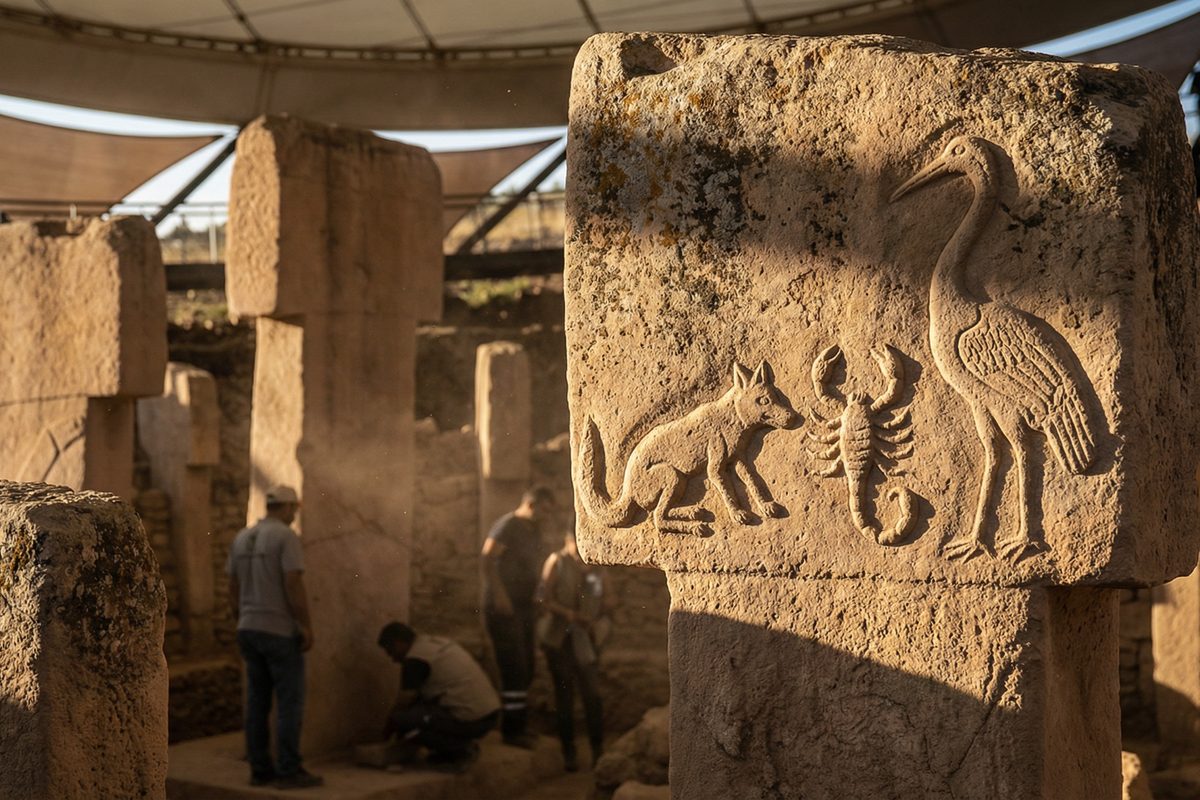
The true marvel of Gobekli Tepe lies in its artistry. The T-shaped pillars, believed by many scholars to represent stylized human figures with arms curving inwards, are adorned with an astonishing array of animal reliefs. These aren't crude doodles; they are sophisticated, dynamic depictions, showcasing a mastery of stone carving that defies their supposed technological limitations. The sheer volume and quality of these ancient animal symbols are unparalleled for their age.
The animals depicted are primarily wild species, reflecting the environment and worldview of these hunter-gatherer communities. We see a menagerie of creatures, some terrifying, some mundane, all rendered with striking detail:
- Snakes: Often depicted in intertwined masses, suggesting fertility, danger, or perhaps a chthonic connection.
- Wild Boars: Powerful and dangerous, frequently shown with bristly backs and tusks.
- Foxes: Agile and cunning, often appearing in pairs or groups.
- Vultures: Birds of prey, sometimes shown with human heads, leading to theories of sky burial or shamanic transformation.
- Scorpions: Another venomous creature, suggesting a respect for the dangerous aspects of nature.
- Lions/Leopards: Large predators, embodying strength and ferocity.
- Spiders, ducks, gazelles, and even a mysterious "H-symbol" also make appearances, adding to the symbolic complexity.
These Gobekli Tepe carvings are not randomly placed; they seem to form coherent narratives or symbolic groupings, though their precise meaning remains elusive. The consistent style and recurring motifs across multiple enclosures suggest a shared iconography and belief system among the diverse groups who contributed to its construction.
Scholarly Theories: Decoding the Ancient Animal Symbols
The purpose and meaning behind the Gobekli Tepe animal carvings are among the greatest archaeological mysteries. Scholars have proposed numerous theories, each offering a fascinating lens through which to view these ancient artworks:
Totemic Symbols and Clan Identity
One prominent theory suggests that the animals represent totemic symbols, perhaps identifying different clans or groups that congregated at Gobekli Tepe. Each group might have been associated with a particular animal, and their presence at the site signified their participation in communal rituals. The repetition of certain animals could indicate the prominence of specific clans.
Shamanism and Spirit Worlds
Given the ritualistic nature of the site, many scholars believe the carvings are deeply intertwined with shamanistic practices. Animals could represent spirit guides, intermediaries between the human and spirit worlds, or even the transformed forms of shamans themselves. The often-exaggerated features and dynamic poses could reflect trance states or visions.
Narrative and Mythological Depictions
Some researchers propose that the carvings illustrate ancient myths, stories, or cosmological beliefs. The arrangement of animals on the pillars might tell a narrative, similar to how later civilizations used friezes to depict epic tales. The "vulture stone" in Enclosure D, with its depiction of a headless human, a scorpion, and various birds, is often cited as a potential depiction of a sky burial ritual or a cataclysmic event, though this remains highly speculative.
Fear, Awe, and the Natural World
Another perspective emphasizes the practical and emotional connection of these hunter-gatherers to their environment. The animals depicted are largely powerful, dangerous, or vital for survival. The carvings could be expressions of awe, fear, or an attempt to harness the power of these creatures through sympathetic magic. They might also serve as a record of the rich biodiversity of the region during that period.
Astronomical Observations
A more recent and controversial theory suggests that some of the Gobekli Tepe pillars, particularly those with specific animal groupings, might encode astronomical information. Researchers have proposed that certain constellations or celestial events are represented, perhaps marking solstices, equinoxes, or even a cometary impact event. While intriguing, this theory requires further substantiation.
The Legacy of the Oldest Temple Carvings
The Gobekli Tepe carvings are more than just ancient art; they are a profound testament to the intellectual and spiritual sophistication of Pre-Pottery Neolithic peoples. They demonstrate a capacity for abstract thought, symbolic representation, and communal effort on an unprecedented scale. The construction and adornment of Gobekli Tepe would have required immense organization, shared belief systems, and a complex social structure, challenging the notion that such advancements only followed the agricultural revolution.
As excavations continue at Gobekli Tepe and nearby sites like Karahan Tepe, new discoveries are constantly refining our understanding. Each unearthed pillar, each newly revealed animal carving, adds another piece to the colossal puzzle of humanity's earliest monumental endeavors. These oldest temple carvings compel us to reconsider the very foundations of civilization, suggesting that perhaps it was not the need for food that first brought humans together to build, but the shared human desire for meaning, ritual, and connection to something larger than themselves.
What secrets still lie buried beneath the earth at Gobekli Tepe? What further insights will these magnificent Gobekli Tepe animal carvings offer into the minds of our distant ancestors? The Forbidden Archive continues to watch with bated breath as this extraordinary site slowly yields its ancient mysteries, forever altering our perception of the human story.
Marcus Hale
Independent Researcher & Archive Curator
Marcus Hale is an independent researcher and the curator of The Forbidden Archive. He has spent over a decade studying anomalous ancient technologies, cross-referencing primary excavation reports, museum catalogues, and peer-reviewed journals to document artifacts that mainstream history struggles to explain.
📖 Take the Archive With You
Enjoyed this mystery? The full ebook covers 50 Ancient Mysteries in depth — lost technologies, suppressed histories, and artifacts that shouldn't exist. 300+ pages, instant PDF download.
Archive Record
Civilization
Pre-Pottery Neolithic
Time Period
9600–8200 BC
Approximate Date
9600–8200 BC
Further Research
Ancient Engineers: An Amazing Look at the Incredible Builders
How ancient civilizations achieved seemingly impossible feats of engineering.
Amazon
Lost Technologies of Ancient Egyptian Builders
Investigation into the construction methods of the ancient world.
Amazon
Affiliate links — we may earn a commission at no cost to you.