Ancient India · Ancient
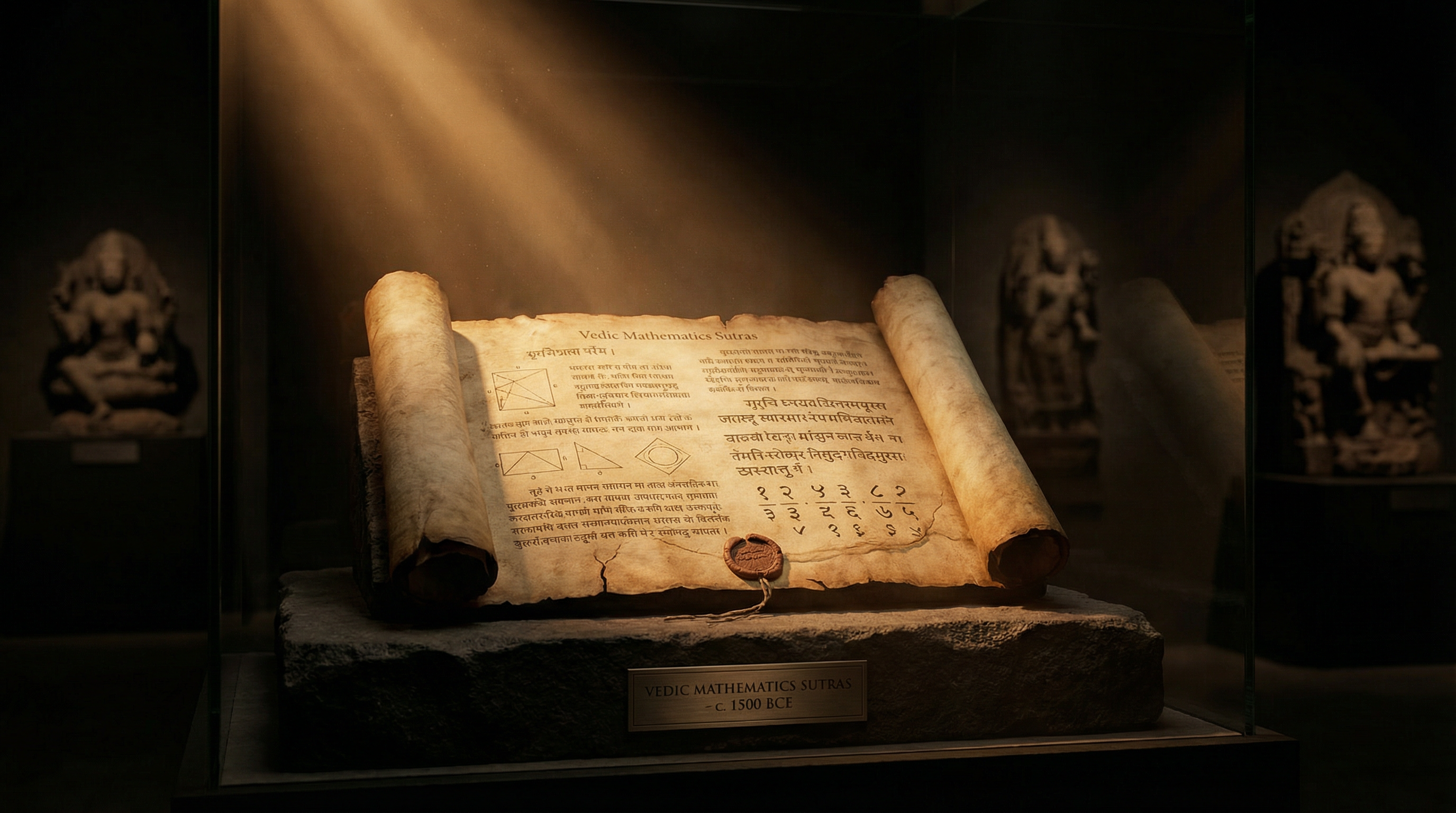
Vedic Mathematics Sutras
6 min read
Last updated April 4, 2026
A system of 16 mathematical sutras (aphorisms) that enable rapid mental calculation of complex arithmetic, algebra, and calculus problems — some operations performed faster than modern calculators.
Choose your reading style:

By Marcus Hale
Independent Researcher & Archive Curator
Welcome, seekers of forgotten knowledge, to The Forbidden Archive. Today, we delve into a system that challenges our understanding of ancient intellectual prowess, a set of mathematical principles so profound, so efficient, that they seem to whisper secrets from a time when human minds were perhaps more attuned to the fundamental rhythms of numbers. We speak of the Vedic Mathematics Sutras, a collection of sixteen aphorisms said to unlock a startling capacity for rapid calculation, often outperforming even modern computational methods. Prepare to have your perceptions of ancient mathematics irrevocably altered.
Historical Background and Discovery Context
The story of Vedic Mathematics, as it is known today, is as intriguing as the system itself, shrouded in a fascinating blend of ancient tradition and modern rediscovery. The term "Vedic Mathematics" was coined by Bharati Krishna Tirtha (1884–1960), a Shankaracharya (head of a monastic order) who claimed to have reconstructed these mathematical principles from ancient Sanskrit texts, specifically parts of the Atharvaveda, one of the four Vedas. He spent eight years in solitary meditation and study, poring over these scriptures, and asserted that they contained hidden mathematical formulae expressed in terse, poetic sutras.
His work, compiled into a single volume titled "Vedic Mathematics or Sixteen Simple Mathematical Formulae from the Veda" and published posthumously in 1965, presented these sixteen sutras (aphorisms) and their corresponding sub-sutras. Tirtha posited that these sutras were not merely mnemonic devices but encapsulated a complete system of mathematics, capable of solving problems in arithmetic, algebra, geometry, and even calculus with astonishing speed and elegance. This claim immediately ignited a debate that continues to this day, polarizing scholars between those who see it as a genuine ancient legacy and those who view it as a brilliant modern invention inspired by ancient wisdom.
Technical Analysis and What Makes It Remarkable
What makes Vedic Mathematics truly extraordinary is its inherent simplicity, coherence, and the sheer speed it imparts to calculations. Unlike conventional methods that often involve multiple steps and carry-overs, the Vedic Sutras offer single-line solutions to complex problems. Consider the multiplication of large numbers. While modern methods require multiple partial products and subsequent additions, Vedic techniques like 'Vertically and Crosswise' (Urdhva Tiryagbhyam) allow for the direct computation of the final answer, often from left to right, mirroring how we read. This method, for instance, can multiply two three-digit numbers in a single mental step for a practiced individual, a feat that would challenge even a calculator user needing to input digits sequentially.
Another striking example is the 'All from 9 and the Last from 10' (Nikhilam Navatashcaramam Dashatah) sutra, which simplifies multiplication when numbers are close to a base (like 10, 100, 1000). This seemingly simple rule transforms complex multiplications into straightforward subtractions and additions. Similarly, square roots of perfect squares can be calculated mentally with ease, and even cubic roots become accessible through pattern recognition inherent in the system. The sutras provide elegant solutions for division, fractions, simultaneous linear equations, and even quadratic equations, often by leveraging properties of numbers that are overlooked in standard curricula. The system's reliance on pattern recognition and complementary numbers makes it incredibly intuitive and less prone to errors than traditional long-form calculations.
Competing Theories and Scholarly Debate
The academic world remains divided on the true origins of Vedic Mathematics. One dominant theory, championed by proponents of the system, asserts that the sutras represent a continuous tradition of mathematical knowledge that existed in ancient India, predating and perhaps even influencing later Greek and Arabic mathematical developments. They argue that the concise, aphoristic nature of the sutras is characteristic of ancient Indian knowledge transmission, where complex ideas were distilled into memorable verses. The sophistication of the algorithms, they contend, points to a deep understanding of number theory and algebraic principles that were independently discovered in India.
Conversely, many mainstream historians of mathematics and Sanskrit scholars argue that while ancient India certainly had a rich mathematical tradition (evidenced by the invention of zero, the decimal system, and significant contributions to trigonometry and algebra), there is no direct textual evidence in the extant Vedic literature that explicitly outlines the 16 sutras as presented by Bharati Krishna Tirtha. Critics suggest that Tirtha, a brilliant scholar in his own right, likely synthesized these principles from various scattered mathematical ideas found in ancient texts, combined them with his own profound insights, and then attributed them to the Vedas as a means of popularizing and legitimizing his work within a culturally revered framework. This perspective views Vedic Mathematics not as a direct ancient discovery, but as a modern reconstruction and interpretation, albeit an incredibly ingenious one.
Why This Challenges Conventional Historical Narratives
Regardless of its precise origin, the existence and efficacy of Vedic Mathematics profoundly challenge conventional historical narratives about the development of mathematical thought. If Tirtha's claims are even partially true, it implies a level of mathematical sophistication in ancient India that far surpasses what is commonly acknowledged. It suggests that complex algorithmic thinking, capable of streamlining calculations, was present centuries, if not millennia, before the advent of modern algebra and computing. The ability to perform multi-digit multiplications or solve simultaneous equations mentally, using a concise set of rules, indicates an advanced understanding of numerical relationships and algebraic structures that we typically attribute to later civilizations.
Furthermore, the system's emphasis on mental computation and pattern recognition highlights a different approach to mathematics – one that is intuitive, holistic, and less reliant on external tools. This stands in contrast to the more formalized, step-by-step methods that became prevalent in Western mathematics. Vedic Mathematics, therefore, forces us to reconsider the linearity of scientific progress and acknowledge the possibility of parallel, equally sophisticated, and perhaps even more elegant, mathematical traditions that developed independently across different cultures.
Conclusion with Lasting Significance
The Vedic Mathematics Sutras, whether a direct echo from antiquity or a masterful modern synthesis, represent a profound intellectual achievement. They offer a unique and powerful approach to mathematics, demonstrating that complex problems can be tackled with remarkable simplicity and speed. Their significance extends beyond mere computational efficiency; they foster a deeper understanding of numbers, encourage mental agility, and reveal the inherent beauty and interconnectedness of mathematical principles.
For the modern world, Vedic Mathematics serves as an invaluable tool for educators seeking to make mathematics more engaging and accessible. It provides alternative methods that can demystify complex operations and build confidence in students. For historians and archaeologists of ideas, it remains a tantalizing mystery – a testament to the enduring human quest to understand and master the language of the universe. The Forbidden Archive recognizes the Vedic Mathematics Sutras not just as an ancient curiosity, but as a living system, a potent reminder that the past still holds secrets capable of illuminating and enriching our present and future understanding of the world.
Marcus Hale
Independent Researcher & Archive Curator
Marcus Hale is an independent researcher and the curator of The Forbidden Archive. He has spent over a decade studying anomalous ancient technologies, cross-referencing primary excavation reports, museum catalogues, and peer-reviewed journals to document artifacts that mainstream history struggles to explain.
Competing Theories
Whether Vedic mathematics represents a continuous ancient tradition or a modern reconstruction remains debated. Proponents argue the sutras encode mathematical principles discovered independently of Greek and Arabic traditions.

Archive Record
Civilization
Ancient India
Time Period
Ancient
Approximate Date
c. 1500–500 BCE
Origin
Indian subcontinent
Current Location
Preserved in Vedic texts
Materials
N/A — mathematical system