Inca Empire · Medieval
Inca Quipu Recording System
4 min read
Last updated March 28, 2026
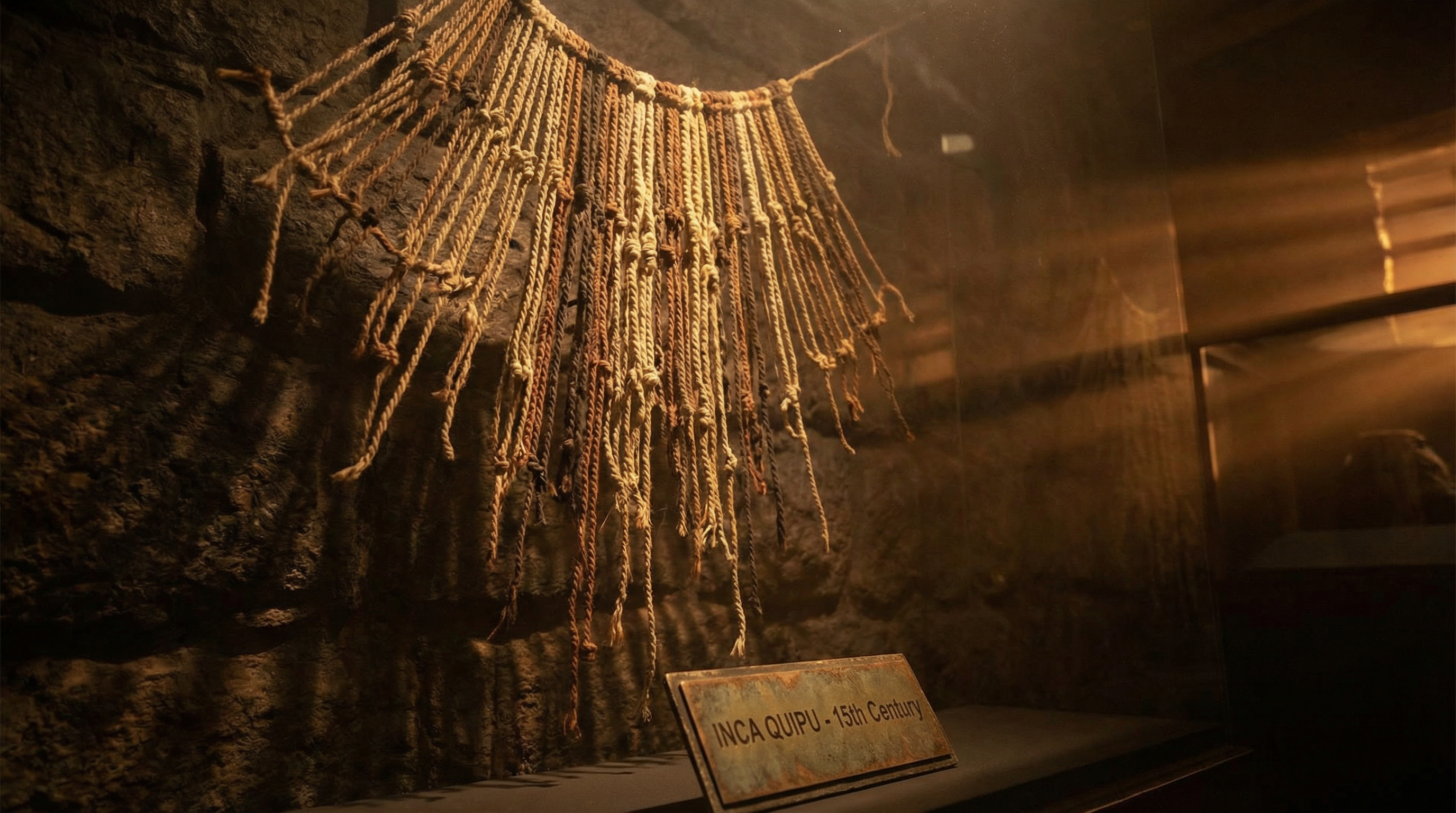
The Inca quipu is a system of knotted strings that recorded numerical data, census information, and possibly narrative text — a three-dimensional data storage system that modern researchers are only beginning to decode.
Also in This Category
Choose your reading style:

By Marcus Hale
Independent Researcher & Archive Curator
The 1532 Encounter at Cajamarca
On November 16, 1532, Francisco Pizarro and his small contingent of Spanish conquistadors captured the Inca emperor Atahualpa at Cajamarca. During the chaotic aftermath, the Spanish noticed something unusual: native administrators were rapidly moving their fingers across clusters of colored strings tied in complex knots. When asked what these were, the Inca officials explained that these devices, known as quipus, held the entire accounting of the empire's storehouses, census figures, and troop movements. To the Spaniards, accustomed to ink on parchment, the idea that a bundle of cotton cords could store complex information seemed impossible. Yet, the Inca Empire—the largest in pre-Columbian America—was administered entirely without a written alphabet, relying instead on this three-dimensional data storage system.
Today, over 600 quipus survive in various museum collections, silent witnesses to a sophisticated civilization that managed a vast territory stretching from modern-day Colombia to Chile. The quipu system utilized a primary cord from which numerous secondary cords, known as pendants, were suspended. These pendants were meticulously knotted at specific intervals. The position, type of knot, color of the cord, and even the direction of the spin (S-ply or Z-ply) all conveyed specific data points. For decades, archaeologists viewed the quipu merely as a primitive abacus or a mnemonic device used to jog the memory of the quipucamayocs (knot-makers). However, recent analytical breakthroughs suggest a far more complex reality.
Decoding the Binary Architecture
Harvard researcher Gary Urton has spearheaded the modern effort to decode the quipu, applying structural analysis to the surviving artifacts. Urton identified 24 distinct binary features in the construction of a quipu. For example, a cord can be spun to the left or the right; a knot can be tied with an overhand or underhand motion; the cord can be attached to the main string from the front or the back. By combining these binary choices with color variations (often utilizing 24 different colors or color combinations), Urton calculates that the quipu system was capable of encoding 1,536 distinct information units.
This number is highly significant. The Sumerian cuneiform system utilized between 1,000 and 1,500 signs, while Egyptian hieroglyphs numbered around 700 to 800 during the Middle Kingdom. The quipu's capacity of 1,536 units places it firmly in the realm of complex writing systems. The realization that the Inca utilized a binary encoding system—hundreds of years before the development of early computer binary systems—has revolutionized our understanding of Andean information technology. The quipu was not just a tool for counting llamas; it was a highly structured, multidimensional database.
Beyond Numbers: The Search for Narrative
While the numerical function of the quipu is well understood—utilizing a base-10 positional system where the highest values are placed near the primary cord and the lowest values near the bottom of the pendant—the possibility of narrative encoding remains a subject of intense investigation. Spanish chroniclers recorded that quipus were used to record histories, genealogies, and even poetry. If true, how did knots and colors translate into words or phonetic sounds?
Some researchers propose that certain quipus, particularly those that do not conform to the base-10 numerical pattern, might represent a form of semasiographic writing, where symbols communicate meaning independently of spoken language, much like musical notation or mathematical symbols. Others, including Urton, suggest that the binary features might encode phonetic information, pointing to the possibility that the quipu was a true glottographic writing system, capable of recording the Quechua language directly.
The challenge lies in the destruction wrought by the Spanish conquest. In 1583, the Third Council of Lima ordered the burning of all quipus, declaring them works of the devil and tools of idolatry. This cultural erasure severed the living link to the quipucamayocs, leaving modern scholars to decipher the system without a Rosetta Stone. The surviving 600 quipus are just a fraction of the millions that must have existed, representing a massive loss of historical data.
The Future of Andean Data Retrieval
The ongoing analysis of quipus involves cross-referencing the physical artifacts with early Spanish colonial documents that claim to be transcriptions of specific quipus. By matching the numbers in the documents with the knots on the cords, researchers hope to isolate specific cord combinations that might represent names, places, or concepts. The Khipu Database Project, initiated by Urton, has digitized the structural details of hundreds of quipus, allowing for computer-assisted pattern recognition.
As we continue to unravel the complexities of this ancient recording system, the quipu forces us to reconsider our definitions of literacy and technology. The Inca demonstrated that information does not need to be inscribed on a two-dimensional surface to be preserved and transmitted. They built an empire using a tangible, tactile database that literally wove data into the fabric of their society.
If the Inca could encode the administration of an entire empire into the twist and color of cotton threads, what other forms of non-linear data storage might exist in the archaeological record, entirely unrecognized by modern eyes?
Marcus Hale
Independent Researcher & Archive Curator
Marcus Hale is an independent researcher and the curator of The Forbidden Archive. He has spent over a decade studying anomalous ancient technologies, cross-referencing primary excavation reports, museum catalogues, and peer-reviewed journals to document artifacts that mainstream history struggles to explain.
Join the Archive
Enjoyed This Mystery?
Get new discoveries like this delivered to your inbox every week. Ancient technologies, lost sciences, and suppressed history — free.
Competing Theories
Harvard researcher Gary Urton has identified 24 distinct binary features in quipu construction, suggesting a system capable of encoding 1,536 distinct information units — comparable to early computer binary systems.
Archive Record
Civilization
Inca Empire
Time Period
Medieval
Approximate Date
c. 1400–1533 CE
Origin
Andes Mountains, South America
Current Location
Various museum collections
Materials
Cotton, wool cords