Han Dynasty China · Classical Antiquity
Ancient Chinese Abacus
5 min read
Last updated March 17, 2026
The Chinese abacus (suanpan) enabled calculations equivalent to modern computers for commerce, astronomy, and engineering, and in the hands of a skilled operator can outperform electronic calculators for certain operations.
Also in This Category
Choose your reading style:

By Marcus Hale
Independent Researcher & Archive Curator
The 1946 Tokyo Calculation Showdown
On November 12, 1946, a crowd gathered in Tokyo to witness a highly anticipated competition that would challenge the supremacy of modern technology. Private Thomas Nathan Wood, an American soldier equipped with a state-of-the-art electromechanical calculator, faced off against Kiyoshi Matsuzaki, a champion operator of the traditional abacus. In a stunning upset that defied the expectations of the post-war era, Matsuzaki and his ancient wooden tool won four out of five rounds. The Japanese expert decisively defeated the American machine in addition, subtraction, division, and a complex composite problem involving multiple operations. The event demonstrated that the Chinese abacus, known as the suanpan, was not merely a primitive relic of a bygone age, but a highly optimized computational device capable of matching and exceeding the speed of mid-20th-century electromechanical technology.
The origins of this extraordinary calculation instrument trace back to the Han Dynasty in Classical Antiquity, around 200 CE, though earlier counting systems certainly influenced its development. Constructed from simple, readily available materials like wood, bamboo, and beads, the suanpan became the indispensable backbone of commerce, astronomy, and engineering across the vast expanses of Asia. Unlike early counting boards that required placing and removing individual stones or bamboo rods—a slow and cumbersome process—the abacus utilized beads sliding smoothly on rods within a rectangular wooden frame. This mechanical innovation allowed for rapid, continuous calculations without the need to record intermediate steps on paper or parchment, effectively serving as a physical extension of the operator's working memory and dramatically accelerating complex mathematical tasks.
Decoding the 2/5 Bead Architecture
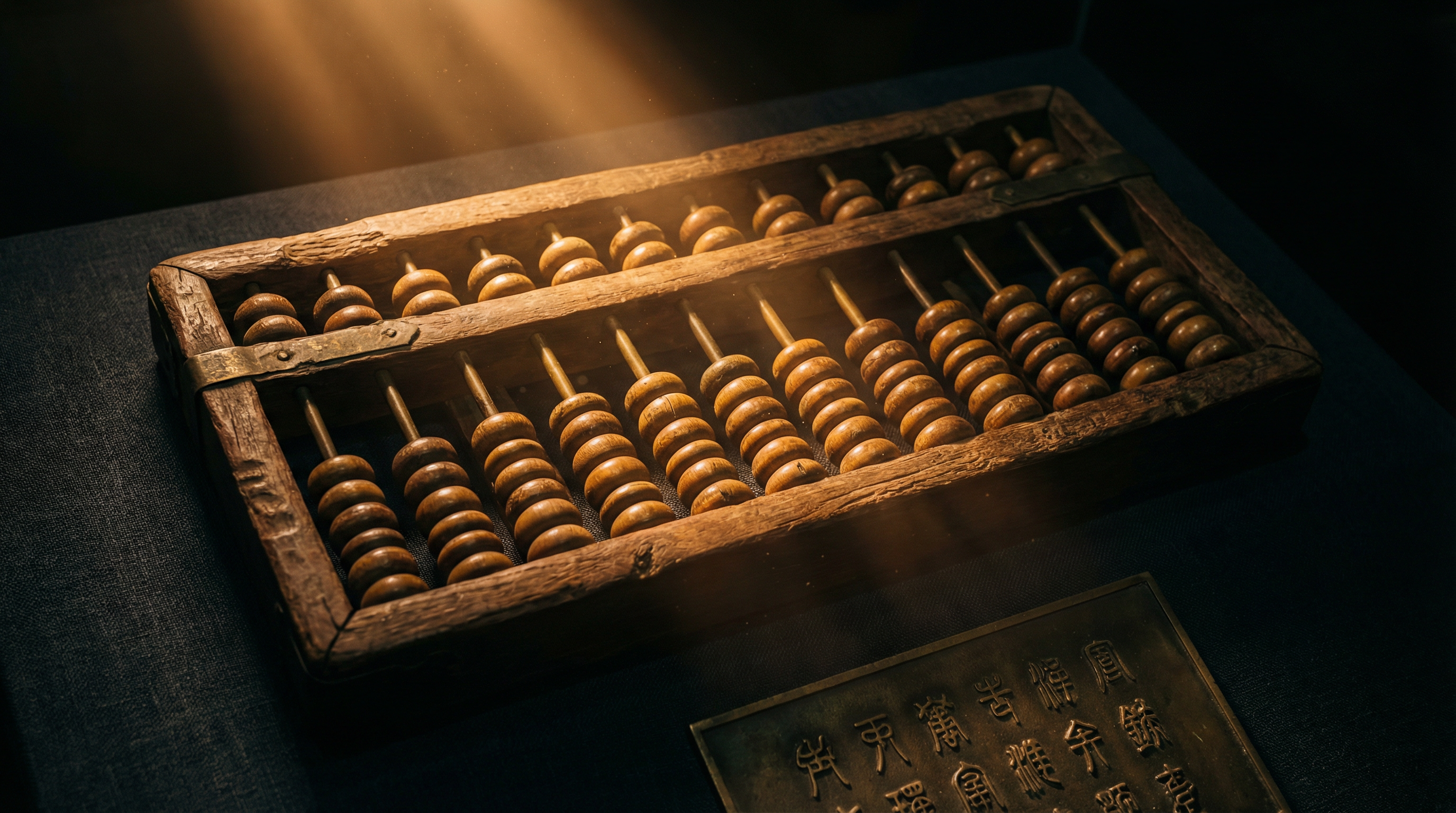
A standard Chinese suanpan features a distinct and mathematically profound layout: a horizontal beam divides the frame into an upper deck and a lower deck. Each vertical rod contains two beads in the upper deck, each representing a value of five, and five beads in the lower deck, each representing a value of one. This specific 2/5 configuration encodes a sophisticated understanding of positional notation and base-10 arithmetic, concepts that were fundamental to the advancement of ancient Chinese mathematics. When an operator manipulates the beads, they are physically representing numbers in a base-10 system, where each rod from right to left represents increasing powers of ten, allowing for calculations involving massive numbers that would be impossible to manage mentally.
However, the physical design implies more than just straightforward decimal calculations. Some researchers argue that the inclusion of two five-value beads and five one-value beads on a single rod—allowing a maximum possible value of 15 per rod before carrying over—indicates a deep knowledge of hexadecimal (base-16) arithmetic. Ancient Chinese measurement systems often utilized base-16 units, such as 16 liang equaling one jin, a standard weight measurement. The suanpan's unique architecture was perfectly adapted to handle these non-decimal conversions seamlessly. This capability showcases an early mastery of multiple numeral systems long before the advent of modern computer science, where hexadecimal systems are now foundational to digital architecture.
The Cognitive Mechanics of Mental Mathematics
Operating a suanpan requires a specific set of physical and cognitive skills that must be honed through years of dedicated practice. Users memorize a series of rhythmic algorithms, often recited as short poems, chants, or mnemonic devices, which dictate the exact finger movements for addition, subtraction, multiplication, and division. These ancient algorithms optimize the physical motion required, minimizing the distance the fingers must travel across the beads and maximizing overall calculation speed. The tactile feedback of the wooden beads striking the central beam or the outer frame provides auditory and physical confirmation of the calculation, engaging multiple senses simultaneously and reinforcing the neural pathways associated with numerical processing.
The true power of the abacus, however, extends far beyond the physical device itself. Through rigorous and sustained training, skilled operators develop the extraordinary ability to visualize the suanpan in their minds. This practice, known as mental abacus or anzan in Japan, allows individuals to perform incredibly complex arithmetic operations at astonishing speeds without any physical tool whatsoever. Neuroimaging studies conducted on expert mental abacus users have shown that they heavily utilize the visual-spatial regions of the brain, rather than the language processing areas typically associated with mental arithmetic in untrained individuals. By transforming numerical calculation into a spatial manipulation task, the ancient design of the suanpan effectively hacks human cognitive architecture to achieve computational speeds that rival electronic calculators.
A Living Legacy Beyond the Museum Glass
While many artifacts originating from 200 CE are securely confined to climate-controlled glass cases in various museum collections around the world, the suanpan remains a vibrant, living technology. Its profound influence spread from its origins in China to Korea, Japan, Vietnam, and eventually across the globe, adapting to local needs and cultural contexts while retaining its core mathematical principles. Even in the current era of ubiquitous smartphones, powerful digital computing, and artificial intelligence, the abacus is still actively taught in many parts of Asia. It is valued not just as a historical curiosity, but as a foundational educational tool for developing mental mathematics skills, improving concentration, and fostering deep numerical fluency in children.
The enduring utility and relevance of the suanpan directly challenges our often linear narrative of technological progress. It forces us to critically reconsider the widespread assumption that newer necessarily equates to better. The famous 1946 competition in Tokyo was not an isolated anomaly, but a powerful, public demonstration of the sheer efficiency and brilliance embedded in the abacus's ancient design. It serves as a compelling reminder that early engineers and mathematicians possessed a profound understanding of both abstract mathematics and human cognition, creating a physical tool so perfectly optimized for its purpose that it remained unsurpassed in speed and reliability for nearly two millennia.
If an instrument constructed entirely of wood and beads can outperform early electronic computers through sheer optimization of human cognitive spatial abilities, what other ancient tools might hold untapped potential for enhancing our modern minds?
Marcus Hale
Independent Researcher & Archive Curator
Marcus Hale is an independent researcher and the curator of The Forbidden Archive. He has spent over a decade studying anomalous ancient technologies, cross-referencing primary excavation reports, museum catalogues, and peer-reviewed journals to document artifacts that mainstream history struggles to explain.
Join the Archive
Enjoyed This Mystery?
Get new discoveries like this delivered to your inbox every week. Ancient technologies, lost sciences, and suppressed history — free.
Competing Theories
The abacus's design encodes a sophisticated understanding of positional notation and base-10 arithmetic. Some researchers argue the suanpan's 2/5 bead configuration implies knowledge of hexadecimal arithmetic used in ancient Chinese measurement systems.
Archive Record
Civilization
Han Dynasty China
Time Period
Classical Antiquity
Approximate Date
c. 200 CE
Origin
China
Current Location
Various museum collections
Materials
Wood, beads