Han Dynasty China · Classical Antiquity
Ancient Chinese Silk Road Maps
5 min read
Last updated March 16, 2026
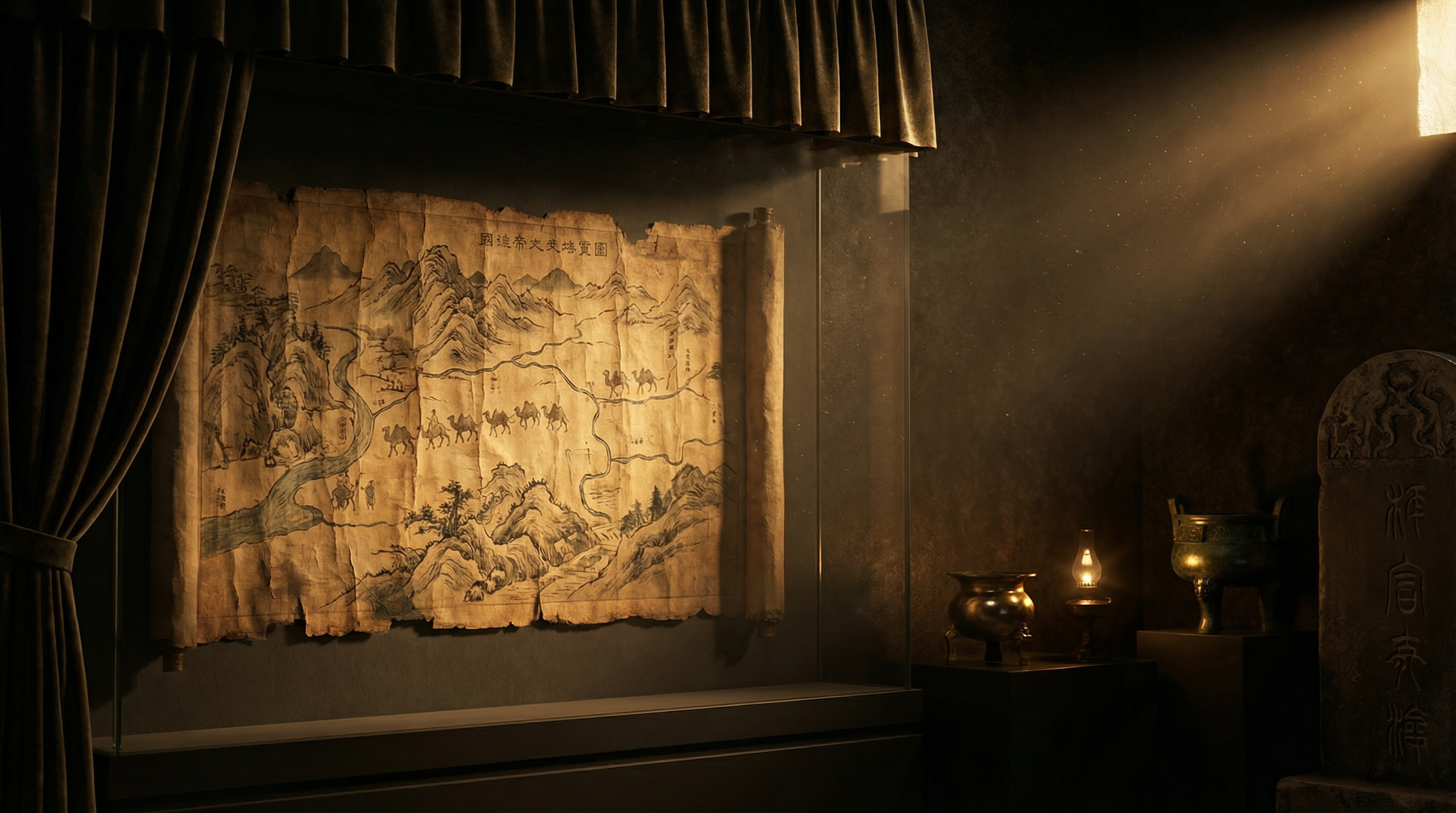
The Mawangdui silk maps from 168 BCE show topographical features, river systems, and military installations with an accuracy that implies systematic surveying techniques centuries ahead of their time.
Also in This Category
Choose your reading style:

By Marcus Hale
Independent Researcher & Archive Curator
A Silk Map Ahead of Its Time
In 168 BCE, long before the widespread adoption of standardized cartography in the West, military strategists of the Han Dynasty were already drafting highly precise topographical maps. The discovery of the Mawangdui silk maps inside a tomb in Changsha, Hunan province, provided a startling look into the surveying capabilities of ancient China. These maps depict river systems, military installations, and mountain ranges with an accuracy that implies a sophisticated understanding of geography and measurement.
Unlike rough sketches or symbolic representations of the world, the Mawangdui maps were created with a clear, systematic approach. They utilize a consistent scale and orientation, elements that are often considered hallmarks of much later cartographic traditions. The level of detail present on the delicate silk surface suggests that the Han military employed a specialized corps of surveyors who traversed the landscape to gather precise data. This data was then meticulously transferred onto silk, a highly valued material reserved for important state documents and luxury goods.
Precision Across the Terrain
What sets the Mawangdui maps apart is their representation of topographical features. The maps include contour-like lines to denote changes in elevation, a technique that provides a three-dimensional understanding of the terrain. This is particularly crucial for military planning, where knowing the high ground can mean the difference between victory and defeat. The inclusion of such detailed elevation data suggests a level of sophistication in ancient surveying that was previously thought impossible.
The river courses shown on the silk align closely with modern satellite imagery, and the distances between various points correspond to modern measurements within a 10% margin of error. Such precision could not have been achieved through mere guesswork or casual observation. It required systematic surveying techniques, possibly involving early forms of triangulation or access to a vast repository of accumulated geographic data. The ability to measure distances accurately over rough terrain points to the use of specialized instruments, perhaps early versions of the surveyor's cross or sighting tubes.
The Han Dynasty Cartographic Corps
The existence of these maps points to a highly organized state apparatus. The Han Dynasty, which ruled from 206 BCE to 220 CE, was known for its bureaucratic efficiency and military expansion. The creation of the Mawangdui maps would have necessitated significant resources, including trained personnel, specialized instruments, and the time required to survey large swathes of territory. The maps were likely produced by a dedicated cartographic corps within the military, tasked with mapping the empire's borders and potential areas of conflict.
Scholars debate the exact methods used by these ancient cartographers. Some suggest the use of the peixiu grid system, although formal records of this system date to a later period. Others propose that the surveyors relied on a combination of pacing, rudimentary sighting instruments, and astronomical observations to establish distances and orientations. Regardless of the specific tools employed, the result was a set of maps that served as vital military assets, allowing commanders to plan campaigns with unprecedented geographic awareness.
Mapping the Silk Road
The Mawangdui maps also offer insights into the early stages of what would become the Silk Road. While the maps primarily focus on military garrisons and local topography, they reflect a broader interest in controlling and understanding the landscape. As the Han Dynasty expanded its influence westward, accurate maps became essential for navigating trade routes, securing borders, and managing relations with neighboring states. The maps suggest that the Han were actively mapping the regions they sought to control, laying the groundwork for the extensive trade networks that would define the Silk Road.
The maps discovered at Mawangdui are not just static documents; they are a window into the strategic mindset of the Han military. They demonstrate a culture that valued empirical data and systematic observation, applying these principles to the practical challenges of governance and warfare. The maps were likely used in conjunction with written reports and census data to administer the empire effectively, ensuring that resources could be allocated efficiently and military forces deployed where they were most needed.
The Legacy of Mawangdui
Today, the Mawangdui silk maps are housed in the Hunan Provincial Museum in Changsha, where they continue to be studied by historians and cartographers. They challenge the assumption that highly accurate, scaled maps were a relatively recent invention, pushing the timeline of sophisticated cartography back by centuries. The maps force a reevaluation of ancient Chinese technological capabilities, suggesting that the Han Dynasty possessed a level of scientific knowledge that was far more advanced than previously recognized.
The preservation of these maps is as impressive as their content. Buried for over two millennia, the silk survived due to the unique conditions of the Mawangdui tombs, which were sealed with layers of charcoal and white clay, creating an airtight environment. This extraordinary preservation allows modern researchers to analyze the ink and silk, confirming the maps' authenticity and age. The meticulous construction of the tombs themselves is another indication of the high status of the individuals interred within, likely members of the Han elite who had access to the empire's most advanced technologies.
The Mawangdui maps serve as a crucial piece of evidence in the study of ancient cartography. They demonstrate that the desire to map the world with precision is not a modern phenomenon, but a fundamental human endeavor that dates back thousands of years. The maps offer a glimpse into a time when the world was still being explored and documented, revealing the ingenuity and determination of those who sought to understand the landscape around them. As we continue to uncover the secrets of the past, the Mawangdui maps serve as a powerful reminder of the sophisticated knowledge possessed by ancient civilizations.
If the Han Dynasty possessed the capability to produce such precise maps in 168 BCE, what other advanced surveying technologies might have been lost to the ravages of time, waiting to be unearthed in forgotten tombs?
Marcus Hale
Independent Researcher & Archive Curator
Marcus Hale is an independent researcher and the curator of The Forbidden Archive. He has spent over a decade studying anomalous ancient technologies, cross-referencing primary excavation reports, museum catalogues, and peer-reviewed journals to document artifacts that mainstream history struggles to explain.
Join the Archive
Enjoyed This Mystery?
Get new discoveries like this delivered to your inbox every week. Ancient technologies, lost sciences, and suppressed history — free.
Competing Theories
The accuracy of the Mawangdui maps implies either systematic triangulation surveying or access to earlier survey data. The maps' military detail suggests they were produced by a specialised cartographic corps within the Han military.
Archive Record
Civilization
Han Dynasty China
Time Period
Classical Antiquity
Approximate Date
c. 168 BCE
Origin
Mawangdui, Hunan, China
Current Location
Hunan Provincial Museum, Changsha
Materials
Silk