Nazca Culture · Classical Antiquity
Nazca Geoglyphs
6 min read
Last updated April 4, 2026
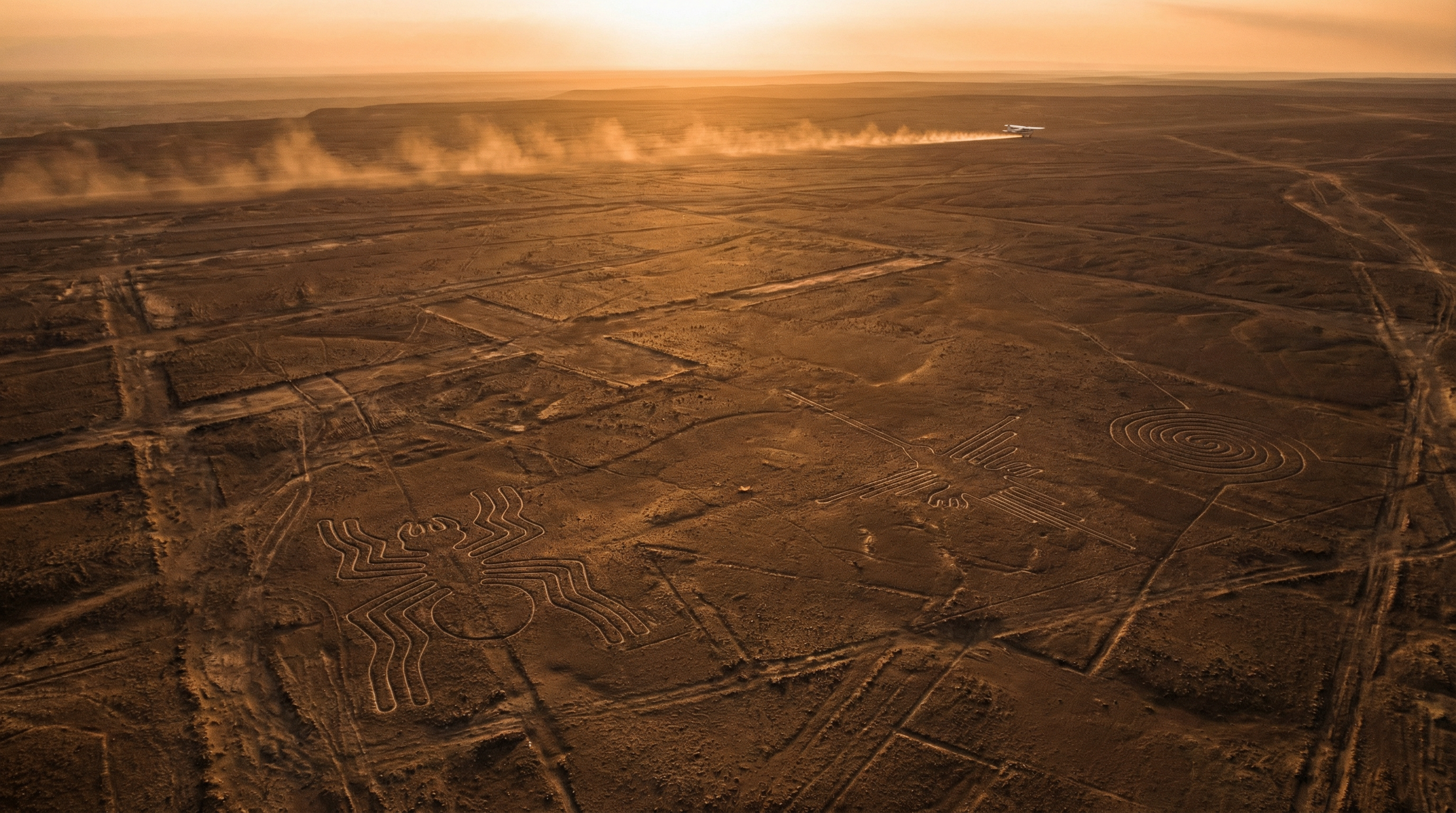
Hundreds of enormous geoglyphs etched into the Peruvian desert, including a 300-metre condor and a 180-metre spider, that can only be fully appreciated from the air — created by a culture with no known means of flight.
Choose your reading style:

By Marcus Hale
Independent Researcher & Archive Curator
Whispers from the Desert: An Unseen Canvas
Imagine a canvas so vast it spans hundreds of square kilometers, its intricate designs invisible to the ground-bound observer, yet perfectly rendered for an audience in the sky. Such is the breathtaking mystery of the Nazca Geoglyphs, an extraordinary collection of lines, geometric shapes, and zoomorphic figures etched into the arid plains of southern Peru. From a colossal 300-meter condor soaring across the desert floor to a delicate 180-meter spider, these monumental artworks defy easy explanation. Created by a culture with no known means of flight, the Nazca Lines present one of archaeology's most enduring puzzles, challenging our perceptions of ancient capabilities and the very nature of human ingenuity. How did a people without wings conceive and execute such precise, aerial masterpieces?
Echoes of a Lost Culture: Discovery and Context
The Nazca Geoglyphs are the enduring legacy of the Nazca culture, a pre-Incan civilization that flourished in the Nazca and Palpa valleys of Peru's southern coast between approximately 100 BCE and 800 CE. While local populations were undoubtedly aware of some of the lines for centuries, their true scale and significance remained largely unappreciated until the advent of air travel in the early 20th century. Pilots flying over the Nazca Pampa first reported seeing vast patterns on the desert floor, sparking international curiosity. The pioneering work of American historian Paul Kosok in the 1930s and, most notably, German mathematician and archaeologist Maria Reiche, who dedicated over 50 years of her life to studying, mapping, and protecting the lines, brought these wonders to global attention. Reiche's meticulous documentation revealed the astonishing complexity and diversity of the geoglyphs, transforming them from mere curiosities into a subject of intense scientific inquiry.
The Nazca culture itself was known for its sophisticated ceramics, textiles, and hydraulic engineering, particularly their impressive network of underground aqueducts called puquios, designed to tap into subterranean water sources in one of the driest regions on Earth. This context is crucial, as it suggests a people deeply connected to their environment and possessing advanced practical skills, which only deepens the mystery of the geoglyphs' creation.
Engineering Marvels: Precision Etched in Stone
The technical brilliance behind the Nazca Geoglyphs is nothing short of astounding. The lines were created by simply removing the reddish-brown iron oxide-coated pebbles that cover the desert surface, exposing the lighter, yellowish-grey subsoil beneath. This seemingly simple technique belies an extraordinary level of planning and execution. The desert's unique climate – extremely dry with minimal wind – has preserved these fragile markings for nearly two millennia. What makes them truly remarkable, however, is their precision.
Many of the straight lines, some extending for distances of up to 50 kilometers, maintain an astonishing accuracy of within 0.1 degrees over their entire length, even across undulating terrain. This implies a sophisticated understanding of surveying and geometry, far beyond what was previously attributed to ancient cultures in the Americas. How did the Nazca achieve such perfect straightness and maintain consistent widths without the aid of modern instruments? Theories suggest the use of simple stakes and ropes, perhaps with observation points on elevated ground or even hot air balloons (though no evidence of the latter has ever been found). The sheer scale and accuracy of these designs, visible only from a significant altitude, continue to baffle engineers and archaeologists alike.
A Tapestry of Theories: From Ritual to Extraterrestrial
The purpose of the Nazca Geoglyphs has been the subject of intense debate and speculation, giving rise to a multitude of theories that range from the prosaic to the fantastical. Early theories, championed by Maria Reiche, often focused on astronomical alignments, suggesting that many of the lines and figures served as an enormous astronomical calendar, marking solstices, equinoxes, and the rising and setting points of celestial bodies. While some alignments have been identified, a comprehensive astronomical system has yet to be definitively proven.
Another prominent theory posits that the lines were ritual pathways or processional routes, used during religious ceremonies. The figures, such as the hummingbird, monkey, and condor, could represent deities or symbols associated with fertility, water, or other vital aspects of Nazca cosmology. Participants might have walked along these lines as part of a spiritual journey, perhaps never seeing the full design but experiencing its sacred geometry.
More recent research has introduced compelling new perspectives. Some scholars suggest a strong connection between the geoglyphs and water. Given the extreme aridity of the Nazca region, water was paramount for survival. Studies have shown that some lines align with underground water sources or point towards areas where water was historically found, suggesting they might have served as markers for water divining or as offerings to water deities. The animal figures, often associated with water in Andean cosmology (e.g., spiders and monkeys often appear before rain), further support this hypothesis.
And, of course, no discussion of the Nazca Lines is complete without mentioning the more speculative theories, including those involving extraterrestrial visitors. The idea that the lines were landing strips for alien spacecraft, popularized by Erich von Däniken, captures the imagination due to the 'only visible from the air' aspect. While scientifically unfounded and lacking any archaeological evidence, this theory highlights the profound sense of wonder and mystery the geoglyphs evoke.
Challenging the Narrative: A Glimpse into Advanced Antiquity
The Nazca Geoglyphs fundamentally challenge conventional historical narratives about the capabilities of ancient civilizations. The prevailing view often assumes that complex surveying, large-scale planning, and a conceptual understanding of aerial perspectives were exclusive to later, more technologically advanced societies. The Nazca Lines, however, demonstrate that a pre-Columbian culture, without metal tools, wheeled vehicles, or known flight, was capable of executing projects of immense scale and astonishing precision.
Their ability to maintain straight lines over tens of kilometers across varied terrain, with an accuracy that rivals modern engineering, forces us to reconsider the intellectual and technical sophistication of ancient peoples. It suggests a profound understanding of mathematics, geometry, and perhaps even rudimentary surveying techniques that are not fully understood today. The Nazca Lines serve as a powerful reminder that our understanding of ancient technologies and cognitive abilities is often incomplete, and that extraordinary achievements can arise from seemingly simple means when coupled with ingenuity, purpose, and a deep connection to the natural and spiritual world.
An Enduring Legacy: Art, Science, and Sacred Space
The Nazca Geoglyphs remain one of the world's most compelling archaeological enigmas. They are not merely ancient artworks but a profound statement of human endeavor, a testament to a culture's ability to transform an entire landscape into a sacred canvas. Whether they were astronomical observatories, ritual pathways, water markers, or a combination of purposes, their creation speaks to a sophisticated worldview and an advanced understanding of their environment.
Today, the Nazca Lines continue to inspire awe and fuel scientific inquiry. They stand as a fragile yet enduring monument, whispering tales of ancient beliefs, engineering prowess, and an enduring human desire to connect with the cosmos. As we continue to study these magnificent markings, they remind us that the past holds countless secrets, and that the ingenuity of ancient civilizations often far surpasses our contemporary assumptions, leaving us to gaze skyward in wonder at the messages etched into the very earth.
Marcus Hale
Independent Researcher & Archive Curator
Marcus Hale is an independent researcher and the curator of The Forbidden Archive. He has spent over a decade studying anomalous ancient technologies, cross-referencing primary excavation reports, museum catalogues, and peer-reviewed journals to document artifacts that mainstream history struggles to explain.
Competing Theories
Theories range from astronomical alignments to ritual pathways to alien landing strips. Recent research suggests some lines align with underground water sources, and the figures may represent deities associated with water and fertility.


Archive Record
Civilization
Nazca Culture
Time Period
Classical Antiquity
Approximate Date
c. 500 BCE – 500 CE
Origin
Nazca Desert, Peru
Current Location
Nazca, Peru (UNESCO World Heritage Site)
Materials
Desert surface (removed iron oxide pebbles)