Han Dynasty China · Classical Antiquity
Han Dynasty Silk Production
6 min read
Last updated April 4, 2026
Han Dynasty silk production used drawloom technology capable of weaving complex multi-colour patterns with thousands of threads — a level of textile engineering not matched in Europe until the 18th century.
Choose your reading style:

By Marcus Hale
Independent Researcher & Archive Curator
Welcome to The Forbidden Archive, where we delve into the enigmatic technologies and forgotten marvels of antiquity. Today, we unravel a mystery woven into the very fabric of history – the extraordinary silk production of the Han Dynasty. For millennia, China held the coveted secret of sericulture, safeguarding a technology that would shape global economies and define luxury. But beyond the mystique of the silkworm, lies an even more astonishing tale: the Han Dynasty’s mastery of textile engineering, a level of sophistication that would not be paralleled in the West for over 1,500 years. Prepare to journey into a world where threads became art, and looms were machines of unparalleled complexity.
A Legacy Woven in Time: Historical Background and Discovery Context
The story of silk in China is as ancient as its civilization itself, with archaeological evidence pushing its origins back to the Neolithic period. However, it was during the Han Dynasty (206 BCE – 220 CE) that silk production reached its zenith, transforming from a precious commodity into a cornerstone of imperial power and international trade. The Han emperors, recognizing the immense value of this shimmering textile, strictly controlled its production and guarded the secrets of sericulture with zealous fervor. To export silkworm eggs, cocoons, or even mulberry seeds was a crime punishable by death.
This tightly controlled monopoly fueled the legendary Silk Road, a network of trade routes that connected East and West, with Chinese silk as its most prized cargo. Fragments of Han Dynasty silk, unearthed from tombs and archaeological sites across China, and even as far afield as Palmyra and Egypt, offer tantalizing glimpses into this golden age of textile artistry. These discoveries, often remarkably preserved in arid conditions, reveal not just the beauty of the fabrics, but also the astonishing technical prowess of their creators. Each fragment is a testament to a lost art, a silent whisper of the intricate machinery that brought it into being.
Engineering in Threads: Technical Analysis and What Makes It Remarkable
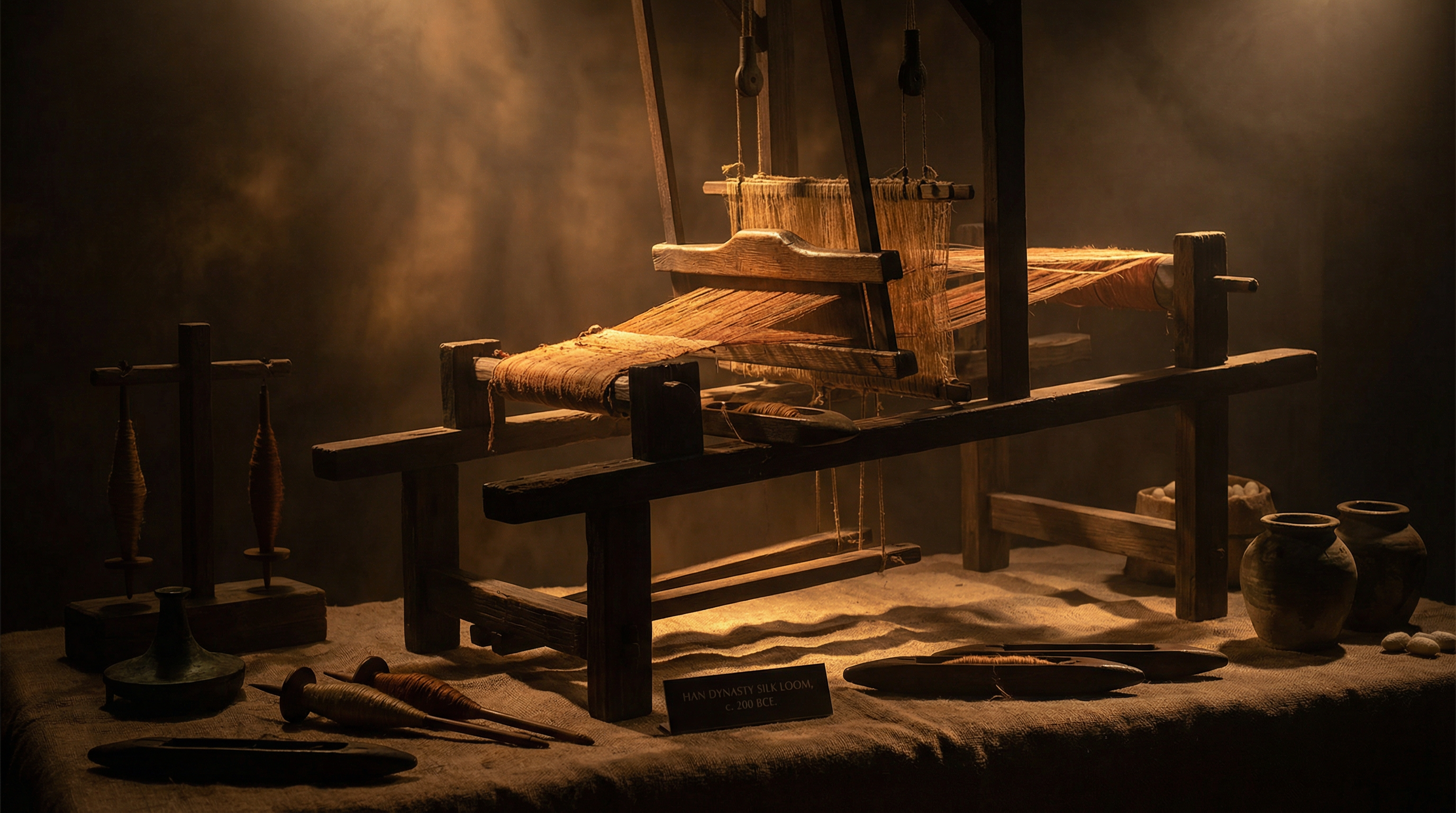
The true marvel of Han Dynasty silk production lies not just in the cultivation of the silkworm, but in the sophisticated weaving technology employed. While simple looms could produce plain weaves, the Han Dynasty textiles frequently display complex, multi-coloured patterns – intricate geometric designs, mythical creatures, and elaborate calligraphic motifs. These patterns were not painted or embroidered; they were *woven* directly into the fabric, thread by painstaking thread.
Modern textile analysis of these ancient fragments has revealed a startling truth: many of these patterns could only have been achieved using a drawloom. A drawloom is a highly complex mechanical device that allows for the individual manipulation of warp threads, enabling the weaver to create intricate patterns that extend beyond the simple repeats of a standard loom. What makes the Han drawlooms truly extraordinary is the sheer number of warp threads that could be independently controlled. Some Han silk fragments exhibit patterns requiring over 1,000 heddles – the individual loops or wires that lift and lower warp threads. This means that a single Han drawloom could potentially manipulate thousands of threads simultaneously to create its elaborate designs.
To put this into perspective, the drawloom technology capable of weaving such complex, multi-colour patterns with thousands of threads was not developed in Europe until the 18th century, with the innovations leading to the Jacquard loom. This places Han Dynasty textile engineering more than 1,500 years ahead of its Western counterparts. The operation of such a loom would have required not only immense skill from the weaver but also a "drawboy" or "drawgirl" to manually pull the required pattern cords, coordinating their actions with the weaver in a ballet of precision and patience. The sheer mechanical complexity implies a deep understanding of engineering principles, a sophisticated division of labor, and a remarkable capacity for innovation that challenges our conventional understanding of ancient technology.
The Secret Keeper: Competing Theories and Scholarly Debate
The enduring mystery surrounding Han Dynasty silk production primarily revolves around the exact nature of their drawlooms. While the textile evidence is undeniable, physical remains of these complex looms are scarce. Wood, the primary material for looms, rarely survives centuries of decay. Therefore, much of our understanding is based on archaeological inference, historical texts, and comparative analysis with later loom technologies.
Scholars debate the precise mechanisms of the Han drawloom. Were they truly as complex as the Jacquard-like systems, or did they employ a more manual, yet still highly sophisticated, system of pattern control? Some theories suggest that early drawlooms might have been operated by multiple assistants, each responsible for a section of the pattern, while others posit that more ingenious mechanical solutions were already in place. The debate also extends to the scale of production. Was this highly specialized weaving confined to imperial workshops, or was there a broader dissemination of this advanced technology? The sheer volume of silk traded along the Silk Road suggests a significant production capacity, hinting at a well-organized and technologically advanced industry.
The most famous "breach" of China's silk monopoly occurred in 552 CE, when, according to Procopius, two Nestorian monks smuggled silkworm eggs out of China to Constantinople for the Byzantine Emperor Justinian. This event is often cited as the end of China's 3,000-year control over silk production. However, while European sericulture began, the quality and complexity of Byzantine and later European silk never truly matched the intricate patterns and fine texture of Han Dynasty textiles. This disparity further underscores the unique technological advantage held by the Chinese, suggesting that the secret was not just the silkworm, but the entire ecosystem of cultivation, processing, and advanced weaving.
Challenging the Narrative: Why This Defies Conventional History
The Han Dynasty's mastery of drawloom technology profoundly challenges conventional historical narratives, particularly those that often place the origins of complex machinery and industrial innovation firmly in the European Renaissance and Industrial Revolution. The evidence of Han silk production forces us to reconsider the timeline and geographical distribution of advanced engineering. It demonstrates that highly sophisticated mechanical devices, capable of automating intricate tasks, existed in East Asia more than a millennium before similar developments in the West.
This technological leap in textile production highlights a forgotten chapter of ingenuity and craftsmanship. It suggests a culture that valued precision, aesthetic complexity, and the systematic application of knowledge to achieve unparalleled results. The Han drawloom is not merely an artifact; it is a symbol of an advanced technological civilization, one that meticulously guarded its innovations and leveraged them to create an economic empire. It compels us to look beyond Eurocentric views of technological progress and appreciate the diverse centers of innovation that shaped the ancient world.
A Thread Through Time: Lasting Significance
The legacy of Han Dynasty silk production is multifaceted and enduring. Economically, it created and sustained the Silk Road, fostering cultural exchange and shaping the economies of vast swathes of Eurasia for over a thousand years. Politically, it was a tool of imperial power, a symbol of wealth and prestige that solidified China's position as a dominant force. Artistically, the intricate patterns and vibrant colors of Han silk represent a pinnacle of textile design, influencing aesthetics across continents.
Technologically, the Han drawloom stands as a testament to the ingenuity of ancient engineers. It reminds us that "ancient" does not equate to "primitive," and that complex machinery and sophisticated manufacturing processes have deep roots in human history. The "secret" of silk was far more than just the silkworm; it was the entire integrated system of sericulture, dyeing, and, crucially, the advanced weaving technology that transformed raw fibers into masterpieces. The ghost of these magnificent looms, though largely unseen, continues to whisper tales of unparalleled skill and innovation, forever woven into the fabric of our understanding of the ancient world.
Marcus Hale
Independent Researcher & Archive Curator
Marcus Hale is an independent researcher and the curator of The Forbidden Archive. He has spent over a decade studying anomalous ancient technologies, cross-referencing primary excavation reports, museum catalogues, and peer-reviewed journals to document artifacts that mainstream history struggles to explain.
Competing Theories
The secret of silk production (silkworm cultivation) was guarded by China for 3,000 years. When Justinian smuggled silkworm eggs to Constantinople in 552 CE, it ended China's monopoly but European production never matched Chinese quality.



Archive Record
Civilization
Han Dynasty China
Time Period
Classical Antiquity
Approximate Date
c. 206 BCE – 220 CE
Origin
China
Current Location
Various museum collections
Materials
Silk, bronze looms