Maya Civilization · Classical Antiquity
Maya Blue Pigment
4 min read
Last updated March 26, 2026
Maya Blue is an ancient pigment of extraordinary durability that has resisted 1,200 years of tropical humidity, acid, and alkali — a chemical stability not understood until modern nanotechnology analysis.
Also in This Category

Choose your reading style:

By Marcus Hale
Independent Researcher & Archive Curator
The Azure Enduring: Unpacking Maya Blue's Nanoscale Secrets
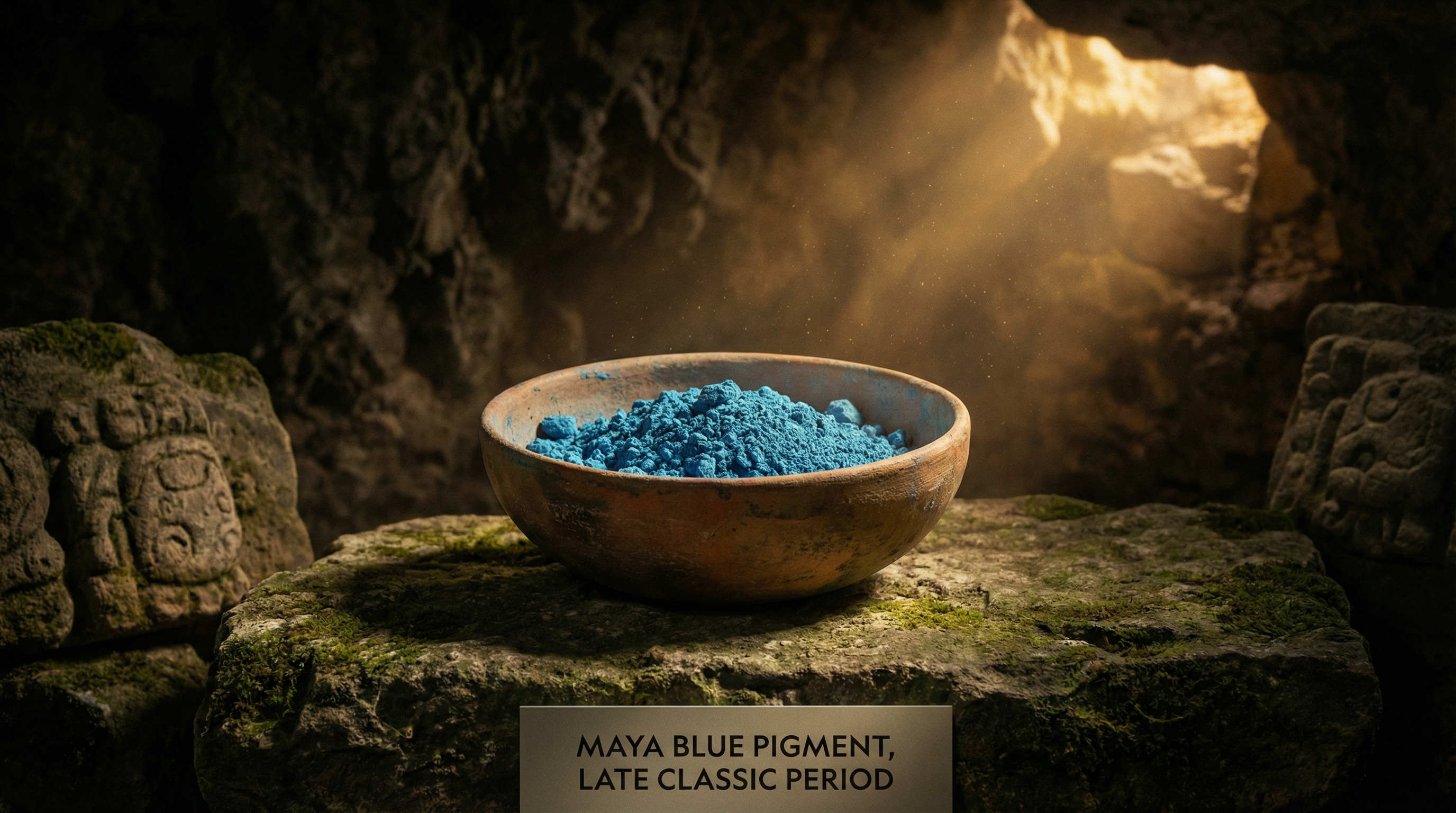
Circa 800 CE, amidst the verdant heartlands of Mesoamerica, a technological marvel was already centuries in the making. It was not a grand temple or an intricate calendar, but a pigment – a vibrant, almost impossibly stable blue that would defy the relentless march of time and the corrosive forces of a tropical environment for over a millennium. This was Maya Blue, a color that adorned murals, pottery, and ritualistic offerings, its brilliance undimmed by the passage of twelve hundred years. Its resilience, a profound mystery to early archaeologists and chemists alike, has only recently begun to yield its secrets, revealing an ancient understanding of material science that predates modern nanotechnology by an astonishing margin.
A Hue Forged in Fire and Clay
The creation of Maya Blue was no simple mixing of colors. It involved a sophisticated process, a deliberate alchemy that transformed humble ingredients into a substance of unparalleled durability. The primary components were indigo, a natural organic dye derived from plants, and palygorskite, a unique fibrous clay. The genius of the Maya lay in their empirical discovery that by heating these two disparate materials together, they could induce a profound chemical and structural transformation. This was not a casual observation but a controlled process, likely refined over generations, to achieve a consistent and predictable outcome.
The indigo, when subjected to heat in the presence of palygorskite, undergoes a remarkable molecular rearrangement. The organic indigo molecules become intercalated within the intricate, porous structure of the palygorskite clay. This interlocking creates a hybrid material, an organic-inorganic composite at a scale so minute it remained invisible to scientific scrutiny until the advent of advanced analytical techniques. This nanoscale integration is the bedrock of Maya Blue's legendary stability.
Durability Beyond Expectation: The Nanocomposite Revelation
For centuries, the extraordinary resistance of Maya Blue to environmental degradation baffled scientists. Unlike other natural pigments that fade, degrade, or react with acids and alkalis, Maya Blue remained stubbornly vibrant. It withstood the humid, acidic conditions of the jungle, the alkaline treatments of archaeological conservation, and even harsh chemical solvents. This chemical inertness was a puzzle that traditional chemistry struggled to solve.
The breakthrough came with the application of modern nanotechnology. Using techniques such as X-ray diffraction, transmission electron microscopy, and nuclear magnetic resonance, researchers were finally able to peer into the atomic and molecular architecture of Maya Blue. What they discovered was nothing short of revolutionary: Maya Blue is an ancient nanocomposite. The indigo molecules are not merely adsorbed onto the clay surface; they are deeply embedded within its crystalline lattice, protected and stabilized by the inorganic matrix. This encapsulation prevents the organic dye from reacting with external agents, effectively shielding it from degradation.
This revelation reclassified Maya Blue from a mere pigment to an advanced material. The Maya, through their meticulous experimentation and observation, had stumbled upon principles of materials science that would not be formally understood or replicated in the Western world until the late 20th and early 21st centuries. Their empirical knowledge allowed them to engineer a material with properties superior to many synthetic pigments developed much later.
Beyond the Palette: The Cultural Resonance of an Enduring Hue
The significance of Maya Blue extends far beyond its chemical properties. Its creation speaks volumes about the Maya's sophisticated understanding of their natural world and their ability to innovate. This wasn't merely about creating a pretty color; it was about creating a durable one, a color that could withstand the rigors of time and climate, ensuring that their artistic and ritualistic expressions would endure.
The pigment was used extensively in Maya art, adorning murals in temples and palaces, painting pottery, and even applied to sacrificial victims in certain rituals, suggesting a profound symbolic importance. Its widespread use and consistent quality across different sites indicate a shared knowledge and perhaps even a standardized production process. The ability to produce such a stable and vibrant blue would have been a source of prestige and power, reflecting the advanced scientific and technological capabilities of the Maya civilization.
The continued study of Maya Blue offers invaluable insights into ancient technological practices and challenges our modern assumptions about the timeline of scientific discovery. It serves as a powerful reminder that complex scientific principles were often understood and applied empirically long before theoretical frameworks were established.
What other ancient materials, currently dismissed as mere curiosities, might hold equally profound nanoscale secrets, awaiting the right technological lens to reveal their true genius?
Marcus Hale
Independent Researcher & Archive Curator
Marcus Hale is an independent researcher and the curator of The Forbidden Archive. He has spent over a decade studying anomalous ancient technologies, cross-referencing primary excavation reports, museum catalogues, and peer-reviewed journals to document artifacts that mainstream history struggles to explain.
Join the Archive
Enjoyed This Mystery?
Get new discoveries like this delivered to your inbox every week. Ancient technologies, lost sciences, and suppressed history — free.
Competing Theories
The discovery that Maya Blue is a nanoscale composite material has led researchers to classify it as an ancient nanocomposite. The Maya's empirical discovery of this technology predates modern materials science by 1,200 years.
Archive Record
Civilization
Maya Civilization
Time Period
Classical Antiquity
Approximate Date
c. 800 CE
Origin
Mesoamerica
Current Location
Various museum collections
Materials
Indigo dye, palygorskite clay