Maya Civilization · Classical Antiquity
Mayan Long Count Calendar
6 min read
Last updated April 4, 2026
The Maya Long Count calendar tracks time across 5,125-year cycles with astronomical precision, incorporating calculations of Venus cycles, lunar months, and solar years that are accurate to within seconds per century.
Choose your reading style:

By Marcus Hale
Independent Researcher & Archive Curator
Echoes of Eternity: Unveiling the Maya's Cosmic Clock
Imagine a civilization, flourishing millennia ago in the dense jungles of Mesoamerica, capable of charting the cosmos with a precision that rivals, and in some cases surpasses, the most advanced astronomical instruments of their European contemporaries. This is not a flight of fantasy, but the profound reality embedded within the intricate carvings and glyphs of the Maya Long Count calendar. Far from a mere system for tracking days, this monumental achievement stands as a testament to an intellectual prowess that challenges our understanding of ancient capabilities. It is a cosmic clock, meticulously calibrated to the rhythms of the universe, capable of tracking time across vast epochs and predicting celestial events with astonishing accuracy. How did a civilization without telescopes, advanced mathematics as we know it, or modern computing achieve such a feat? The answer lies in centuries of dedicated observation, sophisticated mathematical understanding, and a profound connection to the celestial dance above.
Carved in Stone, Written in Time: Historical Context and Discovery
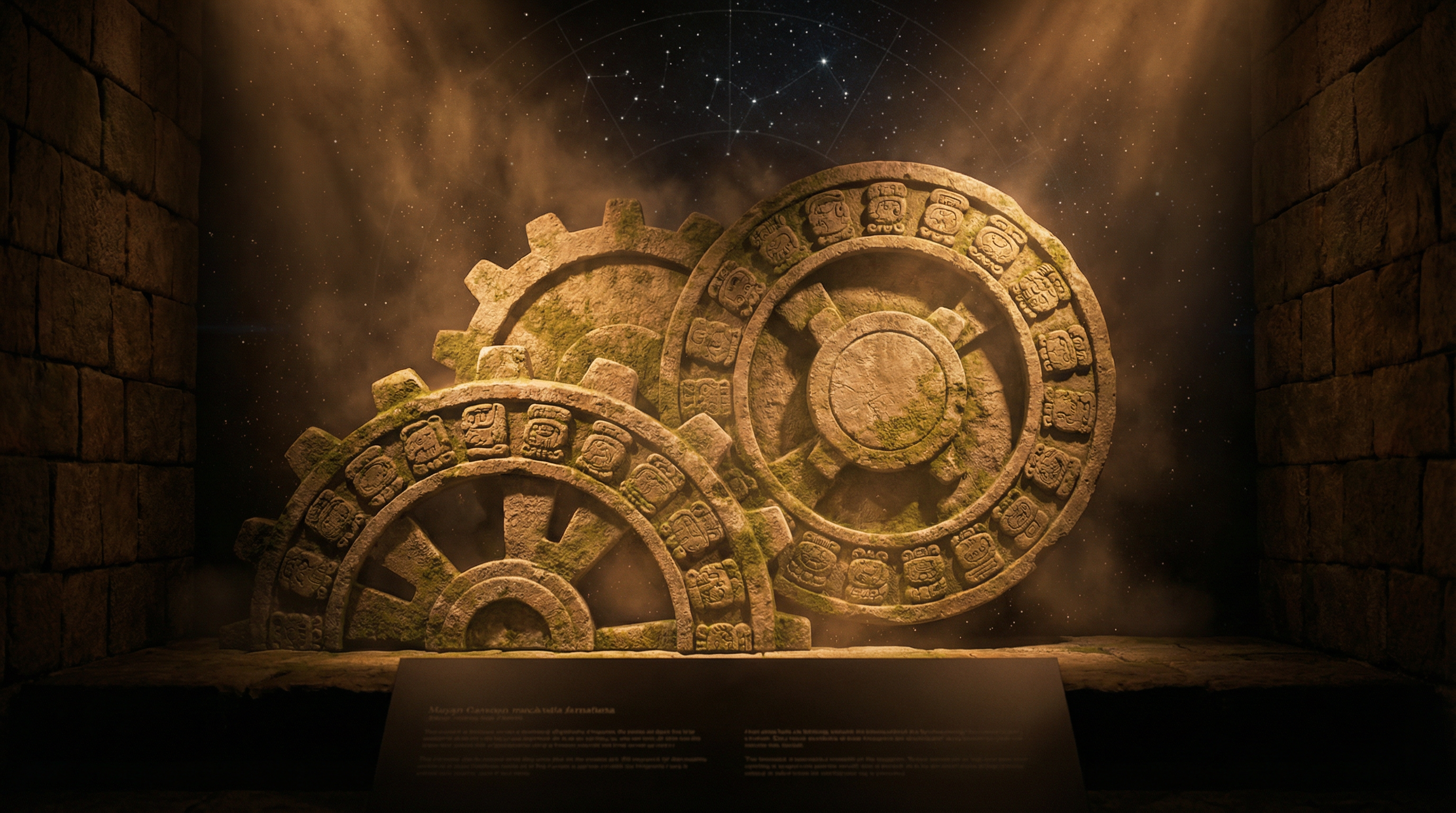
The Maya Long Count calendar, a cornerstone of Maya civilization, emerged and flourished during the Classical Antiquity period, roughly from 250 to 900 CE. Its origins are deeply intertwined with the development of Maya astronomy, mathematics, and religious cosmology. Unlike the cyclical Tzolkin (260-day sacred calendar) and Haab' (365-day civil calendar), which track shorter, repeating cycles, the Long Count provides a linear, non-repeating count of days from a mythical starting point. This epochal date, 0.0.0.0.0 4 Ahau 8 Cumku, corresponds to August 11, 3114 BCE in the Gregorian calendar, a date long before the Maya civilization as we know it even began to coalesce.
Evidence of the Long Count is primarily found inscribed on monumental stone stelae, altars, and lintels across numerous Maya sites, such as Palenque, Tikal, Copán, and Quiriguá. These inscriptions, often accompanied by elaborate iconography and hieroglyphic texts, detail historical events, royal accessions, and astronomical observations, all anchored by precise Long Count dates. Additionally, codices – bark paper books – like the Dresden Codex, further illuminate the Maya's astronomical knowledge and calendrical calculations. The decipherment of these complex glyphs, a painstaking process spanning centuries, has gradually revealed the astonishing depth of Maya intellectual achievement, bringing to light a system of timekeeping that was both practical and deeply spiritual.
The Unseen Mechanics: Technical Analysis of a Cosmic Marvel
What truly sets the Maya Long Count calendar apart is its breathtaking technical sophistication. It operates on a vigesimal (base-20) system, with each position representing a larger unit of time, save for the second position (uinal), which is 18 x 20 = 360 days to approximate the solar year. The units are: Kin (1 day), Uinal (20 days), Tun (360 days), Katun (7,200 days), and Baktun (144,000 days). A full cycle of the Long Count, often referred to as a "Great Cycle," spans 13 Baktuns, or 1,872,000 days, which equates to approximately 5,125 solar years.
The precision achieved by the Maya in their astronomical calculations is nothing short of astounding. Consider their determination of the Venus synodic cycle – the time it takes for Venus to return to the same position relative to the Sun as seen from Earth. The Maya calculated this at 584 days. Modern astronomy places it at 583.92 days. This seemingly small discrepancy translates to an error of only 0.08 days over 500 years. To put this into perspective, this level of accuracy implies centuries of meticulous, uninterrupted observation and sophisticated mathematical extrapolation, all without the aid of optical instruments.
Furthermore, their lunar calendar was equally remarkable. The Maya calculated the length of the lunar month with an accuracy of 0.0003 days per month. This is a level of precision that surpasses the Julian calendar, which was in use in Europe at the same time and had an error of approximately 11 minutes per year. Such minute deviations suggest a profound understanding of celestial mechanics and a dedication to empirical observation that is truly extraordinary for any ancient civilization.
Beyond the Numbers: Competing Theories and Scholarly Debates
The sheer accuracy of the Long Count calendar has naturally sparked intense scholarly debate and a myriad of theories regarding its underlying principles. While the consensus points to centuries of systematic observation and the development of advanced mathematical concepts (including the concept of zero, which they developed independently), some researchers propose more intriguing possibilities.
One prominent theory suggests that the Long Count calendar encodes astronomical cycles not yet fully understood by modern scholars. Could the Maya have been tracking celestial phenomena with periods far longer than those we currently recognize? The cyclical nature of their worldview, where time was not linear but a series of repeating patterns, lends credence to the idea that they might have sought to align their calendar with grander cosmic rhythms. Some speculate about connections to precession of the equinoxes, or even more obscure celestial alignments that might have held profound cosmological significance for them.
Another area of debate revolves around the practical application of such precision. Was it purely for religious and ceremonial purposes, aligning human events with divine cosmic order? Or did it also serve more pragmatic functions, such as predicting agricultural cycles, navigation, or even long-term climate patterns? The intertwining of Maya science, religion, and daily life makes it difficult to draw clear distinctions, suggesting that the calendar likely served a multifaceted role.
Rewriting the Narrative: Challenging Conventional History
The Maya Long Count calendar fundamentally challenges conventional historical narratives that often place ancient Mesoamerican civilizations in a subordinate position regarding scientific and technological advancement. The prevailing Eurocentric view frequently assumes that such levels of astronomical and mathematical sophistication were the exclusive domain of Old World civilizations. The Maya, however, provide compelling evidence to the contrary.
Their independent development of a complex writing system, advanced mathematics (including positional notation and the concept of zero), and an astronomical calendar of unparalleled accuracy demonstrates a parallel trajectory of intellectual evolution. It forces us to reconsider the notion of "progress" and acknowledge that diverse cultures, operating in isolation, could arrive at equally profound insights into the workings of the universe. The Long Count calendar is not merely an interesting artifact; it is a powerful corrective to historical biases, highlighting the independent genius and intellectual achievements of a civilization that charted its own course through time and space.
A Legacy Etched in the Stars: Lasting Significance
The Maya Long Count calendar stands as one of humanity's most extraordinary intellectual achievements. It is a monumental testament to the power of observation, the elegance of mathematical thought, and the profound human desire to understand our place within the vast cosmic tapestry. Its accuracy, particularly concerning the Venus synodic cycle and the lunar month, continues to astonish and inspire, prompting us to ask deeper questions about the nature of ancient knowledge and the methodologies employed by civilizations long past.
Beyond its technical brilliance, the Long Count calendar offers a window into the Maya worldview – a universe governed by cyclical time, where celestial events were not random occurrences but predictable manifestations of divine order. It reminds us that science and spirituality were often inseparable in ancient cultures, each informing and enriching the other. As we continue to decipher the remaining mysteries encoded within Maya glyphs, the Long Count calendar remains a beacon, illuminating the incredible intellectual legacy of a civilization that looked to the stars and, in doing so, achieved a form of immortality.
Marcus Hale
Independent Researcher & Archive Curator
Marcus Hale is an independent researcher and the curator of The Forbidden Archive. He has spent over a decade studying anomalous ancient technologies, cross-referencing primary excavation reports, museum catalogues, and peer-reviewed journals to document artifacts that mainstream history struggles to explain.
Competing Theories
The precision of Maya astronomical calculations implies centuries of systematic observation and record-keeping. Some researchers argue the Long Count calendar encodes astronomical cycles not fully understood by modern scholars.


Archive Record
Civilization
Maya Civilization
Time Period
Classical Antiquity
Approximate Date
c. 250–900 CE
Origin
Mesoamerica
Current Location
Various museum collections
Materials
Stone, bark paper