Mughal India · Early Modern
Jantar Mantar Observatory
6 min read
Last updated April 4, 2026
A collection of 19 architectural astronomical instruments built by Maharaja Jai Singh II, capable of measuring time to within 2 seconds and predicting eclipses with remarkable accuracy.
Choose your reading style:

By Marcus Hale
Independent Researcher & Archive Curator
Jantar Mantar: Mughal India's Celestial Symphony in Stone
Imagine a time before digital clocks, before GPS, before satellites charted the heavens. A time when the precise movements of celestial bodies were not just a scientific pursuit, but a matter of state, religion, and survival. Now, imagine an observatory, not of gleaming brass and telescopic lenses, but of colossal stone structures, each an instrument of breathtaking scale and precision, capable of measuring time to within two seconds and predicting eclipses with uncanny accuracy. This is not a scene from a forgotten science fiction novel, but the reality of Jantar Mantar, a collection of astronomical observatories built in Mughal India. These monumental structures stand as a testament to an advanced understanding of the cosmos, challenging our conventional notions of ancient technology and revealing a sophisticated scientific tradition that flourished centuries ago.
Historical Background and Discovery Context
The Jantar Mantar observatories, a name derived from the Sanskrit "Yantra Mantra" meaning "instruments and formulae," were constructed in the early 18th century by Maharaja Jai Singh II, the visionary Rajput ruler of Amber (later Jaipur). A polymath and passionate astronomer, Jai Singh II was deeply disturbed by the inaccuracies in the astronomical tables of his time. He was well-versed in both Indian and Islamic astronomical traditions, and his ambition was to create new, more precise instruments that would reconcile these discrepancies and provide accurate data for calendrical reforms, astrological predictions, and timekeeping.
Between 1724 and 1735, Jai Singh II commissioned five such observatories across northern India: in Delhi, Jaipur, Ujjain, Mathura, and Varanasi. While the Mathura observatory has largely disappeared, the others remain, with the Jaipur site being the largest and best preserved. These observatories were not merely academic curiosities; they were state-of-the-art scientific facilities, reflecting a deliberate effort to advance astronomical knowledge and apply it for practical purposes. Jai Singh II even sent scholars to Europe and Persia to study their astronomical practices, demonstrating an open-minded approach to scientific inquiry that transcended geographical and cultural boundaries.
Technical Analysis and What Makes It Remarkable
The genius of Jantar Mantar lies in its unique approach to astronomical measurement. Instead of relying on small, delicate instruments, Jai Singh II opted for monumental, fixed structures made of stone and marble. This design choice was deliberate: the sheer size of the instruments minimized observational errors inherent in smaller devices, allowing for unprecedented accuracy. The observatories house a collection of 19 primary instruments, each with a specific function.
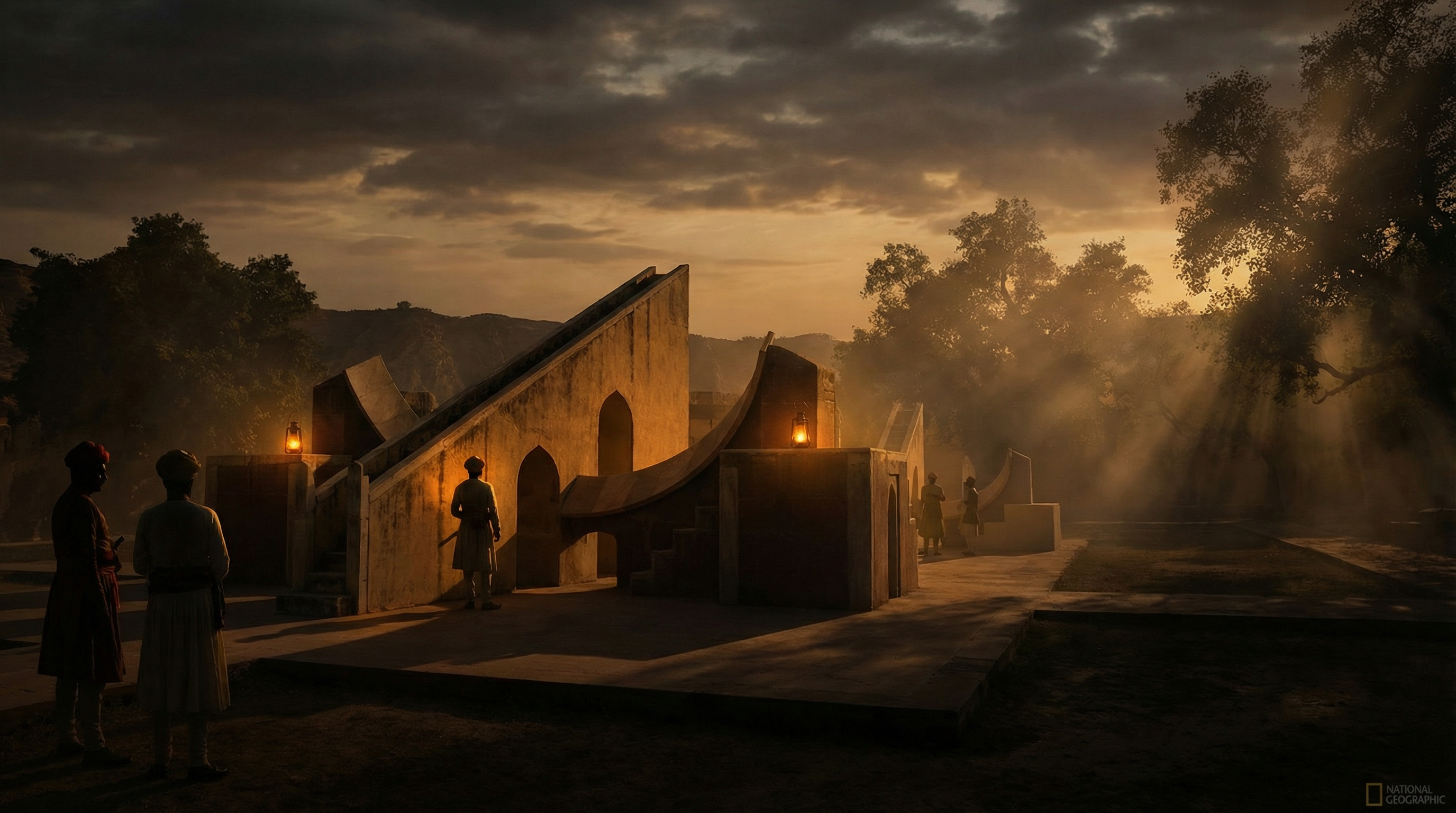
The undisputed star of Jantar Mantar is the Samrat Yantra, or "Supreme Instrument." This colossal sundial, standing nearly 73 feet (22 meters) high, is the largest sundial in the world. Its gnomon, a ramp-like structure aligned with the Earth's axis, casts a shadow that moves across two quadrants, each precisely calibrated. The precision of the Samrat Yantra is astounding: it can measure local time to an accuracy of two seconds. This level of temporal resolution was virtually unparalleled in its era, rivaling and in some aspects surpassing the capabilities of contemporary European observatories.
Other remarkable instruments include the Jai Prakash Yantra, two hemispherical bowls sunk into the ground, representing the celestial sphere, used to determine the position of celestial bodies. The Rama Yantra, a pair of cylindrical structures, measured the altitude and azimuth of stars. The Misra Yantra, or "Mixed Instrument," could determine the shortest and longest days of the year and even tell the time in different cities around the world. The sheer scale and ingenious design of these instruments allowed for direct observation and calculation, without the need for complex telescopic optics, demonstrating a profound understanding of spherical trigonometry and celestial mechanics.
Competing Theories and Scholarly Debate
While the construction and purpose of Jantar Mantar are well-documented, scholarly debate often centers on the origins of the mathematical principles underpinning its design. One prominent theory posits a strong continuity with ancient Indian astronomical traditions. Many of the instruments and their underlying mathematical concepts can be traced back to texts like the Surya Siddhanta, an ancient Indian astronomical treatise dating back possibly to the 4th or 5th century CE, and other Siddhantic literature. These texts detail sophisticated methods for calculating planetary positions, eclipses, and time, suggesting a rich astronomical heritage spanning thousands of years.
Some scholars argue that Jai Singh II's innovations were primarily a refinement and monumentalization of existing Indian knowledge, rather than a radical departure. They point to the fact that the geometric principles employed were deeply embedded in Indian mathematics and astronomy for centuries. Conversely, other scholars emphasize the influence of Islamic and even European astronomy, given Jai Singh II's known interest in these traditions. While he did consult with European Jesuits and Islamic astronomers, the core design principles and the unique monumental scale appear to be distinctly Indian, reflecting a synthesis rather than a mere imitation.
The debate highlights a crucial aspect of scientific history: the interconnectedness of knowledge. Jantar Mantar stands as a powerful example of how different intellectual traditions can converge and inspire new forms of scientific inquiry, yet its fundamental design ethos remains deeply rooted in a long-standing indigenous tradition of celestial observation.
Why This Challenges Conventional Historical Narratives
Jantar Mantar fundamentally challenges the Eurocentric narrative of scientific progress, particularly in the realm of astronomy. For too long, the narrative has often focused on the European Renaissance and the subsequent scientific revolution as the sole progenitors of advanced astronomical instrumentation and theory. Jantar Mantar, however, provides compelling evidence of a sophisticated, independently developed scientific tradition in India that was flourishing concurrently with, and in some aspects, even surpassing, its European counterparts.
The precision achieved by these stone instruments, particularly the two-second accuracy of the Samrat Yantra, demonstrates that advanced scientific methodologies were not exclusive to any single civilization or geographical region. It forces us to reconsider the timeline and geographical distribution of scientific innovation, revealing a more complex and multi-faceted global history of science. The existence of such observatories also dispels the notion that pre-modern Indian science was solely mystical or philosophical; it was intensely practical, observational, and mathematically rigorous.
Furthermore, the sheer scale of the observatories speaks to a significant investment in scientific infrastructure and patronage, indicating that astronomy was a highly valued discipline within the Mughal court and Rajput kingdoms. This level of state support for scientific research is often attributed primarily to European monarchies during the Enlightenment, yet Jantar Mantar proves that such patronage existed elsewhere, fostering environments conducive to groundbreaking scientific endeavors.
Conclusion with Lasting Significance
Jantar Mantar is more than just a collection of ancient instruments; it is a profound monument to human ingenuity, a silent symphony in stone that continues to resonate with scientific wonder. It stands as a powerful reminder of Mughal India's intellectual prowess and its significant contributions to the global tapestry of scientific knowledge. The observatories are not merely historical relics; they are living laboratories, offering insights into the astronomical practices and mathematical sophistication of a bygone era.
Its lasting significance lies in its ability to inspire awe and curiosity, encouraging us to look beyond conventional historical narratives and appreciate the diverse origins of scientific discovery. Jantar Mantar compels us to acknowledge that the pursuit of understanding the cosmos is a universal human endeavor, one that has been undertaken with remarkable brilliance in cultures across the globe. As we gaze upon these colossal instruments, we are transported back to a time when the universe whispered its secrets to those who dared to listen, and who possessed the genius to capture its rhythms in stone.
Marcus Hale
Independent Researcher & Archive Curator
Marcus Hale is an independent researcher and the curator of The Forbidden Archive. He has spent over a decade studying anomalous ancient technologies, cross-referencing primary excavation reports, museum catalogues, and peer-reviewed journals to document artifacts that mainstream history struggles to explain.
Competing Theories
The instruments incorporate mathematical principles from ancient Indian astronomy texts, suggesting continuity with Vedic astronomical traditions spanning thousands of years.

Archive Record
Civilization
Mughal India
Time Period
Early Modern
Approximate Date
c. 1724–1730 CE
Origin
Jaipur, India
Current Location
Jaipur, India (UNESCO World Heritage Site)
Materials
Stone, marble, brass