Song Dynasty China · Medieval
Chinese Astronomical Clock Tower
6 min read
Last updated April 4, 2026
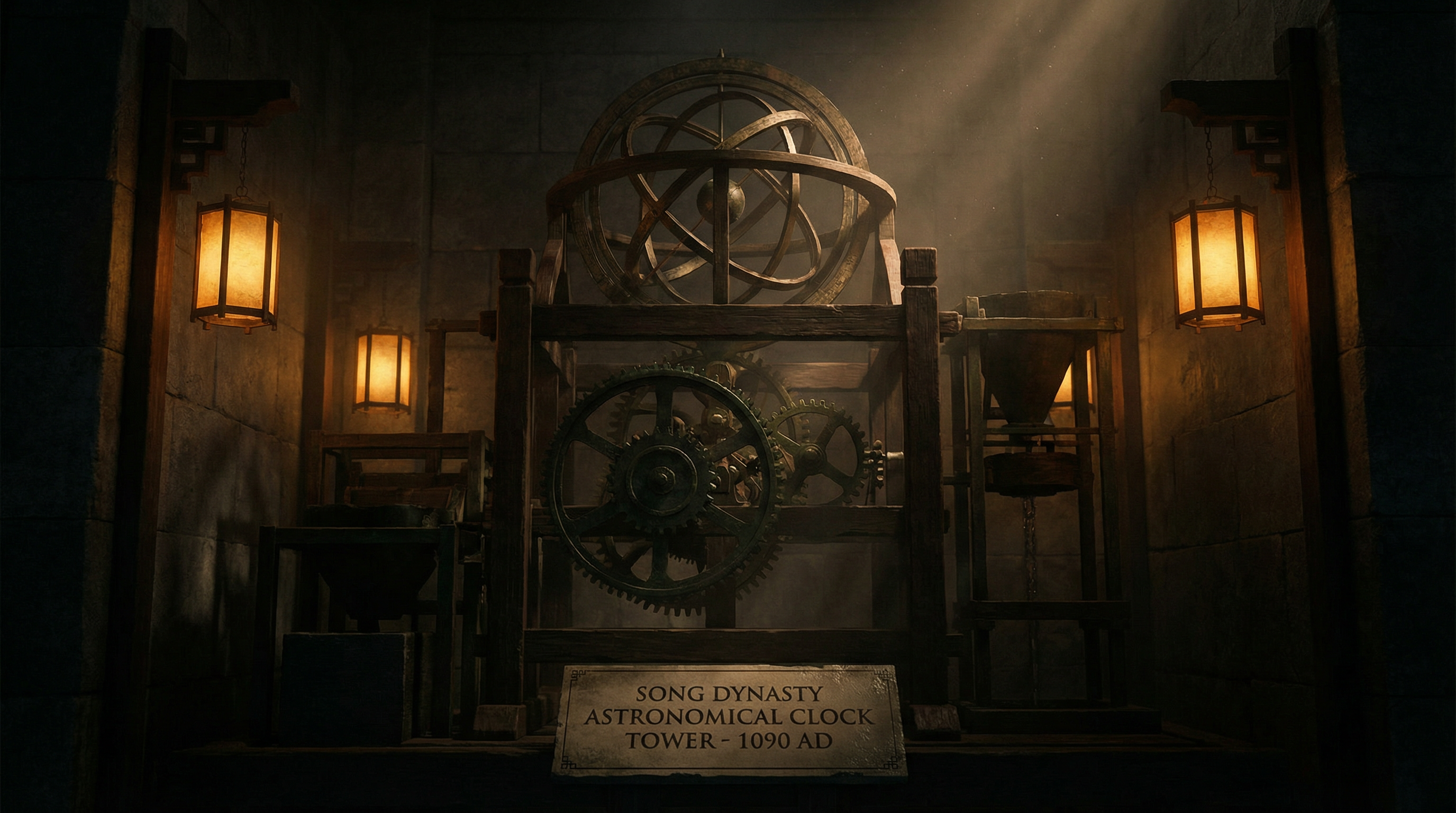
Su Song's astronomical clock tower in Kaifeng was a 10-metre mechanical clock with an escapement mechanism, armillary sphere, and celestial globe — 200 years before European mechanical clocks.
Choose your reading style:

By Marcus Hale
Independent Researcher & Archive Curator
The Echo of Time: A Medieval Marvel Lost to History?
Imagine a world where time was not just told, but observed, predicted, and even celebrated with mechanical precision. A world where the movements of the heavens were mirrored in intricate gears and flowing water, all housed within a towering structure that dominated the skyline. This was not a dream of the Renaissance, but a reality in 11th-century Song Dynasty China. At a time when Europe was still largely relying on sundials and water clocks for rudimentary timekeeping, a brilliant polymath named Su Song unveiled an astronomical clock tower in Kaifeng that would redefine the very concept of mechanical horology. This monumental device, a 10-meter marvel of engineering, boasted an escapement mechanism, an armillary sphere, and a celestial globe – capabilities that would not be matched in the West for another two centuries. Its existence challenges our Eurocentric understanding of technological progress and begs the question: how much of our history remains hidden, waiting to be rediscovered?
A Golden Age of Innovation: Historical Context of Su Song's Masterpiece
The Song Dynasty (960-1279 CE) was a period of extraordinary intellectual and technological flourishing in China. Amidst a vibrant culture of scholarship, invention, and artistic expression, astronomical observation held immense importance. The accurate prediction of celestial events was not merely a scientific pursuit; it was a matter of imperial legitimacy, deeply intertwined with the Mandate of Heaven. It was within this fertile ground that Su Song, a renowned scholar, statesman, and engineer, was commissioned by Emperor Zhezong to construct a new astronomical clock. Completed in 1092 CE, his masterpiece, known as the "Cosmic Engine" or "Water-Powered Astronomical Clock Tower," stood as a testament to Song ingenuity.
The tower was located in the capital city of Kaifeng, a bustling metropolis that was then the largest city in the world. Its sheer scale and complexity were unprecedented. Su Song meticulously documented its construction and operation in his treatise, the Xin Yi Xiang Fa Yao (New Design for an Armillary Sphere and Celestial Globe), a detailed technical manual that, miraculously, has survived to this day. This invaluable document provides us with an extraordinary window into the mind of a medieval genius and the sophisticated engineering practices of his era. Sadly, the clock tower itself did not endure. It was dismantled and moved during political upheavals, eventually falling into disrepair and being lost to time, a casualty of war and neglect.
The Heart of the Machine: Technical Brilliance and Remarkable Precision
What made Su Song's clock tower so revolutionary was its intricate internal mechanism. At its core lay a water-powered escapement system, a device that regulated the release of energy to ensure a constant, precise movement of the gears. This escapement, driven by a continuous flow of water, allowed the clock to keep time with astonishing accuracy, reportedly within seconds per day. This level of precision was unparalleled for its era and would not be achieved in Europe until the 17th century with the advent of pendulum clocks.
Beyond mere timekeeping, the tower was a fully integrated astronomical observatory. It featured a rotating armillary sphere on its top, powered by the clockwork, which allowed observers to visually track the movements of celestial bodies. Inside the tower, a celestial globe, also mechanically driven, displayed the constellations and planetary positions, providing a dynamic model of the cosmos. The clock also had automated figures that emerged from doors at specific intervals, striking gongs and bells to announce the time, much like later European cuckoo clocks. Crafted from bronze, iron, and wood, this colossal machine was a symphony of interconnected parts, each precisely engineered to fulfill its role in the grand cosmic dance it simulated.
The Silk Road Enigma: Debating the Transmission of Knowledge
The striking similarity between Su Song's escapement mechanism and those found in early European mechanical clocks, which began to appear in the late 13th and early 14th centuries, has fueled a long-standing and fascinating scholarly debate. Did European clockmakers independently invent the escapement, or did knowledge of this crucial technology travel westward along the Silk Road? The prevailing Eurocentric narrative often posits independent invention, yet the temporal gap and the functional parallels are difficult to ignore.
Historians like Joseph Needham, a pioneering scholar of Chinese science and civilization, strongly argued for the possibility of knowledge transfer. He pointed out that while direct evidence of a specific blueprint traveling from China to Europe is scarce, the extensive trade and cultural exchange along the Silk Road made such transmission plausible. Ideas, designs, and even skilled artisans could have carried the principles of the escapement across continents. Conversely, some scholars maintain that the European escapement evolved from different mechanical traditions, such as those found in watermills and automata. The lack of a clear "smoking gun" means the debate continues, but the very existence of Su Song's clock forces us to consider a more interconnected and less linear view of technological progress.
Challenging the Narrative: A Paradigm Shift in Historical Understanding
Su Song's astronomical clock tower is more than just an impressive piece of engineering; it is a profound challenge to conventional historical narratives, particularly those that frame the "Scientific Revolution" and the origins of complex machinery as exclusively Western phenomena. For too long, the story of technological advancement has been told with a distinct European bias, often overlooking or downplaying the significant contributions of other civilizations.
The Kaifeng clock demonstrates that sophisticated mechanical engineering, precise timekeeping, and complex astronomical instrumentation were thriving in China centuries before their widespread appearance in Europe. It forces us to reconsider the timeline of global innovation and acknowledge the parallel, and often preceding, developments in the East. This artifact reveals a more nuanced and global history of science and technology, one where ideas flowed in multiple directions, and where brilliance was not confined to a single continent. It reminds us that the seeds of modernity were sown in diverse cultures, often far earlier than commonly acknowledged.
A Legacy of Precision: The Enduring Significance of Su Song's Vision
Although Su Song's magnificent clock tower ultimately succumbed to the ravages of time and conflict, its legacy endures through his meticulous documentation and the ongoing scholarly debate it inspires. Its existence serves as a powerful reminder of the advanced scientific and engineering capabilities of Song Dynasty China. It underscores the fact that the pursuit of knowledge and the desire to understand and harness the cosmos are universal human endeavors, manifesting in remarkable ways across different cultures and eras.
The Celestial Engine of Kaifeng stands as a testament to human ingenuity, a symbol of a lost golden age of Chinese mechanics. It compels us to look beyond familiar narratives and embrace a more inclusive understanding of our shared technological heritage. As we continue to uncover and reinterpret the artifacts of the past, Su Song's astronomical clock tower remains a beacon, illuminating the incredible achievements of ancient civilizations and challenging us to reconsider the true origins of the modern world.
Marcus Hale
Independent Researcher & Archive Curator
Marcus Hale is an independent researcher and the curator of The Forbidden Archive. He has spent over a decade studying anomalous ancient technologies, cross-referencing primary excavation reports, museum catalogues, and peer-reviewed journals to document artifacts that mainstream history struggles to explain.
Competing Theories
Whether European clockmakers independently invented the escapement or learned of it through Silk Road contacts remains debated. The similarity between Su Song's mechanism and early European clocks has led some historians to argue for knowledge transfer.
Archive Record
Civilization
Song Dynasty China
Time Period
Medieval
Approximate Date
c. 1088–1092 CE
Origin
Kaifeng, China
Current Location
Destroyed; described in Su Song's texts
Materials
Bronze, iron, wood