Maya Civilization · Classical Antiquity
Mayan Water Management Systems
6 min read
Last updated April 4, 2026
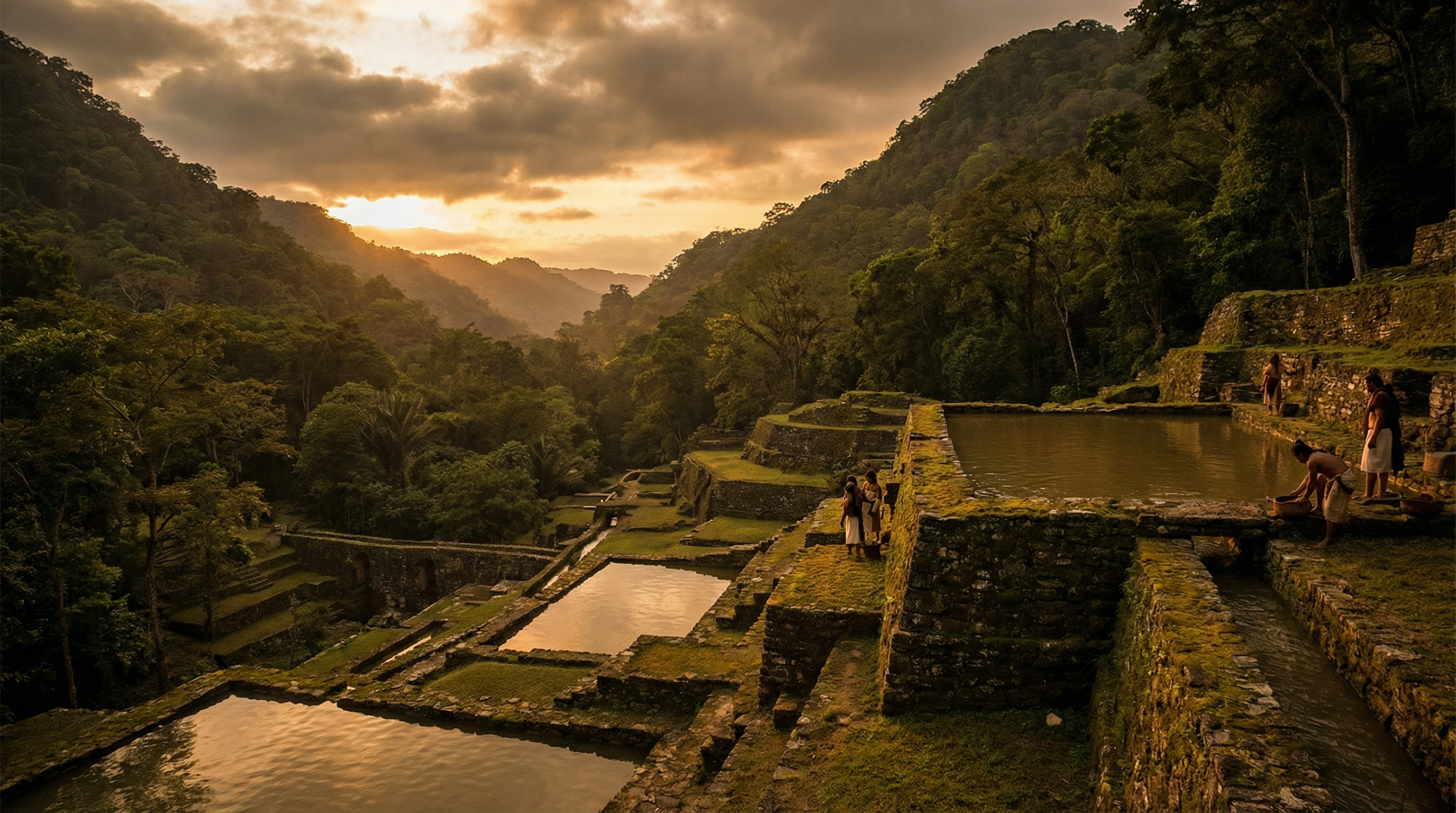
Maya cities in the Yucatan managed water through a network of reservoirs, canals, and filtration systems that supplied cities of 100,000 people in a region with no rivers or surface water.
Choose your reading style:

By Marcus Hale
Independent Researcher & Archive Curator
Welcome to The Forbidden Archive, where we delve into the enigmatic technologies and forgotten wisdom of ancient civilizations. Today, we journey deep into the heart of the Yucatán Peninsula, a land synonymous with towering pyramids, intricate calendars, and a civilization that seemingly vanished. Yet, beneath the dense jungle canopy lies a testament to an engineering marvel that sustained millions: the Maya water management systems. Imagine cities thriving, supporting populations exceeding 100,000, in a region utterly devoid of rivers or natural surface water. How did they achieve this hydrological miracle? The answer lies in a sophisticated network of reservoirs, canals, and filtration systems that not only collected precious rainwater but purified it with a technology that wouldn't be rediscovered by the modern world for millennia.
Historical Background and Discovery Context
For centuries, the dense jungles of the Yucatán kept many secrets of the Maya civilization hidden. Early explorers and archaeologists marveled at the monumental architecture – the temples of Tikal, the observatories of Chichen Itza, the intricate carvings of Palenque. However, the true genius of Maya urban planning, particularly their mastery over water, remained largely overlooked. The prevailing narrative often focused on their astronomical prowess or their complex writing system, while the mundane, yet utterly essential, infrastructure that made their cities possible was treated as secondary. It was only through painstaking archaeological investigation, meticulously mapping the intricate urban landscapes, that the true scale and sophistication of their water systems began to emerge.
The discovery of these systems wasn't a single "eureka!" moment, but rather a gradual unfolding of understanding. As archaeologists excavated major sites like Tikal, they began to uncover an intricate web of plastered channels, berms, and depressions that were clearly designed not for defense or ceremony, but for the collection and storage of water. The sheer volume of water these systems were designed to handle, and the engineering precision required to build them, quickly elevated their significance. This wasn't merely about digging a few wells; it was about transforming an arid landscape into a sustainable metropolis, a testament to an empirical understanding of hydrology that rivals, and in some aspects, surpasses, many contemporary ancient civilizations.
Technical Analysis and What Makes It Remarkable
The Maya water management system was a multi-faceted approach, ingeniously adapted to the unique challenges of the Yucatán. At its core were massive reservoirs, often strategically located in natural depressions or modified quarries. The city of Tikal, a prime example, boasted over 10 major reservoirs with an astonishing collective capacity of approximately 900,000 cubic meters of water. To put this into perspective, that's enough water to fill over 360 Olympic-sized swimming pools. These reservoirs were fed by an extensive network of plastered canals and channels, designed to capture every drop of rainwater during the wet season. These channels often snaked through the urban landscape, diverting runoff from plazas, courtyards, and even rooftops, channeling it towards the storage facilities.
What truly sets the Maya system apart, however, is the evidence of advanced filtration. Recent archaeological discoveries, particularly at Tikal, have revealed the presence of sophisticated filtration beds. These beds were constructed with layers of coarse sand, quartz crystals, and most astonishingly, zeolite. Zeolite is a microporous, aluminosilicate mineral known for its exceptional ability to purify water by removing harmful microbes, heavy metals, and other contaminants. This natural filter was strategically placed at key points within the water network, ensuring that the water flowing into the main reservoirs was not only abundant but also clean and safe for consumption. The use of zeolite for water purification is a technology that was not systematically employed in modern water treatment until the 20th century, making the Maya's application of it truly extraordinary and a testament to their profound empirical knowledge.
Competing Theories and Scholarly Debate
While the physical evidence of these sophisticated water systems is undeniable, the precise nature of the Maya's understanding of water purification, particularly their use of zeolite, remains a subject of scholarly debate. One prevailing theory suggests that the Maya possessed a deep, empirical understanding of the properties of materials like zeolite. Through generations of observation and experimentation, they likely discovered that certain geological formations, when used in conjunction with sand and quartz, produced clearer, healthier water. This would imply a systematic and intentional application of filtration technology, passed down through generations of engineers and urban planners.
Conversely, some scholars argue that while the Maya undoubtedly used these materials, their understanding of the underlying chemical and biological processes of purification might have been more accidental or based on observable outcomes rather than a scientific grasp of microbiology. They might have simply noticed that water filtered through certain types of rock and sand tasted better and led to fewer illnesses, without fully comprehending the microscopic mechanisms at play. However, the consistency of this technology across multiple Maya sites, and its strategic placement within the water networks, strongly suggests a deliberate and informed approach. The debate largely hinges on whether this was an intuitive, experience-based knowledge or a more formalized, proto-scientific understanding.
Why This Challenges Conventional Historical Narratives
The discovery and detailed understanding of the Maya water management systems fundamentally challenges several long-held conventional historical narratives. Firstly, it shatters the romanticized, yet often simplistic, image of ancient civilizations as primitive or lacking in sophisticated engineering. The Maya, in their mastery of hydrology, demonstrate a level of ingenuity and technical prowess that rivals, and in some cases surpasses, their contemporaries in other parts of the world. Their ability to sustain vast urban populations in a challenging environment without modern tools or scientific theories forces a re-evaluation of what ancient societies were truly capable of.
Secondly, it directly confronts the notion that advanced water purification techniques are a purely modern invention. The Maya's use of zeolite, millennia before its rediscovery in the 20th century, highlights a profound disconnect in our understanding of historical technological progression. It suggests that knowledge, once gained, can be lost and rediscovered, and that our linear view of scientific advancement may be overly simplistic. This finding compels us to consider what other "modern" technologies might have had ancient precursors, and what other forgotten wisdom lies buried beneath the sands of time. The Maya's hydrological achievements stand as a powerful testament to human adaptability and intellectual curiosity, reminding us that innovation is not exclusive to any single era or culture.
Conclusion with Lasting Significance
The intricate water management systems of the Maya civilization are more than just an archaeological curiosity; they are a profound statement about human ingenuity, resilience, and the enduring quest for survival. In a region where water was the ultimate currency of life, the Maya engineered a solution that not only sustained their vast cities but elevated their quality of life through the provision of clean, potable water. The discovery of zeolite filtration at Tikal is particularly significant, pushing the boundaries of our understanding of ancient technological capabilities and challenging the very timeline of scientific discovery.
As we continue to face global challenges related to water scarcity and pollution, the lessons from the ancient Maya become increasingly relevant. Their holistic approach to water management – from collection and storage to purification and distribution – offers valuable insights into sustainable urban planning. The Forbidden Archive continues its mission to unearth such forgotten marvels, reminding us that the past is not merely a collection of relics, but a rich repository of knowledge waiting to be rediscovered and applied to the challenges of our present and future. The Maya's hidden hydrology stands as a beacon, illuminating the extraordinary depths of ancient wisdom, and urging us to look deeper, for the solutions to tomorrow's problems may very well lie in the forgotten brilliance of yesterday.
Marcus Hale
Independent Researcher & Archive Curator
Marcus Hale is an independent researcher and the curator of The Forbidden Archive. He has spent over a decade studying anomalous ancient technologies, cross-referencing primary excavation reports, museum catalogues, and peer-reviewed journals to document artifacts that mainstream history struggles to explain.
Competing Theories
The discovery of zeolite filtration at Tikal suggests the Maya had empirical knowledge of water purification. Whether this was systematic or accidental remains debated, but the consistency of the technology across multiple sites suggests intentional use.

Archive Record
Civilization
Maya Civilization
Time Period
Classical Antiquity
Approximate Date
c. 250–900 CE
Origin
Yucatan Peninsula, Mexico and Guatemala
Current Location
Various archaeological sites
Materials
Limestone, plaster, stone