Rashtrakuta Dynasty · Medieval
Kailasa Temple Rock Carving
4 min read
Last updated February 26, 2026
The world's largest monolithic structure, carved from a single basalt cliff by removing 200,000 tonnes of rock — a feat that modern engineers say would take 100 years with current technology.
Also in This Category
Choose your reading style:

By Marcus Hale
Independent Researcher & Archive Curator
The 200,000-Tonne Excavation Mystery
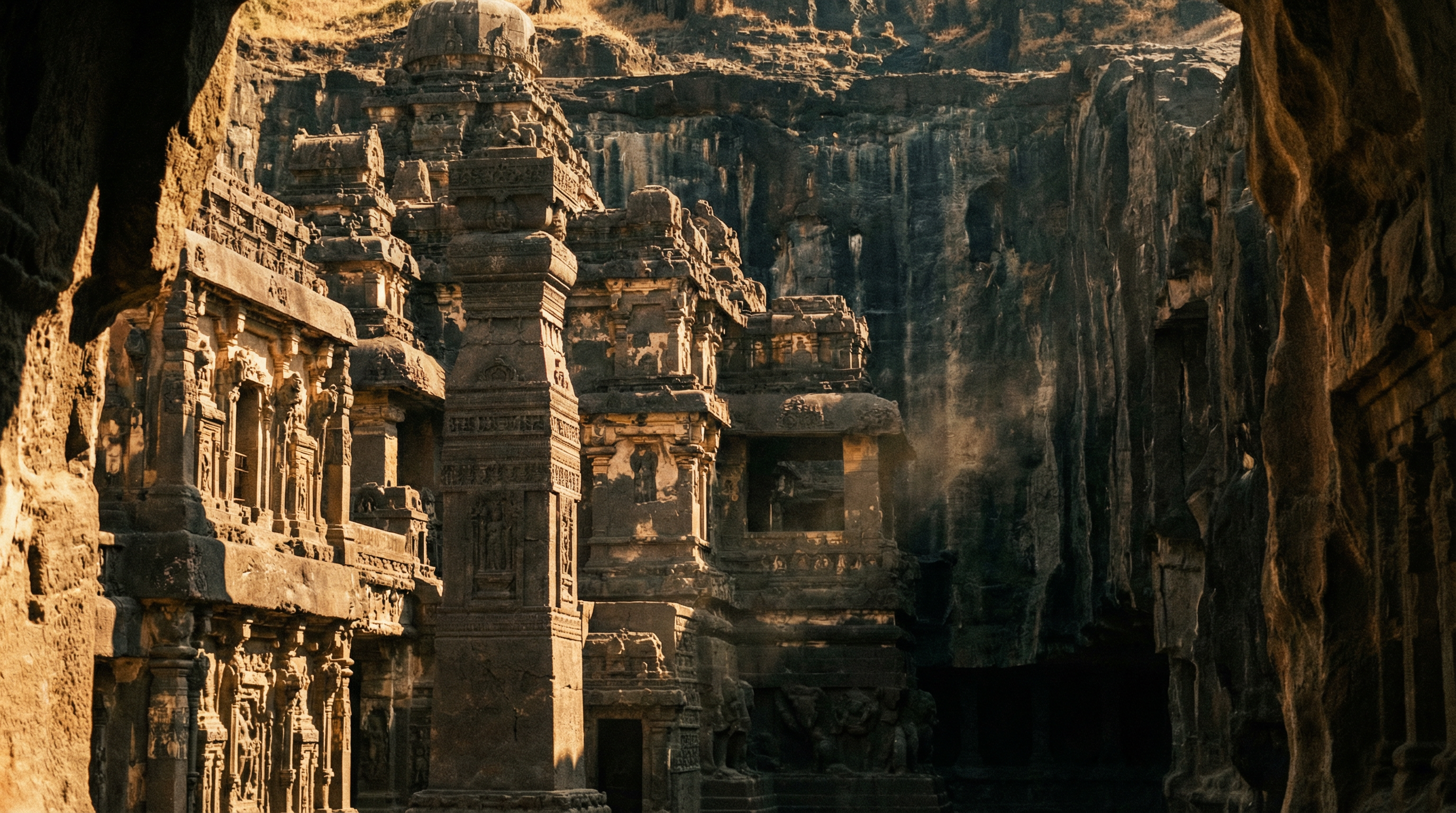
In the arid landscape of Maharashtra, India, a single basalt cliff holds one of the most baffling architectural achievements in human history. The Kailasa Temple at the Ellora Caves is not built; it is carved. Specifically, it was excavated top-down from a solid mountain of rock. To create this massive structure, ancient workers had to remove an estimated 200,000 tonnes of solid basalt. The sheer volume of material removed presents a logistical nightmare that even modern engineers struggle to fully explain.
What makes this site truly unique is the method of construction. Unlike traditional buildings where stones are cut elsewhere and brought to the site to be stacked, the artisans here started at the top of the cliff and worked their way down. This means every intricate carving, every pillar, and every life-sized elephant had to be perfectly planned before the first strike of a chisel. A single mistake would have ruined the entire section, as there was no way to replace a piece of rock once it was removed. Yet, the complex stands today with astonishing precision, covering an area twice the size of the Parthenon in Athens.
Where Did the Debris Go?
One of the most persistent questions surrounding the Kailasa Temple involves the excavated material. Removing 200,000 tonnes of rock is equivalent to digging out roughly 100,000 cubic meters of solid stone. In any modern mining or large-scale excavation project, managing the spoil—the waste material—is a massive undertaking. Yet, around the Ellora site, there is a distinct lack of the expected mountain of construction debris. Where did all that basalt go?
Some researchers suggest the rock was repurposed for other structures in the region, but finding 200,000 tonnes of matching basalt in nearby medieval constructions has proven difficult. Others propose it was dumped into a nearby river, though geological surveys of the riverbed do not entirely support this massive influx of angular, freshly cut stone. The absence of this debris trail adds a layer of complexity to our understanding of the Rashtrakuta Dynasty's project management capabilities during the 8th century.
The 150-Year Timeline Problem
Conventional historical accounts attribute the temple's construction to King Krishna I, who ruled from approximately 756 to 773 CE. This 17-year window presents a severe mathematical problem. Modern civil engineers have calculated that even with 7,000 laborers working 12-hour shifts every single day, extracting that volume of rock using 8th-century tools—iron chisels and hammers—would take at least 150 years. To complete the excavation and the incredibly detailed finishing work in under two decades would require an excavation rate that seems physically impossible for the era.
To put this in perspective, workers would have had to remove roughly 32 tonnes of solid rock every single day, day and night, for 17 years. This calculation does not even account for the time needed to carve the elaborate sculptures of deities, mythical creatures, and complex geometric patterns that cover almost every surface of the temple. The disparity between the historical timeline and the physical reality of the site has led some scholars to propose that the site might be much older, or that the builders possessed excavation techniques that have since been lost to history.
Engineering a Mountain
Beyond the brute force required for excavation, the architectural planning of the Kailasa Temple is staggering. The complex includes a multi-story main temple, numerous shrines, pillared halls, and a massive courtyard, all connected by stone bridges that were left in place as the surrounding rock was cleared away. The drainage system alone is a marvel; channels were cut into the rock to ensure that monsoon rains would flow away from the structure rather than pooling and causing erosion.
Furthermore, the acoustic properties of certain halls within the complex suggest a deep understanding of sound engineering. Chants and prayers echo through the solid rock corridors in ways that amplify specific frequencies. How did medieval architects, working top-down into a solid cliff face, calculate the acoustic resonance of rooms that did not yet exist? The level of spatial awareness required to visualize and execute such a design from a solid block of stone is unparalleled in the ancient world.
Reevaluating Ancient Capabilities
The Kailasa Temple forces us to confront the limitations of our current understanding of ancient engineering. We often assume a linear progression of technology, where older civilizations were inherently less capable than those that followed. However, sites like this suggest that certain specialized skills—particularly in large-scale stone manipulation—may have peaked in antiquity and subsequently been lost.
The precision, the scale, and the sheer audacity of the Kailasa project remain a profound puzzle. As we continue to study the site with modern tools like ground-penetrating radar and 3D laser scanning, we are finding more questions than answers. The temple stands not just as a religious monument, but as a massive, 200,000-tonne question mark carved into the earth.
If modern technology would require over a century to replicate this monolithic structure, what forgotten methods allowed ancient artisans to carve an entire mountain into a masterpiece in less than a generation?
Marcus Hale
Independent Researcher & Archive Curator
Marcus Hale is an independent researcher and the curator of The Forbidden Archive. He has spent over a decade studying anomalous ancient technologies, cross-referencing primary excavation reports, museum catalogues, and peer-reviewed journals to document artifacts that mainstream history struggles to explain.
Join the Archive
Enjoyed This Mystery?
Get new discoveries like this delivered to your inbox every week. Ancient technologies, lost sciences, and suppressed history — free.
Competing Theories
The precision of the carving, the logistics of removing 200,000 tonnes of rock, and the absence of construction debris at the site have led some researchers to question conventional explanations of the temple's construction.
Archive Record
Civilization
Rashtrakuta Dynasty
Time Period
Medieval
Approximate Date
c. 756–773 CE
Origin
Ellora, Maharashtra, India
Current Location
Ellora Caves, Maharashtra (UNESCO World Heritage Site)
Materials
Single basalt rock