Mississippian Culture · Medieval
Mississippian Cahokia Mounds
6 min read
Last updated April 4, 2026
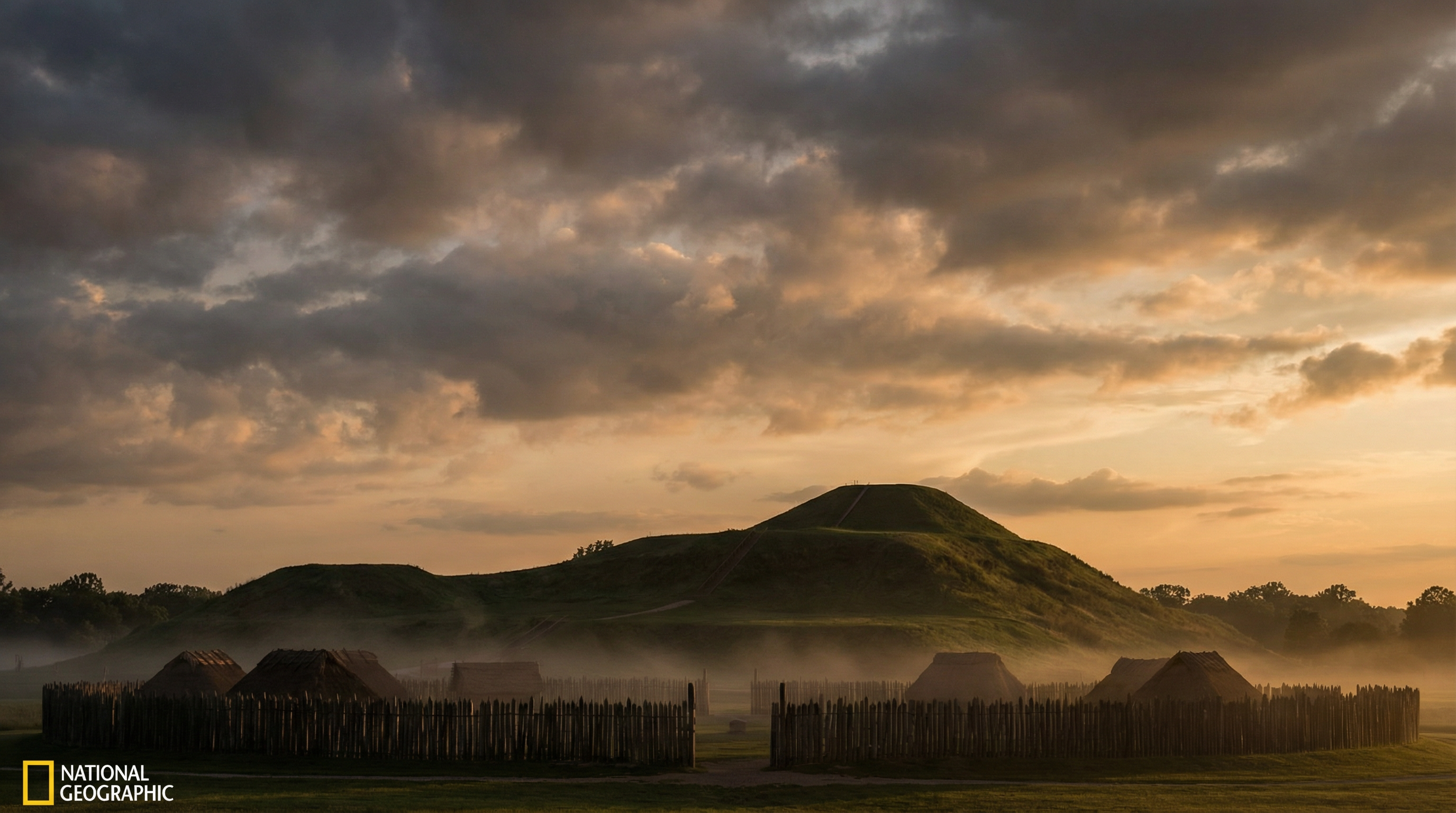
Cahokia was the largest pre-Columbian city north of Mexico, with a population of 20,000 and a central mound larger at its base than the Great Pyramid of Giza — built entirely by hand without metal tools.
Choose your reading style:

By Marcus Hale
Independent Researcher & Archive Curator
Welcome, intrepid explorers of the past, to The Forbidden Archive. Today, we delve into a mystery that challenges our very understanding of pre-Columbian North America – a city of monumental scale, built entirely by hand, that rose and fell with a speed that still baffles archaeologists. We speak of Cahokia, the largest pre-Columbian city north of Mexico, a sprawling urban center that once rivaled the great cities of Europe in population and complexity, yet remains largely unknown to the wider world. Its colossal earthen mounds, meticulously planned urban layout, and sudden abandonment whisper tales of a sophisticated civilization that flourished in the heart of the American Midwest, leaving behind an enduring enigma.
The Rise and Fall of a North American Metropolis
Imagine a bustling city, teeming with 20,000 inhabitants, its skyline dominated by colossal earthen pyramids, some larger at their base than the Great Pyramid of Giza. This was Cahokia, not in ancient Egypt or Mesoamerica, but in what is now Illinois, just across the Mississippi River from modern-day St. Louis. From approximately 1050 CE to 1200 CE, Cahokia was the epicenter of the Mississippian culture, a complex society of mound-builders whose influence stretched across the American Southeast and Midwest. Its discovery, or rather its recognition as a sophisticated urban center, is a relatively recent phenomenon. For centuries, the mounds were seen as natural hills or the work of a less advanced people. It wasn't until systematic archaeological excavations in the 20th century, particularly under the guidance of scholars like Warren K. Moorehead and Melvin Fowler, that the true scale and sophistication of Cahokia began to emerge. These investigations revealed not just isolated mounds, but a meticulously planned city with residential areas, ceremonial plazas, and a complex social hierarchy.
Engineering Marvels Without Metal or Wheel
What makes Cahokia an unparalleled feat of ancient engineering? Consider this: the city's inhabitants, the Mississippians, achieved their monumental constructions without the aid of metal tools, draft animals, or the wheel. Every basket of earth, every timber, every stone was moved and placed by human hands. The sheer scale is staggering. Monks Mound, the largest structure at Cahokia and indeed in North America, covers an astounding 5.6 hectares (14 acres) at its base and rises to a height of 30 meters (100 feet). It contains an estimated 22 million cubic feet of earth – more earth than the Great Pyramid of Giza. This colossal undertaking required an immense labor force, sophisticated organization, and a deep understanding of engineering principles to ensure stability and drainage.
Beyond the sheer volume of earth, Cahokia's urban planning speaks volumes about its builders' advanced knowledge. The city was laid out on a precise grid plan, with major streets and plazas aligned to the cardinal directions. This alignment is not arbitrary; it suggests a deep understanding of astronomy and a worldview where celestial observations played a crucial role in civic and religious life. Evidence of "Woodhenges" – large circles of timber posts used for astronomical observations, particularly solstices and equinoxes – further underscores this sophisticated knowledge. These alignments likely guided agricultural cycles, ceremonial calendars, and even the very layout of the city, implying a powerful priestly class or ruling elite capable of orchestrating such grand designs.
The construction techniques themselves were ingenious. Layers of different soils were carefully chosen and compacted to create stable platforms. The mounds were often built in stages, with new layers added over time, indicating a long-term vision and sustained effort. The sheer logistical challenge of coordinating thousands of laborers, sourcing materials, and maintaining a consistent vision over generations is a testament to the organizational prowess of the Mississippian people.
The Unanswered Questions: Abandonment and Decline
While Cahokia's rise is a marvel, its decline and ultimate abandonment by around 1400 CE present one of archaeology's most enduring mysteries. Why would such a flourishing, complex society simply vanish? Scholarly debate rages, with several compelling theories vying for explanation.
One prominent theory points to environmental factors. Climate change, particularly a period of prolonged drought or increased flooding, could have severely impacted Cahokia's agricultural base, leading to food shortages and resource depletion. The intensive farming practices required to feed such a large population may have also led to soil exhaustion and deforestation, further exacerbating environmental stress.
Another theory focuses on political and social collapse. The immense power and resources concentrated in Cahokia may have led to internal strife, revolts, or the fragmentation of its centralized authority. The burden of maintaining such a large population and monumental construction projects could have become unsustainable, leading to social unrest and a breakdown of order. Evidence of increased fortifications in later periods suggests a growing need for defense, hinting at external threats or internal conflict.
Epidemic disease is also a strong contender. While direct evidence is scarce, the close living quarters of a dense urban population would have been fertile ground for the rapid spread of infectious diseases. A devastating plague could have decimated the population, leading to the collapse of social structures and the eventual abandonment of the city.
It is also possible that a combination of these factors, a perfect storm of environmental, social, and biological pressures, led to Cahokia's demise. The exact sequence and interplay of these events remain a subject of intense research and speculation.
Challenging Conventional Narratives
Cahokia profoundly challenges conventional historical narratives about pre-Columbian North America. For too long, the prevailing view depicted indigenous peoples as primarily nomadic hunter-gatherers or living in small, scattered settlements. Cahokia shatters this misconception, revealing a highly organized, urbanized society with sophisticated engineering, astronomical knowledge, and complex social structures. It demonstrates that monumental architecture and urban planning were not exclusive to the "Old World" or Mesoamerica, but were also a hallmark of indigenous civilizations in North America.
The existence of Cahokia forces us to reconsider the scale of human achievement and societal complexity that existed on this continent before European contact. It highlights the vast knowledge and ingenuity of the Mississippian people, whose accomplishments often go unacknowledged in broader historical contexts. Cahokia stands as a testament to their ability to transform their environment, organize vast labor forces, and create a thriving urban center that was, for a time, the largest city in North America.
A Legacy of Earth and Enigma
The colossal earthen mounds of Cahokia stand as silent sentinels, enduring monuments to a forgotten civilization. They are a powerful reminder that history is far more complex and multifaceted than often portrayed, filled with unexpected brilliance and profound mysteries. The unanswered questions surrounding Cahokia's rise and fall continue to fuel archaeological inquiry, pushing the boundaries of our understanding of ancient societies.
Cahokia's legacy is not just in its physical remains, but in the intellectual challenge it presents. It compels us to look beyond Eurocentric narratives and appreciate the rich tapestry of human history across all continents. As we continue to uncover its secrets, Cahokia serves as a vital link to a vibrant, sophisticated past, urging us to recognize the extraordinary achievements of the Mississippian people and the enduring power of human ingenuity, even without the tools we often deem essential. The Forbidden Archive will continue to explore such profound enigmas, shedding light on the hidden chapters of our shared human story.
Marcus Hale
Independent Researcher & Archive Curator
Marcus Hale is an independent researcher and the curator of The Forbidden Archive. He has spent over a decade studying anomalous ancient technologies, cross-referencing primary excavation reports, museum catalogues, and peer-reviewed journals to document artifacts that mainstream history struggles to explain.
Competing Theories
Cahokia's sudden rise and equally sudden abandonment (by 1400 CE) remains unexplained. Theories include climate change, political collapse, and epidemic disease. The city's astronomical alignments suggest a priestly class with sophisticated knowledge.
Archive Record
Civilization
Mississippian Culture
Time Period
Medieval
Approximate Date
c. 600–1400 CE
Origin
Illinois, USA
Current Location
Cahokia Mounds State Historic Site, Illinois (UNESCO World Heritage Site)
Materials
Earth