Chola Empire · Medieval
Brihadeeswarar Temple Engineering
5 min read
Last updated February 24, 2026
A 66-metre granite temple tower built without mortar, featuring an 80-tonne capstone at its apex that was raised using a ramp system stretching 6 kilometres.
Also in This Category

Choose your reading style:

By Marcus Hale
Independent Researcher & Archive Curator
The 1010 CE Granite Marvel of Thanjavur
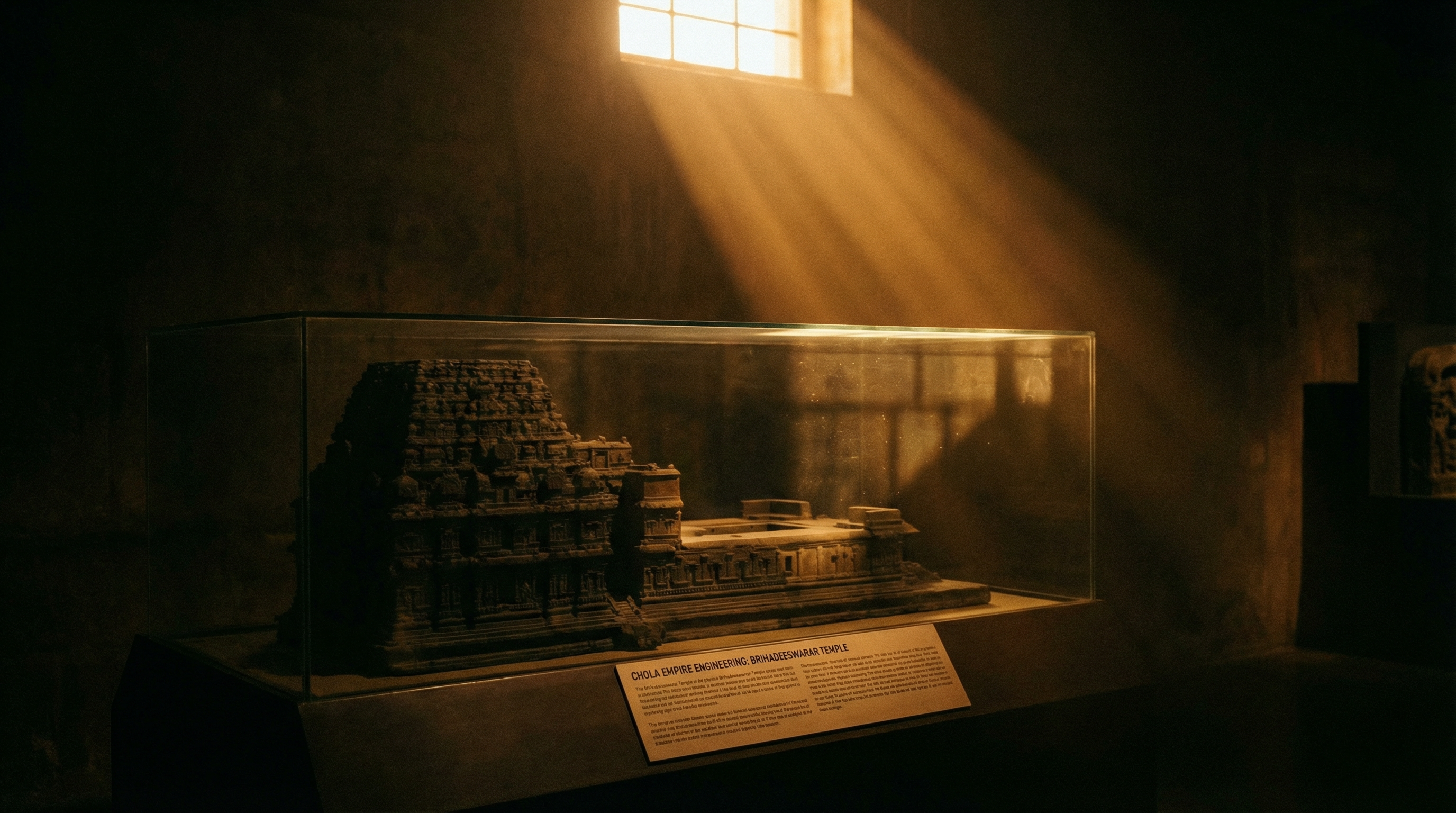
In the year 1010 CE, the Chola Empire completed a structure that defied the standard engineering practices of the medieval world. Rising 66 meters into the sky above Thanjavur, India, the Brihadeeswarar Temple tower was constructed entirely of granite, without a single drop of mortar holding its massive blocks together. This precision-engineered interlocking stone system has survived over a millennium of seismic activity, outlasting countless modern structures.
The scale of the project challenges our understanding of 11th-century logistics, as the temple builders transported an estimated 130,000 tons of granite to the site, despite the fact that the nearest granite quarry was located 50 kilometers away. The effort required to move these stones across the landscape, let alone hoist them into precise positions, points to a highly organized and mathematically advanced civilization.
The logistics of moving 130,000 tons of granite over 50 kilometers in 1010 CE is staggering. Assuming a cart could carry one ton, and a trip took a week, it would require a massive fleet of carts and draft animals operating continuously for years just to transport the raw materials. Furthermore, the granite had to be quarried, shaped, and polished before it could be used. The manpower required for this operation suggests a highly centralized state with the ability to mobilize and sustain a massive workforce over an extended period.
The Chola Empire, under the reign of Rajaraja I, clearly possessed the resources and the organizational capacity to undertake such a monumental project. The temple stands not only as a religious monument but also as a demonstration of imperial power and administrative efficiency.
The 80-Ton Capstone Mystery
The most puzzling aspect of the Brihadeeswarar Temple sits at its very apex. An 80-ton solid granite capstone crowns the 66-meter tower. Placing a stone of this magnitude at such a height without modern cranes or hydraulic lifts remains a subject of intense analysis among modern structural engineers.
The prevailing theory suggests the Chola engineers constructed an earthen ramp to drag the capstone to the top. However, to maintain a manageable gradient of 1:100 for hauling 80 tons, this ramp would have needed to stretch approximately 6 kilometers from the base of the temple. The volume of earth required to build a 6-kilometer ramp, and the subsequent effort to dismantle it, represents an engineering feat almost as impressive as the temple itself.
Consider the logistics of constructing such a ramp. It would require millions of cubic meters of earth, which would have to be excavated, transported, and compacted to create a stable surface capable of supporting the immense weight of the capstone and the hundreds of workers needed to haul it. The ramp would also need to be carefully graded to ensure a consistent incline, as any sudden changes in slope could cause the stone to slip or become stuck.
The process of hauling the stone up the ramp would have been a massive undertaking, requiring precise coordination and immense physical effort. It is estimated that hundreds of men, and perhaps elephants, would have been needed to pull the stone up the incline. The fact that they were able to successfully maneuver an 80-ton block of granite to a height of 66 meters using only human and animal power highlights their ingenuity and determination.
Interlocking Precision and Seismic Resilience
The structural integrity of the Brihadeeswarar Temple relies entirely on the precise cutting and placement of its granite blocks. By employing a complex system of interlocking joints, the builders created a structure capable of absorbing and distributing the energy from earthquakes. This dry-masonry technique allowed the tower to flex slightly during seismic events, preventing the catastrophic failures common in rigid, mortar-bound buildings.
Modern architects often study the temple's foundation and weight distribution. The wide base and tapering design of the tower ensure that the immense downward pressure of the 80-ton capstone actually reinforces the interlocking stones, pressing them more firmly together rather than pushing them apart. This demonstrates a profound empirical understanding of physics and load-bearing dynamics.
The use of interlocking stones is a highly sophisticated construction technique that requires precise mathematical calculations and expert craftsmanship. Each stone must be carved to exact dimensions to ensure a perfect fit with its neighbors. The builders of the Brihadeeswarar Temple achieved a level of precision that is rarely seen in modern masonry, let alone in a structure built over a thousand years ago.
Reevaluating Medieval Indian Engineering
The Brihadeeswarar Temple forces a reevaluation of the technological capabilities of medieval Indian empires. The Chola dynasty did not merely build a place of worship; they executed a masterclass in material science, logistics, and structural engineering. The precision required to carve interlocking granite—one of the hardest stones available—using only iron chisels and wooden mallets speaks to a highly refined tradition of craftsmanship.
The construction of the temple also highlights the advanced state of mathematical and astronomical knowledge in medieval India. The layout of the temple complex is based on precise geometric principles, and the orientation of the main shrine is aligned with the cardinal directions.
The fact that the builders were able to achieve such precision without the aid of modern instruments is a clear indication of their mastery of geometry and astronomy. As we continue to analyze the methods used to construct this mortarless monolith, we must ask ourselves how much technical knowledge has been lost to time.
How did a civilization in 1010 CE calculate the exact structural tolerances required to support an 80-ton capstone on a mortarless 66-meter tower, and what other advanced engineering techniques from the Chola Empire remain undiscovered?
Marcus Hale
Independent Researcher & Archive Curator
Marcus Hale is an independent researcher and the curator of The Forbidden Archive. He has spent over a decade studying anomalous ancient technologies, cross-referencing primary excavation reports, museum catalogues, and peer-reviewed journals to document artifacts that mainstream history struggles to explain.
Join the Archive
Enjoyed This Mystery?
Get new discoveries like this delivered to your inbox every week. Ancient technologies, lost sciences, and suppressed history — free.
Competing Theories
Engineers estimate the ramp required to raise the capstone would have needed to be 6 km long at a 1:100 gradient. The logistics of this construction in 1010 CE remain a subject of debate.

Archive Record
Civilization
Chola Empire
Time Period
Medieval
Approximate Date
c. 1010 CE
Origin
Thanjavur, Tamil Nadu, India
Current Location
Thanjavur, India (UNESCO World Heritage Site)
Materials
Granite, no mortar