Aztec Empire · Medieval
Aztec Aqueduct System
7 min read
Last updated April 4, 2026
Tenochtitlan's double-pipe aqueduct system supplied fresh water to a city of 200,000 people on an island in a salt lake — a hydraulic engineering feat that astonished Spanish conquistadors.
Choose your reading style:

By Marcus Hale
Independent Researcher & Archive Curator
Welcome to The Forbidden Archive, where we delve into the enigmatic technologies and forgotten marvels of the ancient world. Today, we journey to the heart of the Aztec Empire, to the magnificent city of Tenochtitlan, a metropolis that defied its challenging environment through an engineering feat that would astound even the most advanced societies of its time: its sophisticated aqueduct system. Imagine a bustling city of 200,000 souls, thriving on an island in the middle of a vast, saline lake. How did such a civilization sustain itself, providing fresh, potable water to its teeming populace? The answer lies in an ingenious hydraulic network that not only met the demands of its people but incorporated principles of redundancy and pressure management centuries ahead of its European counterparts. This was not merely a water supply; it was a testament to Aztec ingenuity, a silent marvel that whispered of a technological understanding far beyond what many history books often portray.
Historical Background and Discovery Context
The story of Tenochtitlan's aqueduct system is inextricably linked with the rise of the Aztec Empire itself. Founded in 1325 CE, Tenochtitlan grew from humble beginnings on an island in Lake Texcoco into one of the largest and most powerful cities in the pre-Columbian Americas. The challenge, however, was immense: while the lake provided a natural defense and fertile ground for chinampas (floating gardens), its waters were brackish. Fresh water was a critical necessity, not just for drinking and cooking, but for agriculture and hygiene in a city that prided itself on its cleanliness. Early solutions likely involved shallow wells and canoes bringing water from mainland springs, but as the city expanded, a more robust and permanent solution was imperative.
The primary source of fresh water was Chapultepec, a hill located approximately 4 kilometers west of Tenochtitlan. The construction of the first major aqueduct, initiated by the tlatoani (ruler) Itzcoatl in the early 15th century and later expanded by Moctezuma I, marked a pivotal moment in the city's development. Our most vivid and astonishing accounts of this system come from the Spanish conquistadors, particularly Hernán Cortés. Upon his arrival in 1519, Cortés was utterly captivated by Tenochtitlan. In his letters to King Charles V, he described the city's infrastructure with a mixture of awe and disbelief, singling out the water system as being "as good as, or better than, any in Spain." This firsthand account provides invaluable insight into the operational state and perceived sophistication of the aqueduct at the time of European contact, underscoring its functional excellence and the profound impression it left on observers from a technologically different world.
Technical Analysis and What Makes It Remarkable
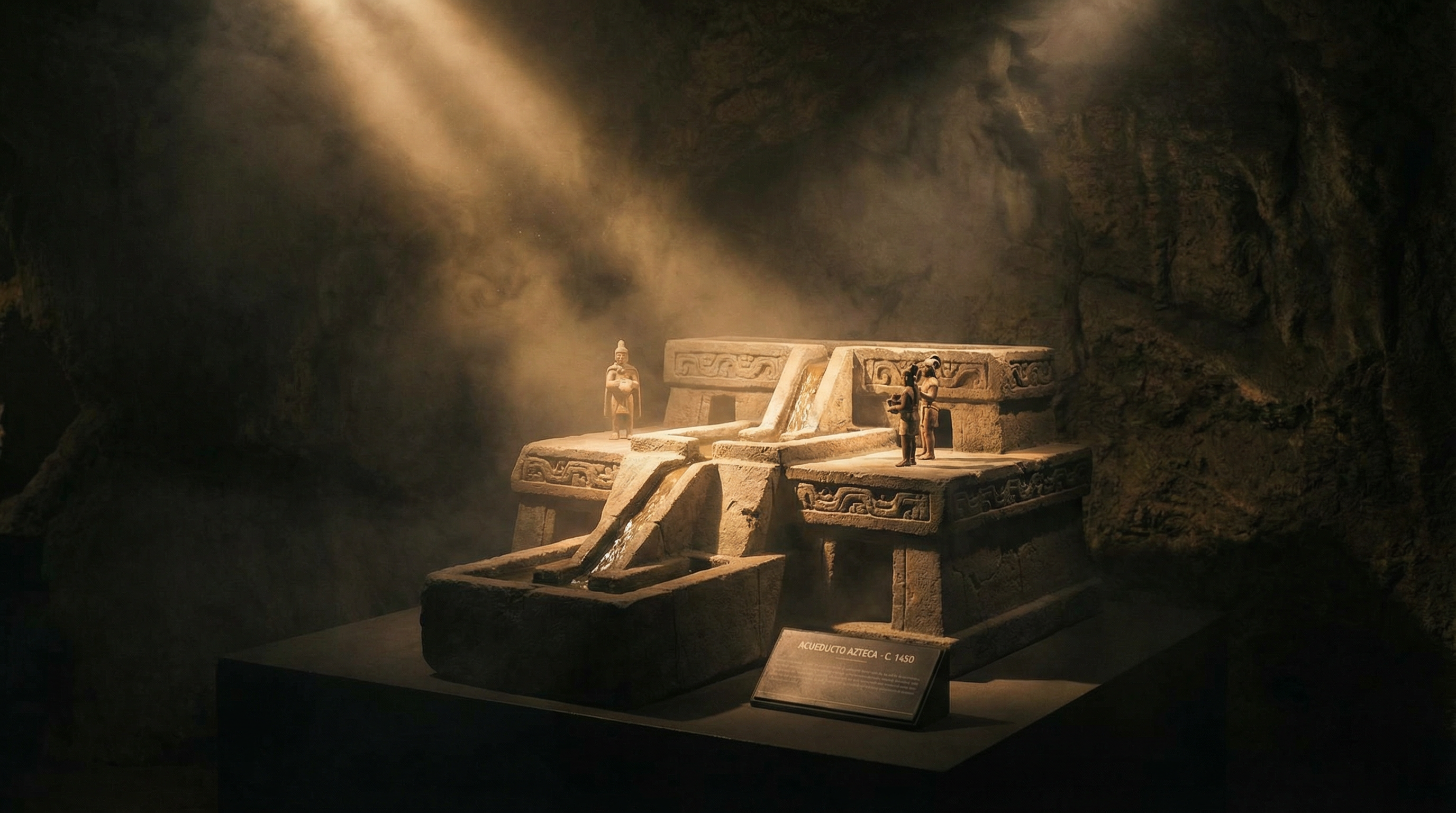
The Aztec aqueduct system was a marvel of practical engineering, designed to overcome significant environmental challenges. Its primary function was to transport fresh water from the springs of Chapultepec across the lake to Tenochtitlan. The construction involved two main channels, each approximately 1.5 meters wide, built on elevated causeways made of stone and mortar. These channels were often lined with clay pipes or carefully fitted stone blocks to prevent leakage and contamination.
What truly sets the Aztec aqueduct apart from many contemporary and even later European systems is its ingenious dual-pipe redundancy. The system was designed with two parallel pipes. This meant that while one channel was actively supplying water to the city, the other could be shut down for cleaning, maintenance, or repair without interrupting the city's fresh water supply. This principle of redundancy, ensuring continuous service through parallel infrastructure, was not widely adopted in European water systems until the 19th century. The Aztecs understood the critical importance of an uninterrupted water flow for a city of Tenochtitlan's size and societal complexity, implementing a solution that speaks volumes about their foresight and engineering prowess.
Furthermore, the system demonstrated a sophisticated understanding of hydraulics. The aqueduct maintained water pressure through careful management of elevation changes. While the overall drop from Chapultepec to Tenochtitlan was slight, the engineers meticulously designed the gradient across the 4-kilometer causeway to ensure a consistent flow. This was not a simple open channel; there were sections where water was conveyed through closed conduits, indicating an awareness of pressure dynamics. Evidence also suggests the incorporation of sedimentation tanks or settling basins near the springs and possibly along the route, acting as rudimentary filtration systems to ensure the water delivered to the city was as clean as possible. The distribution within the city involved a network of smaller canals and public fountains, ensuring equitable access for all residents.
Competing Theories and Scholarly Debate
While the existence and general function of the Aztec aqueduct are well-established, scholarly debate often centers on the extent of its "sophistication" compared to Old World systems and the independent nature of its development. Some historians, while acknowledging its effectiveness, might argue that the term "aqueduct" itself, with its Roman connotations, might overstate the complexity of the Aztec design, suggesting it was more of an open canal system in many parts. However, archaeological evidence and historical accounts, particularly Cortés's observations, strongly support the presence of closed conduits and advanced structural elements.
A key area of discussion revolves around the independent development of these engineering principles. There is no evidence to suggest any direct influence from Roman, Greek, or other Old World hydraulic traditions on the Aztecs. This implies that the Aztecs independently conceived and implemented solutions like dual-pipe redundancy and pressure management, driven by the unique environmental challenges of their island city. This independent innovation challenges diffusionist theories that often attribute advanced technologies to singular points of origin, highlighting the capacity for parallel technological evolution across different civilizations.
Another point of interest is the labor and organizational structure required for such a massive undertaking. The construction and maintenance of the aqueduct would have necessitated a highly organized society with skilled engineers, laborers, and a robust administrative system capable of coordinating resources and manpower. Understanding the social and political structures that enabled such monumental projects provides further insight into the Aztec state's capabilities.
Why This Challenges Conventional Historical Narratives
The Aztec aqueduct system directly challenges several conventional historical narratives, particularly those that tend to underestimate the technological and scientific achievements of pre-Columbian American civilizations. For too long, a Eurocentric bias has often portrayed indigenous American societies as less advanced, particularly in areas of engineering and infrastructure, compared to their European counterparts.
The dual-pipe redundancy, in particular, stands as a stark counter-narrative. The fact that the Aztecs implemented a system for continuous water supply through parallel infrastructure centuries before it became standard practice in Europe forces a re-evaluation of what constitutes "advanced" engineering. It demonstrates that innovation is not exclusive to one cultural sphere or historical trajectory. It underscores that different civilizations, facing similar problems, can arrive at equally, if not more, elegant solutions through independent intellectual development.
Furthermore, the sheer scale and efficiency of the aqueduct system, capable of sustaining a city of 200,000 people in a challenging environment, speaks to a profound understanding of urban planning, resource management, and public health. It reveals a society that prioritized the well-being of its citizens through sophisticated infrastructure, a characteristic often attributed primarily to classical European civilizations. The Aztec aqueduct is a powerful reminder that technological progress is multifaceted and that brilliant minds existed across the globe, independently charting courses of innovation that deserve equal recognition and study.
Conclusion with Lasting Significance
The Aztec aqueduct system of Tenochtitlan is more than just an ancient water supply; it is a profound testament to the ingenuity, organizational prowess, and advanced engineering capabilities of a civilization often misunderstood. From its strategic design utilizing dual pipes for uninterrupted service to its meticulous management of water pressure and quality, this system stands as a beacon of pre-Columbian technological achievement.
Its significance resonates far beyond the ruins of Tenochtitlan. It compels us to challenge preconceived notions about ancient civilizations and to recognize the independent development of sophisticated technologies across diverse cultures. The principles employed by Aztec engineers — redundancy, pressure management, and large-scale urban water supply — are foundational to modern hydraulic engineering. By studying such marvels, we not only gain a deeper appreciation for the Aztec Empire but also enrich our understanding of the universal human capacity for innovation and problem-solving.
The Forbidden Archive continues its quest to uncover and illuminate such extraordinary achievements, reminding us that the echoes of ancient brilliance still have much to teach us about our shared human heritage and the boundless potential of the human mind.
Marcus Hale
Independent Researcher & Archive Curator
Marcus Hale is an independent researcher and the curator of The Forbidden Archive. He has spent over a decade studying anomalous ancient technologies, cross-referencing primary excavation reports, museum catalogues, and peer-reviewed journals to document artifacts that mainstream history struggles to explain.
Competing Theories
Hernán Cortés described the Tenochtitlan water system as more sophisticated than anything in Spain. The engineering principles used — dual-pipe redundancy, pressure management, and filtration — were independently developed from European hydraulic traditions.

Archive Record
Civilization
Aztec Empire
Time Period
Medieval
Approximate Date
c. 1325–1521 CE
Origin
Tenochtitlan (Mexico City), Mexico
Current Location
Archaeological remains beneath Mexico City
Materials
Stone, clay pipes