Ancient India · Ancient
Ancient Indian Atomic Theory
5 min read
Last updated April 4, 2026
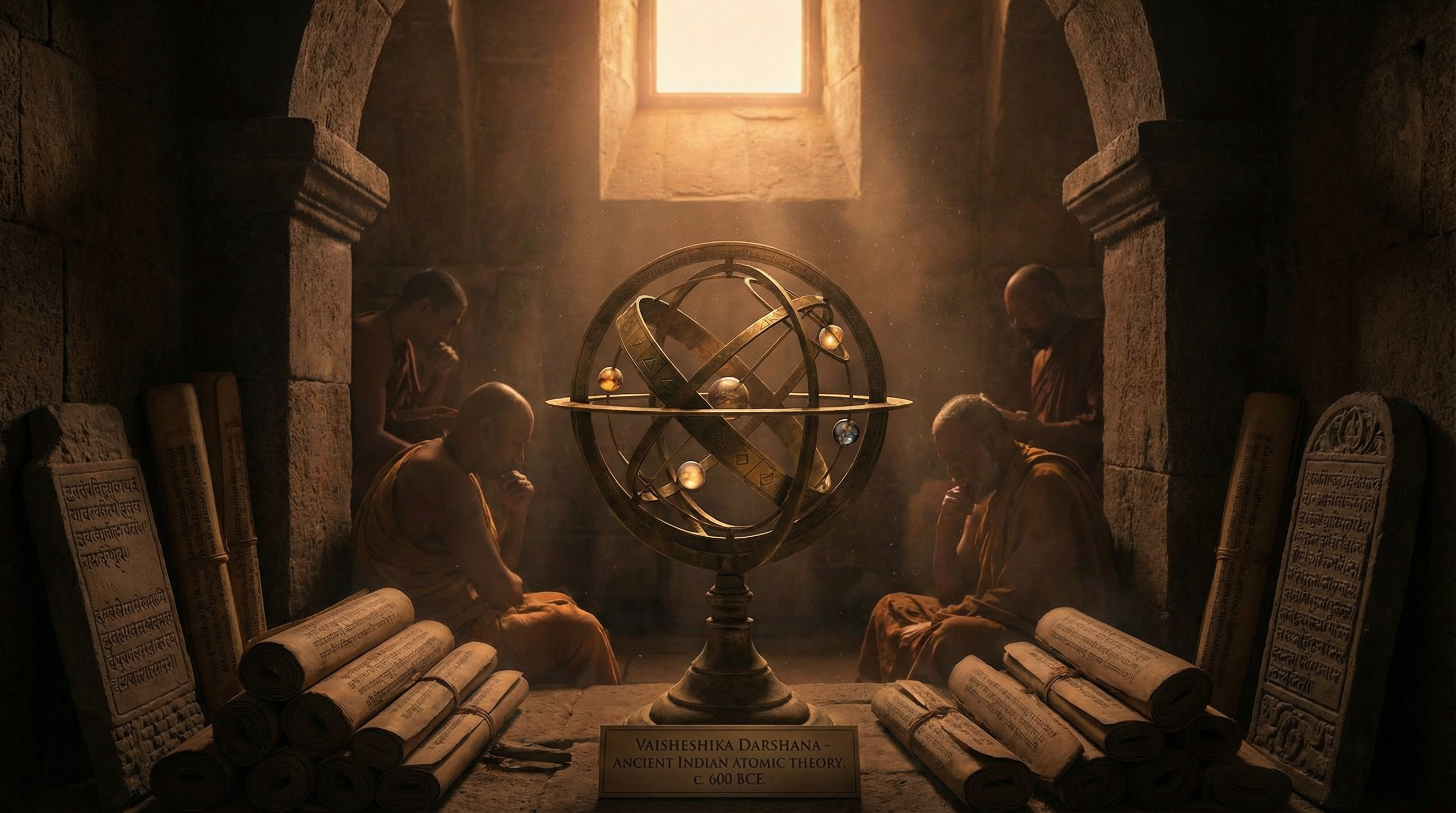
The Vaisheshika school of Indian philosophy developed a detailed atomic theory of matter around 600 BCE, predating Democritus by over a century and describing atoms, molecules, and chemical combinations.
Choose your reading style:

By Marcus Hale
Independent Researcher & Archive Curator
The Unseen Architects of Reality: A Pre-Socratic Atomic Vision
Imagine a world where the fundamental building blocks of existence were pondered and meticulously described, not in the laboratories of the 20th century, but in the philosophical schools of ancient India, centuries before the celebrated Greek atomists. This is not a fanciful tale, but a profound historical reality that challenges our conventional understanding of scientific progress. At The Forbidden Archive, we delve into such enigmas, and few are as compelling as the ancient Indian atomic theory, a sophisticated framework that posited the existence of indivisible particles, their combinations, and even the role of heat in chemical change, all around 600 BCE. This extraordinary intellectual leap, largely overlooked in Western scientific narratives, offers a tantalizing glimpse into a forgotten dawn of physics, suggesting that the pursuit of ultimate reality is a universal and timeless human endeavor.
Kanada and the Vaisheshika Sutra: Unearthing the Origins of Atomism
The genesis of this remarkable atomic theory is primarily attributed to the sage Kanada (also known as Kashyapa), who is believed to have lived around the 6th century BCE. His seminal work, the Vaisheshika Sutra, forms the foundational text of the Vaisheshika school of Hindu philosophy. The term "Vaisheshika" itself derives from "vishesha," meaning "particularity" or "distinction," reflecting the school's focus on the distinct, ultimate constituents of matter. While the exact historical context of Kanada's life remains somewhat shrouded in the mists of time, the philosophical framework he established is strikingly clear and detailed. It emerged during a vibrant period of intellectual ferment in ancient India, characterized by diverse philosophical schools debating the nature of reality, consciousness, and the cosmos. Unlike many other philosophical systems that focused solely on metaphysics or ethics, the Vaisheshika school distinguished itself by offering a rigorous, atomistic explanation for the physical world, attempting to reconcile observed phenomena with underlying, unobservable principles. This systematic approach to understanding the material universe sets it apart and positions it as a precursor to modern scientific inquiry.
Paramanu and the Dance of Dyads: Technical Brilliance of Vaisheshika Atomism
What makes the Vaisheshika atomic theory truly remarkable is its astounding precision and foresight. Kanada’s system posits the existence of paramanu (literally "ultimate measure" or "atom"), which are described as indivisible, eternal, imperceptible, and spherical particles. These paramanus are not all identical; they possess distinct qualities (guna) such as taste, smell, color, and touch, corresponding to the four classical elements of earth, water, fire, and air. Crucially, these paramanus are not static; they are in constant motion. The theory then describes how these paramanus combine: two paramanus form a dvyanuka (dyad), and three dvyanukas combine to form a tryanuka (triad). These triads are considered the smallest perceptible units of matter, akin to molecules. The Vaisheshika school also delved into the concept of chemical change, proposing that heat (from fire paramanus) plays a crucial role in altering the qualities of substances, such as the ripening of fruit or the baking of clay. This sophisticated understanding of matter, its constituent parts, and their interactions, including the transformative power of heat, bears an uncanny resemblance to concepts that would only be formally developed in Western science millennia later. The emphasis on quantitative aspects, even in a philosophical context, is particularly striking, suggesting a deep observational insight into the physical world.
Philosophy or Proto-Science? The Enduring Debate
The question that inevitably arises when confronting such advanced ancient knowledge is whether it was purely a product of philosophical speculation or if it was informed by some form of empirical observation or proto-scientific experimentation. Scholars remain divided on this crucial point. Some argue that the precision with which Kanada describes the paramanu, their combinations, and the effects of heat suggests more than mere abstract thought. They contend that such detailed descriptions might imply a rudimentary form of observation or even experimentation, perhaps through careful manipulation of materials and keen sensory perception. Others maintain that while intellectually profound, the Vaisheshika atomic theory remained largely a philosophical framework, developed through rigorous logic and introspection rather than systematic empirical investigation in the modern sense. The absence of documented experimental procedures or instruments makes it difficult to definitively prove an empirical basis. However, the very existence of such a detailed and coherent atomic model, predating Democritus by at least a century and arguably offering a more nuanced understanding of atomic properties and combinations, compels us to reconsider the boundaries between ancient philosophy and nascent scientific inquiry.
Rewriting the Timeline: Challenging Eurocentric Scientific Narratives
The significance of ancient Indian atomic theory extends far beyond its intrinsic intellectual merit; it fundamentally challenges conventional Eurocentric narratives of scientific development. For centuries, the credit for the atomic hypothesis has been almost exclusively given to the Greek philosophers Leucippus and Democritus, who lived in the 5th century BCE. While their contributions are undeniable, the Vaisheshika school's earlier and arguably more detailed atomic framework forces us to broaden our understanding of scientific origins. It demonstrates that sophisticated scientific thought was not confined to a single geographical or cultural sphere but emerged independently in diverse civilizations. This discovery compels historians of science to re-evaluate the global timeline of scientific progress, acknowledging the parallel and often preceding intellectual achievements of non-Western cultures. It underscores the importance of a more inclusive and global perspective when tracing the lineage of scientific ideas, reminding us that knowledge is a universal heritage, often with multiple, independent points of origin.
A Legacy of Inquiry: The Enduring Resonance of Ancient Atomism
The Vaisheshika atomic theory, while not directly leading to a continuous experimental tradition in the same way as modern science, represents a monumental achievement of human intellect. It stands as a testament to the ancient Indian capacity for abstract reasoning, meticulous observation, and profound philosophical inquiry into the nature of reality. Its concepts of indivisible particles, their qualitative differences, and their combinations into larger structures resonate with remarkable accuracy with the fundamental principles of modern atomic theory and chemistry. While the motivations and methodologies differed, the core questions and some of the proposed answers are strikingly similar. The legacy of Kanada and the Vaisheshika school serves as a powerful reminder that the human quest to understand the universe is a continuous, multifaceted journey, with brilliant insights emerging from unexpected corners of history. It invites us to look beyond established narratives and embrace the rich, diverse tapestry of human intellectual achievement, recognizing that the seeds of scientific understanding were sown across the globe, long before the modern era.
Marcus Hale
Independent Researcher & Archive Curator
Marcus Hale is an independent researcher and the curator of The Forbidden Archive. He has spent over a decade studying anomalous ancient technologies, cross-referencing primary excavation reports, museum catalogues, and peer-reviewed journals to document artifacts that mainstream history struggles to explain.
Competing Theories
Whether Kanada's atomic theory was purely philosophical or based on empirical observation remains debated. Some scholars argue the precision of his descriptions implies experimental knowledge.

Archive Record
Civilization
Ancient India
Time Period
Ancient
Approximate Date
c. 600 BCE
Origin
Indian subcontinent
Current Location
Preserved in Vaisheshika philosophical texts
Materials
N/A — philosophical framework