Han Dynasty China · Classical Antiquity
Chinese Seismoscope of Zhang Heng
6 min read
Last updated April 4, 2026
The world's first seismoscope, invented by Zhang Heng in 132 CE, capable of detecting earthquakes hundreds of kilometres away and indicating the direction of the seismic event.
Choose your reading style:

By Marcus Hale
Independent Researcher & Archive Curator
Imagine a world without instant communication, where news traveled at the pace of a horse. Now imagine a device, crafted nearly two millennia ago, that could detect an earthquake hundreds of kilometers away, pinpoint its direction, and do so before the ground even trembled in the imperial capital. This is not the stuff of science fiction, but the astonishing reality of the Houfeng Didong Yi – the "earthquake-detecting instrument" – invented by the polymath Zhang Heng of Han Dynasty China. A marvel of ancient engineering, this device challenges our very understanding of technological progression and stands as a testament to the ingenuity of a civilization often underestimated in the annals of scientific discovery. How did it work? And why does its existence continue to baffle and inspire us today?
Historical Background and Discovery Context
The stage for this extraordinary invention was set in 132 CE, during the Eastern Han Dynasty, a period of remarkable intellectual and cultural flourishing in China. Zhang Heng (78–139 CE) was no ordinary scholar. A true polymath, he excelled as an astronomer, mathematician, cartographer, engineer, poet, and statesman. His contributions ranged from improving astronomical instruments like the armillary sphere to developing a precise water-powered clock. Yet, among his many achievements, the seismoscope remains perhaps his most enigmatic and celebrated.
The Han Dynasty was plagued by frequent earthquakes, which were often interpreted as divine displeasure or omens of political instability. The ability to detect these tremors, even if not to predict them, would have been of immense practical and symbolic value to the imperial court. It is within this context of both scientific curiosity and practical necessity that Zhang Heng conceived and constructed his device. The historical records, particularly the Book of Later Han (Hou Han Shu), provide tantalizing descriptions of the seismoscope, detailing its appearance and, crucially, its successful operation.
The most famous account of its efficacy dates to 138 CE. The seismoscope famously indicated an earthquake originating in the Longxi region (modern-day Gansu province), some 500 kilometers to the west of the capital, Luoyang. Initially, no one in Luoyang felt anything, and the court was skeptical. However, a few days later, a messenger arrived, confirming that a devastating earthquake had indeed struck Longxi, precisely as the seismoscope had indicated. This event solidified Zhang Heng's reputation and cemented the device's place in history, a feat of remote sensing that predates modern seismology by over 1,700 years.
Technical Analysis and What Makes It Remarkable
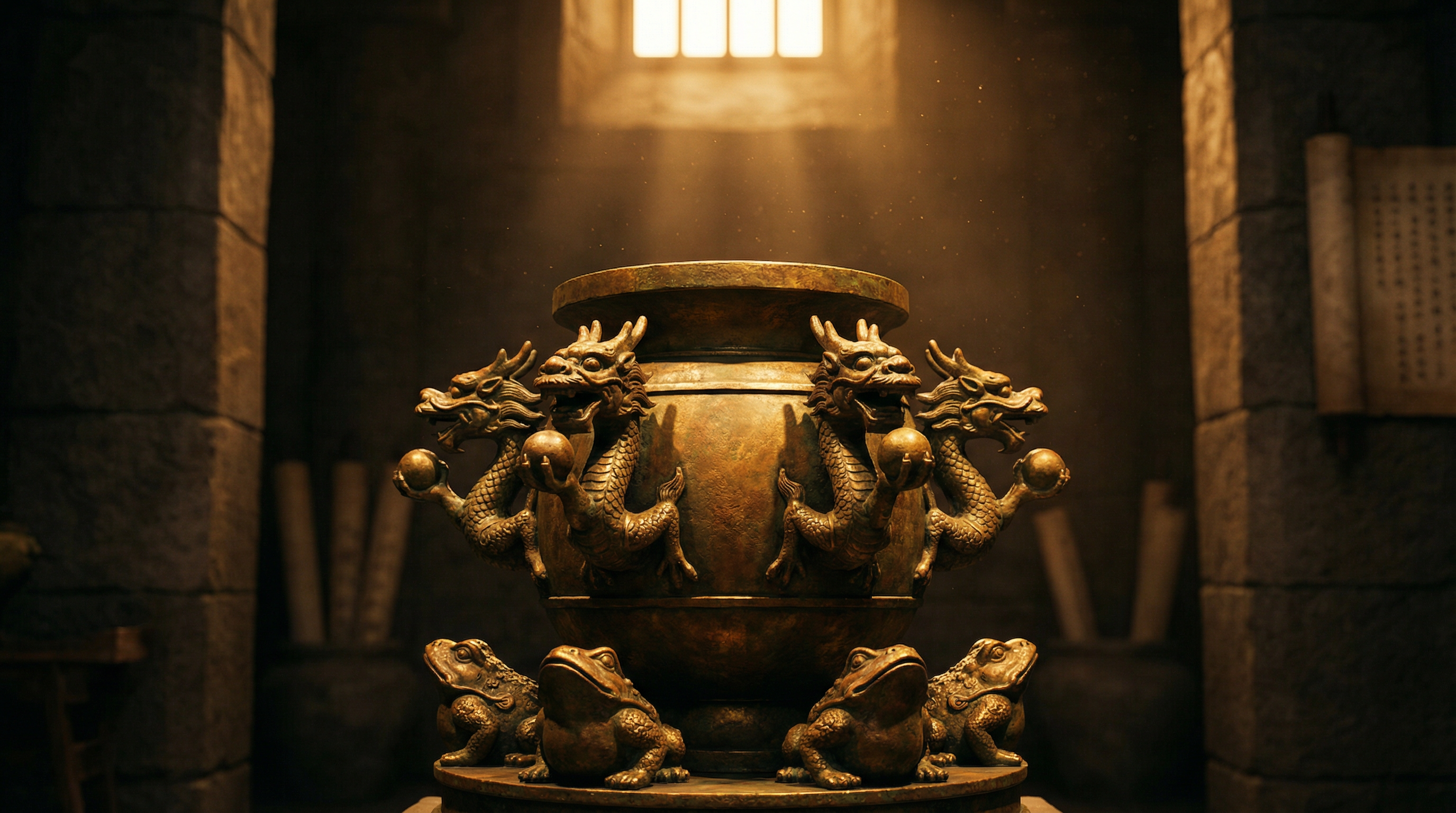
The original seismoscope was a large, ornate bronze vessel, approximately eight feet in diameter. Its exterior was adorned with eight dragons, each holding a bronze ball in its mouth, positioned around the circumference, corresponding to the eight principal compass directions (north, northeast, east, southeast, south, southwest, west, northwest). Below each dragon sat a bronze toad with its mouth open, ready to receive a falling ball.
The genius of the device lay in its internal mechanism. The historical texts are frustratingly vague about the exact workings, stating only that "inside the device was a delicate mechanism, with a suspended column that could move to release a ball." When an earthquake occurred, the internal mechanism would be triggered, causing one of the dragons to release its ball into the mouth of the toad below. The direction of the dragon that dropped its ball indicated the direction from which the seismic waves originated.
What makes this truly remarkable is the sensitivity required. To detect an earthquake 500 km away means the device was responding to seismic waves that, by the time they reached Luoyang, would have been imperceptible to human senses. It was not merely detecting local tremors but distant, significant seismic events. The precision of indicating direction further elevates its sophistication, suggesting a mechanism capable of discerning the initial impulse of ground motion.
Competing Theories and Scholarly Debate
Given the lack of detailed blueprints, the exact internal mechanism of Zhang Heng's seismoscope has been a subject of intense scholarly debate and numerous reconstruction attempts for centuries. Two primary theories dominate the discussion:
- The Inverted Pendulum Theory: This theory posits that the central element was an inverted pendulum, a heavy mass balanced on a pivot point. When seismic waves arrived, the ground motion would cause the pendulum to topple in the direction of the tremor. Levers or linkages connected to the pendulum would then trigger the release mechanism for the corresponding dragon. This design offers high sensitivity and directional accuracy. Many modern reconstructions, including the one at the China Science and Technology Museum, are based on this principle.
- The Suspended Column Theory: This theory suggests a column suspended from above, or perhaps a complex system of interconnected pendulums. The Book of Later Han mentions a "suspended column," which lends some textual support to this idea. In this model, the column's oscillation due to seismic waves would activate a series of levers or cams, releasing the ball. While potentially sensitive, achieving directional accuracy with a simple suspended column without additional complex linkages is more challenging.
The challenge in reconstruction lies in creating a mechanism that is sensitive enough to react to distant tremors but robust enough not to be triggered by minor vibrations like footsteps or wind. The fact that Zhang Heng's original device worked effectively and accurately, as historical records attest, speaks volumes about the sophistication of his understanding of mechanics and seismology, even without the benefit of modern scientific instruments.
Why This Challenges Conventional Historical Narratives
The existence of Zhang Heng's seismoscope profoundly challenges the Eurocentric view of scientific and technological development. For too long, the narrative of innovation has largely centered on the Western world, with significant breakthroughs often attributed to European thinkers and engineers. The seismoscope, however, stands as irrefutable proof of advanced scientific thought and engineering prowess in ancient China, centuries before similar concepts were even contemplated in the West.
It demonstrates an understanding of fundamental physics – inertia, pendulum mechanics, and the nature of wave propagation – that was far ahead of its time. It also highlights an early application of instrumentation for scientific observation, moving beyond mere philosophical speculation to practical, data-gathering technology. The seismoscope is not an isolated anomaly; it is part of a broader pattern of Chinese innovation that includes gunpowder, paper, printing, and the compass, all of which significantly impacted global civilization.
Furthermore, it underscores the importance of interdisciplinary knowledge. Zhang Heng's ability to integrate astronomical observations with mechanical engineering and an understanding of natural phenomena allowed him to create a device that transcended the limitations of his era. It forces us to reconsider the timeline of scientific discovery and acknowledge the diverse origins of human ingenuity.
Conclusion with Lasting Significance
Zhang Heng's seismoscope remains one of the most compelling artifacts of ancient technology. It is a silent testament to the genius of a Han Dynasty polymath and the advanced scientific capabilities of classical Chinese civilization. While the exact internal workings may forever remain a subject of scholarly reconstruction and debate, its historical impact is undeniable. It successfully detected distant earthquakes, provided crucial information to the imperial court, and stands as the world's first known instrument for seismological study.
Its significance extends beyond its technical brilliance. The seismoscope serves as a powerful reminder that innovation is not exclusive to any single culture or time period. It urges us to look beyond conventional historical narratives and appreciate the rich tapestry of human achievement across the globe. As we continue to unravel the mysteries of ancient technologies, Zhang Heng's dragon-adorned oracle continues to whisper tales of ingenuity, challenging our assumptions and inspiring us to look for the echoes of brilliance in every corner of the past.
Marcus Hale
Independent Researcher & Archive Curator
Marcus Hale is an independent researcher and the curator of The Forbidden Archive. He has spent over a decade studying anomalous ancient technologies, cross-referencing primary excavation reports, museum catalogues, and peer-reviewed journals to document artifacts that mainstream history struggles to explain.
Competing Theories
Modern reconstructions of the device have confirmed its basic operating principle, but the exact internal mechanism remains unknown. Some versions use an inverted pendulum; others use a suspended column.


Archive Record
Civilization
Han Dynasty China
Time Period
Classical Antiquity
Approximate Date
c. 132 CE
Origin
Luoyang, China
Current Location
China Science and Technology Museum, Beijing (replica)
Materials
Bronze, copper