Qin Dynasty China · Classical Antiquity
Terracotta Army Manufacturing
6 min read
Last updated April 4, 2026
An army of 8,000 individually crafted terracotta soldiers, each with unique facial features, produced in an assembly-line process that predates modern manufacturing by 2,200 years.
Choose your reading style:

By Marcus Hale
Independent Researcher & Archive Curator
An Army Forged in Clay: A Pre-Industrial Enigma
Beneath the loess-laden plains of Shaanxi province, China, lies an archaeological marvel that continues to baffle and inspire: the Terracotta Army. Discovered serendipitously by farmers digging a well in 1974, this subterranean host of 8,000 life-sized warriors, chariots, and horses stands as a silent testament to the ambition of China's first emperor, Qin Shi Huang. Yet, beyond its sheer scale and artistic grandeur, the Terracotta Army presents a profound enigma for archaeologists and historians alike. How was such an immense, detailed, and seemingly standardized force produced over two millennia before the advent of modern industrial manufacturing? The answer lies not in magic, but in a sophisticated, proto-industrial production system that challenges our very understanding of ancient technological capabilities.
The Emperor's Eternal Guard: Historical Context and Discovery
The Terracotta Army was commissioned by Qin Shi Huang (259–210 BCE), the unifier of China and founder of the Qin Dynasty. Driven by a desire for immortality and a belief that his earthly power should extend into the afterlife, Qin Shi Huang embarked on the construction of an enormous mausoleum complex. This subterranean palace, larger than any other tomb ever discovered, was designed to mirror his terrestrial empire, complete with rivers of mercury, palaces, and an entire army to protect him in the next world. The construction of this monumental undertaking began shortly after his ascension to the throne in 246 BCE and continued for nearly 40 years, involving an estimated 700,000 laborers.
The discovery itself was a moment of accidental brilliance. In March 1974, local farmers digging a well near Xi'an stumbled upon fragments of terracotta figures. What began as a local curiosity soon escalated into one of the most significant archaeological finds of the 20th century. Subsequent excavations revealed a series of vast pits, each containing hundreds, if not thousands, of meticulously arranged warriors, facing east, ready to defend their emperor from perceived threats from the conquered states. The sheer scale and detail of the discovery immediately captivated the world, prompting intense research into the methods of its creation.
Engineering an Empire: Technical Analysis of a Proto-Industrial Process
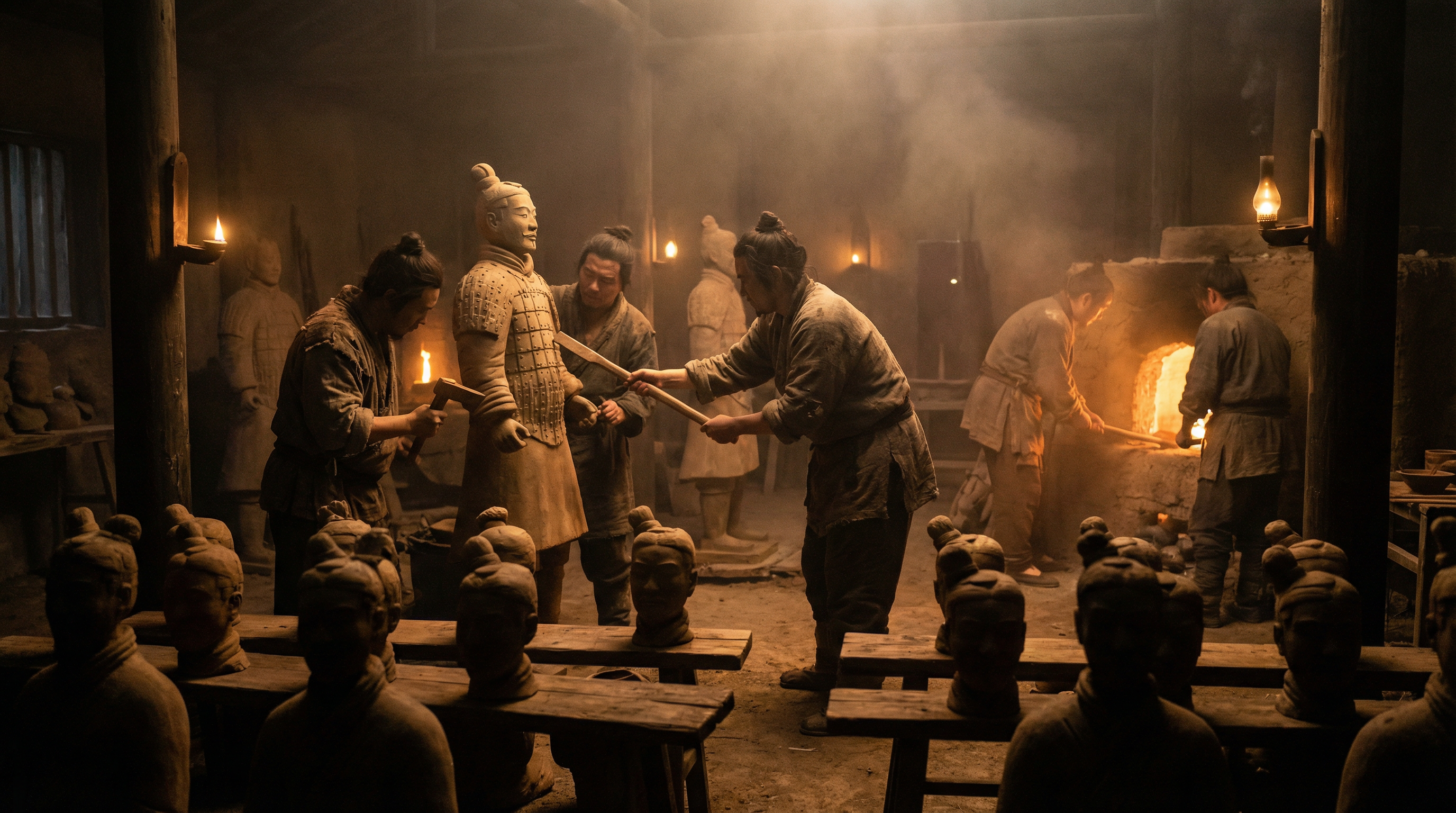
The most remarkable aspect of the Terracotta Army, from a technological perspective, is its manufacturing process. At first glance, the individuality of each soldier – unique facial features, hairstyles, and expressions – suggests an artisanal, hand-crafted approach. However, detailed analysis has revealed a far more complex and efficient system, one that predates the European Industrial Revolution by over 2,200 years. This was not simply a collection of individual sculptures; it was a mass-produced army, built on principles of standardization and modularity.
Archaeological and scientific studies, including 3D scanning and chemical analysis, have uncovered a sophisticated assembly-line process. The bodies of the soldiers were not sculpted from a single block of clay. Instead, they were constructed from a series of standardized, pre-fabricated components. Legs, torsos, arms, and heads were mass-produced separately using molds and coils of clay. These modular parts were then assembled, much like a modern factory production line. Once the basic form was complete, individual artisans would then add the unique details – the intricate facial features, hairstyles, and armor elements – giving each soldier its distinct personality. This division of labor allowed for both efficiency in production and a remarkable level of individualization.
Further evidence of this advanced manufacturing process comes from the weapons carried by the Terracotta soldiers. While many of the original wooden components have long since decayed, thousands of bronze weapons – swords, spears, halberds, and crossbow triggers – have survived in pristine condition. What is truly astonishing is the degree of standardization and precision found in these bronze artifacts. For instance, bronze crossbow triggers from different pits and different manufacturing batches are interchangeable to within an astonishing 0.1mm tolerance. This level of precision suggests not only highly skilled metallurgists but also a sophisticated system of quality control and standardization that is typically associated with much later industrial periods. The use of advanced alloys, chrome plating (a process not "re-discovered" until the 20th century), and mass-production techniques for these weapons further underscores the technological prowess of the Qin Dynasty.
Challenging the Narrative: Competing Theories and Scholarly Debate
While the evidence for a modular, proto-industrial production system is compelling, some aspects continue to fuel scholarly debate. One area of discussion revolves around the exact scale of the workshops and the degree of centralized control. Were these massive state-run factories, or a network of smaller, specialized workshops coordinated by the imperial administration? The presence of artisan marks on some figures suggests a system of accountability, but the overall organizational structure remains a subject of ongoing research.
Another point of contention is the origin of the technology. While the Qin Dynasty was known for its administrative efficiency and technological innovation, the sheer leap in manufacturing complexity seen in the Terracotta Army is remarkable. Some scholars propose that the techniques were developed organically within China, building on existing ceramic traditions. Others suggest possible, albeit unproven, influences from further west, though the unique characteristics of the Terracotta Army's production firmly place its origins within Chinese ingenuity. The debate often centers on whether such a complex system could have emerged without a long preceding tradition of similar large-scale, standardized production, or if it was a singular, imperial-driven innovation.
Rewriting History: The Significance of Qin Manufacturing
The manufacturing process behind the Terracotta Army fundamentally challenges conventional historical narratives about the development of industrial production. For centuries, the Industrial Revolution in 18th-century Europe has been credited with pioneering mass production, interchangeable parts, and assembly-line techniques. The Terracotta Army, however, demonstrates that these core principles were understood and implemented on an unprecedented scale in China over two millennia earlier. This discovery forces a re-evaluation of the timeline and geographical origins of industrial thought and practice.
It highlights that concepts like standardization, modularity, and division of labor are not exclusive to modern Western industrialization but can arise in different cultural and historical contexts when specific conditions – such as a powerful centralized state, abundant resources, and a clear objective – align. The Qin Dynasty's ability to mobilize vast resources, organize skilled labor, and implement advanced production techniques for a project of this magnitude speaks volumes about its administrative and technological sophistication. It reveals a society capable of engineering not just an empire, but also the means to immortalize it with an army forged in clay and precision.
An Enduring Legacy: The Echoes of Qin's Innovation
The Terracotta Army is far more than an archaeological spectacle; it is a profound testament to ancient human ingenuity and organizational prowess. It stands as a physical manifestation of a proto-industrial revolution that occurred long before its recognized Western counterpart. The lessons learned from its construction – the power of standardization, modular design, and efficient division of labor – resonate even today in our modern manufacturing processes.
As we continue to unravel the mysteries of its creation, the Terracotta Army serves as a powerful reminder that technological innovation is not a linear progression confined to specific eras or regions. It underscores the importance of looking beyond conventional historical frameworks and appreciating the diverse and often surprising pathways of human technological development. The silent ranks of Qin Shi Huang's eternal army continue to speak volumes, not just about an emperor's ambition, but about the extraordinary capabilities of ancient Chinese engineering and manufacturing.
Marcus Hale
Independent Researcher & Archive Curator
Marcus Hale is an independent researcher and the curator of The Forbidden Archive. He has spent over a decade studying anomalous ancient technologies, cross-referencing primary excavation reports, museum catalogues, and peer-reviewed journals to document artifacts that mainstream history struggles to explain.
Competing Theories
The standardisation of weapons in the Terracotta Army is particularly striking — bronze crossbow triggers are interchangeable to within 0.1mm tolerance, suggesting quality control systems of extraordinary precision.
Archive Record
Civilization
Qin Dynasty China
Time Period
Classical Antiquity
Approximate Date
c. 246–208 BCE
Origin
Xi'an, Shaanxi, China
Current Location
Emperor Qinshihuang's Mausoleum Site Museum, Xi'an
Materials
Terracotta, bronze, wood