Aztec Empire · Medieval
Aztec Floating Gardens (Chinampas)
5 min read
Last updated March 19, 2026
The Aztec chinampas were artificial islands built in Lake Texcoco that produced multiple harvests per year and fed a city of 200,000 people — an agricultural engineering feat not surpassed until modern intensive farming.
Also in This Category


Choose your reading style:

By Marcus Hale
Independent Researcher & Archive Curator
In 1519, Spanish conquistador Hernán Cortés stood on the causeways of Tenochtitlan, gazing at a city that seemed to float on water. The Aztec capital, home to an estimated 200,000 people, was larger than London or Paris at the time. Yet, the true marvel was not the towering pyramids or the bustling markets, but the sprawling network of artificial islands that fed this massive population. These were the chinampas, often mischaracterized as "floating gardens," an agricultural engineering system that remains one of the most productive ever devised by human hands. The sheer scale of this endeavor fundamentally reshaped the Valley of Mexico, turning a shallow, brackish lake into an agricultural powerhouse that sustained an empire.
The Mechanics of Lake Texcoco's Artificial Islands
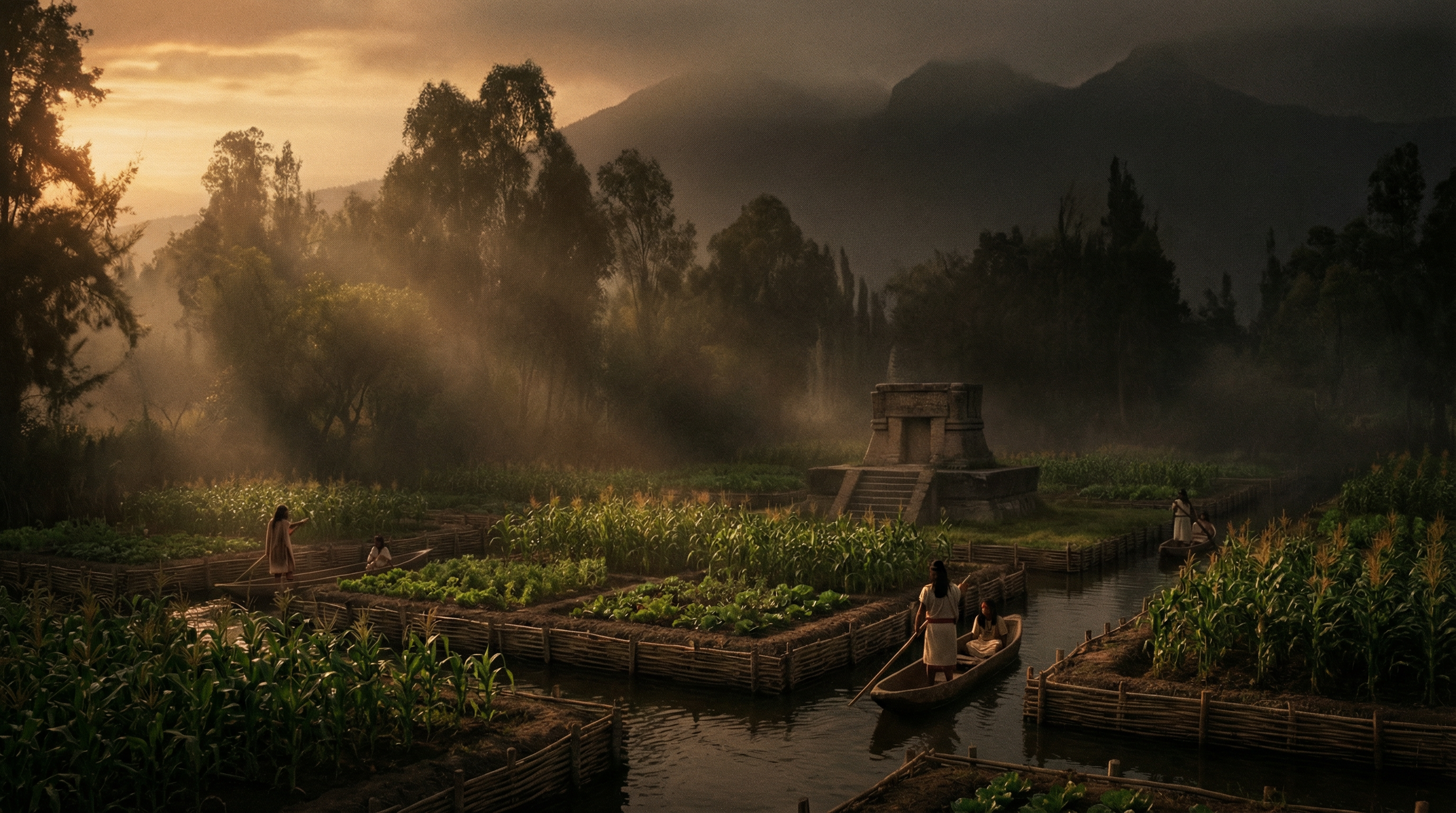
To understand the magnitude of this achievement, we must look at the painstaking construction process. The Aztecs did not simply throw dirt into Lake Texcoco. They drove thick wooden stakes deep into the lakebed, measuring out precise rectangular plots, typically 30 meters long and 2.5 meters wide. Between these stakes, they wove a dense lattice of reeds, branches, and aquatic vegetation, creating a porous underwater fence that served as the foundation for the artificial landmass. Workers then hauled nutrient-rich mud from the lake bottom, layering it meticulously with decaying plant matter over this woven base until the surface rose securely above the water level.
This was a closed-loop nutrient system designed with an acute understanding of hydrology and ecology. The lake sediment provided immediate, potent fertilization, while the surrounding water ensured constant irrigation through capillary action. The porous walls allowed roots to reach directly into the lake, eliminating the need for manual watering. Furthermore, the canals between the chinampas served as transportation arteries, allowing farmers to navigate the system in shallow canoes, bringing crops directly to the bustling markets of Tenochtitlan. It was a brilliant solution to a hostile environment, transforming marshland into a highly organized, highly productive agricultural grid.
Yields That Defy Modern Farming Standards
The numbers associated with chinampa agriculture are staggering, even by modern industrial standards. While conventional farming in medieval Europe might yield one or two harvests a year, the chinampas consistently produced up to seven harvests annually. This unprecedented intensity was achieved through meticulous crop rotation and a highly efficient, staggered planting system. Farmers cultivated seeds in small, nutrient-dense mud seedbeds, transplanting them to the main chinampa only when they were robust enough to survive. This method maximized the use of space and time, ensuring that the main plots were never left fallow.
The primary crops—maize, beans, squash, amaranth, and tomatoes—formed a symbiotic relationship known as the milpa system. The tall maize stalks provided a sturdy structure for the climbing beans, while the broad squash leaves shaded the soil, retaining moisture and suppressing weeds. This polyculture approach, combined with the continuous replenishment of fresh lake mud and the return of crop waste to the water, meant the soil never exhausted its nutrients. It is a level of sustainable intensification that modern agricultural engineers are still struggling to replicate in urban environments, relying on chemical fertilizers and complex irrigation systems to achieve what the Aztecs accomplished with mud and reeds.
The Debate Over Agricultural Origins
Scholars have long debated how the Aztecs developed such a sophisticated and massive system. The traditional view held that chinampas were a relatively late invention, born out of necessity as the population of Tenochtitlan exploded in the 14th and 15th centuries. In this narrative, the Aztecs were forced to innovate to avoid starvation. However, recent core sampling and radiocarbon dating of the lakebed suggest a different, more complex timeline. Some researchers argue that the fundamental techniques were developed much earlier, perhaps by the Toltecs or even earlier civilizations in the Valley of Mexico, and were systematically refined over centuries.
This suggests a culture of rigorous, multi-generational agricultural experimentation rather than sudden, desperate invention. The precise management of water levels—crucial to prevent flooding or drying out—required complex engineering on a massive scale, including dikes, aqueducts, and sluice gates. The 16-kilometer Nezahualcoyotl dike, built in the 1440s under the direction of the poet-king of Texcoco, was specifically designed to separate the fresh water of Lake Xochimilco from the brackish waters of Lake Texcoco, protecting the chinampas from damaging salinity. This was not a haphazard adaptation, but a highly planned, state-sponsored infrastructure project that required centralized coordination and a deep understanding of hydraulic engineering.
A Blueprint for the Future of Urban Agriculture?
Today, the remnants of this vast system can still be seen in Xochimilco, a UNESCO World Heritage Site in southern Mexico City. While much of the original network has been lost to centuries of urban sprawl, ill-conceived drainage projects, and modern development, the surviving chinampas continue to produce food using methods that have barely changed in 800 years. These remaining islands are a living museum of ancient ingenuity, offering a glimpse into the agricultural engine that powered the Aztec Empire.
As modern cities grapple with escalating challenges of food security, water scarcity, and severe soil degradation, the chinampas offer a compelling historical precedent. They demonstrate that high-yield, sustainable urban agriculture is not a utopian dream, but a proven reality that existed centuries ago. The Aztec engineers solved problems that we are still facing today, creating a resilient food system that thrived without chemical inputs or fossil fuels. They achieved this using nothing more than mud, reeds, human labor, and a profound, intimate understanding of their local ecosystem.
If a civilization 800 years ago could feed 200,000 urban residents using a closed-loop, zero-waste system built on a shallow lake, what is preventing our modern metropolises from achieving the same level of agricultural integration?
Marcus Hale
Independent Researcher & Archive Curator
Marcus Hale is an independent researcher and the curator of The Forbidden Archive. He has spent over a decade studying anomalous ancient technologies, cross-referencing primary excavation reports, museum catalogues, and peer-reviewed journals to document artifacts that mainstream history struggles to explain.
Join the Archive
Enjoyed This Mystery?
Get new discoveries like this delivered to your inbox every week. Ancient technologies, lost sciences, and suppressed history — free.
Competing Theories
The chinampa system required precise management of water levels, soil composition, and crop rotation. Some researchers argue the system was developed over centuries through systematic agricultural experimentation.
Archive Record
Civilization
Aztec Empire
Time Period
Medieval
Approximate Date
c. 1200–1521 CE
Origin
Lake Texcoco, Mexico
Current Location
Xochimilco, Mexico City (UNESCO World Heritage Site)
Materials
Aquatic vegetation, mud, wooden stakes