Aztec Empire · Pre-Columbian
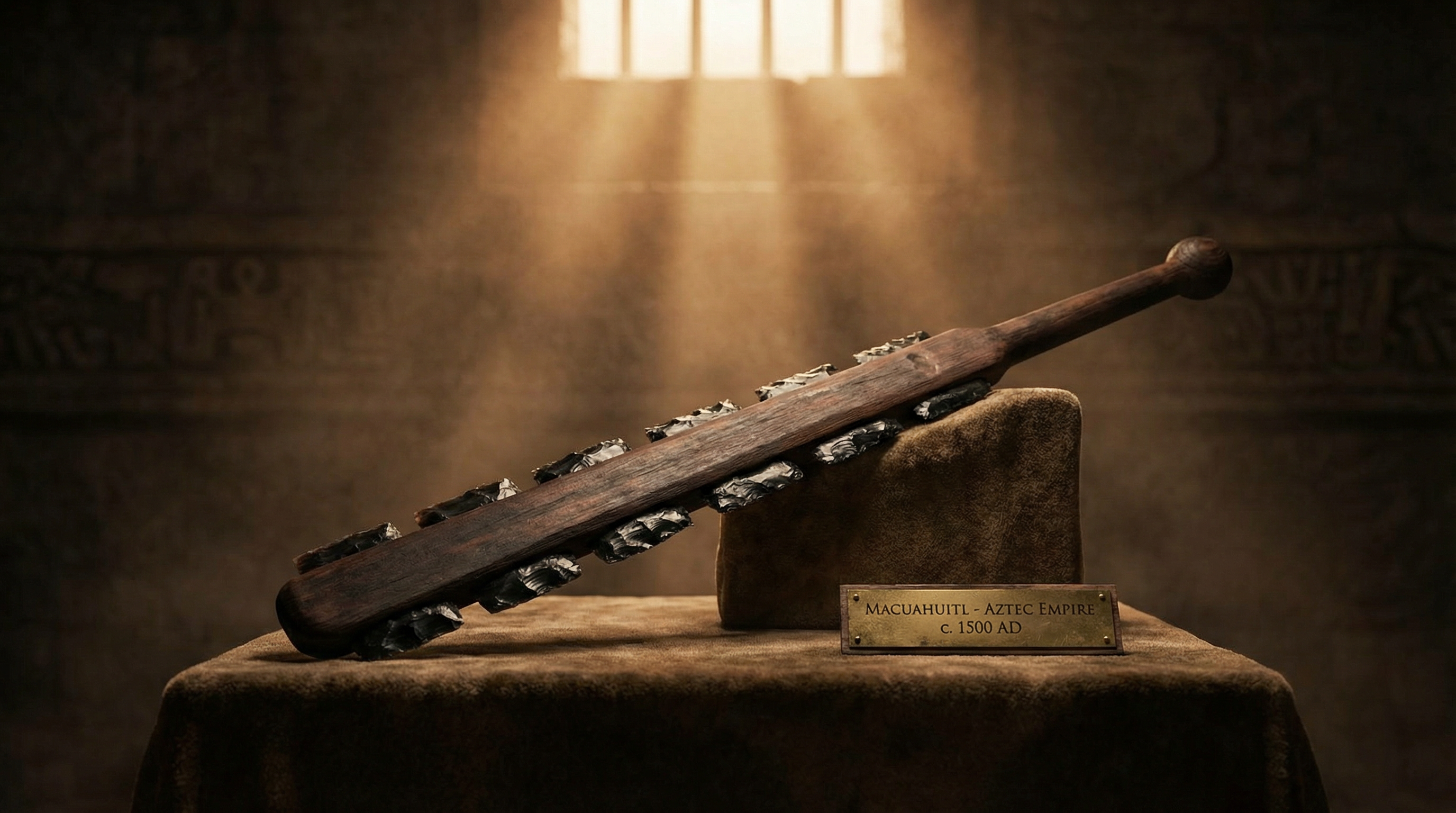
Aztec Macuahuitl Obsidian Sword
7 min read
Last updated April 4, 2026
The Aztec obsidian-edged wooden sword that Spanish conquistadors reported could decapitate a horse in a single blow, with blades sharper than modern surgical steel.
Choose your reading style:

By Marcus Hale
Independent Researcher & Archive Curator
Welcome, seekers of forgotten truths, to The Forbidden Archive. Today, we delve into a weapon that challenges our very understanding of ancient warfare and material science: the Aztec Macuahuitl. Imagine a sword, not of gleaming steel, but of wood and volcanic glass, capable of decapitating a horse in a single, devastating blow. Such was the reputation of the macuahuitl, a weapon so formidable that Spanish conquistadors, armed with their Toledo steel, chronicled its terrifying efficacy with a mixture of awe and dread. This isn't merely an ancient artifact; it's a testament to a pre-Columbian mastery of engineering and material science that produced cutting edges sharper than anything modern metallurgy can achieve. Prepare to have your perceptions of ancient weaponry irrevocably altered.
Historical Background and Discovery Context
The macuahuitl was the signature weapon of the Aztec warrior, a fearsome instrument of war wielded across the vast expanse of the Aztec Empire (also known as the Triple Alliance) during the Postclassic period of Mesoamerican history, roughly from the 14th to the early 16th century. Its use was widespread among various Mesoamerican cultures, but it was the Aztecs who perfected and popularized its design, making it an iconic symbol of their martial prowess.
Our primary understanding of the macuahuitl comes from a combination of sources: indigenous codices, archaeological findings, and, perhaps most dramatically, the accounts of the Spanish conquistadors. Bernal Díaz del Castillo, a foot soldier in Hernán Cortés's expedition, vividly described encounters with these weapons. He recounted instances where Spanish horses were disemboweled, and Spanish soldiers, despite their steel armor, suffered horrific wounds. One particularly chilling account details a macuahuitl severing a horse's head clean off, a feat that speaks volumes about the weapon's destructive power. These European observations, often tinged with a mix of fear and grudging respect, provide invaluable, albeit biased, insights into the macuahuitl's impact on the battlefield.
Unfortunately, no complete, original macuahuitl has survived to the present day. The last known authentic example was reportedly housed in the Royal Armory in Madrid but was destroyed by a fire in 1884. Our knowledge is thus pieced together from detailed descriptions, illustrations in codices like the Codex Mendoza, and archaeological fragments of obsidian blades that fit the macuahuitl's design. This absence of a complete artifact only adds to its mystique, forcing us to reconstruct its formidable nature through historical narrative and scientific deduction.
Technical Analysis and What Makes It Remarkable
At first glance, the macuahuitl appears deceptively simple: a wooden club embedded with sharp blades. However, its true genius lies in the selection and application of its materials. The core of the weapon was typically crafted from a dense, resilient oak wood, providing the necessary heft and structural integrity for a bludgeoning weapon. The true marvel, however, lay in the blades.
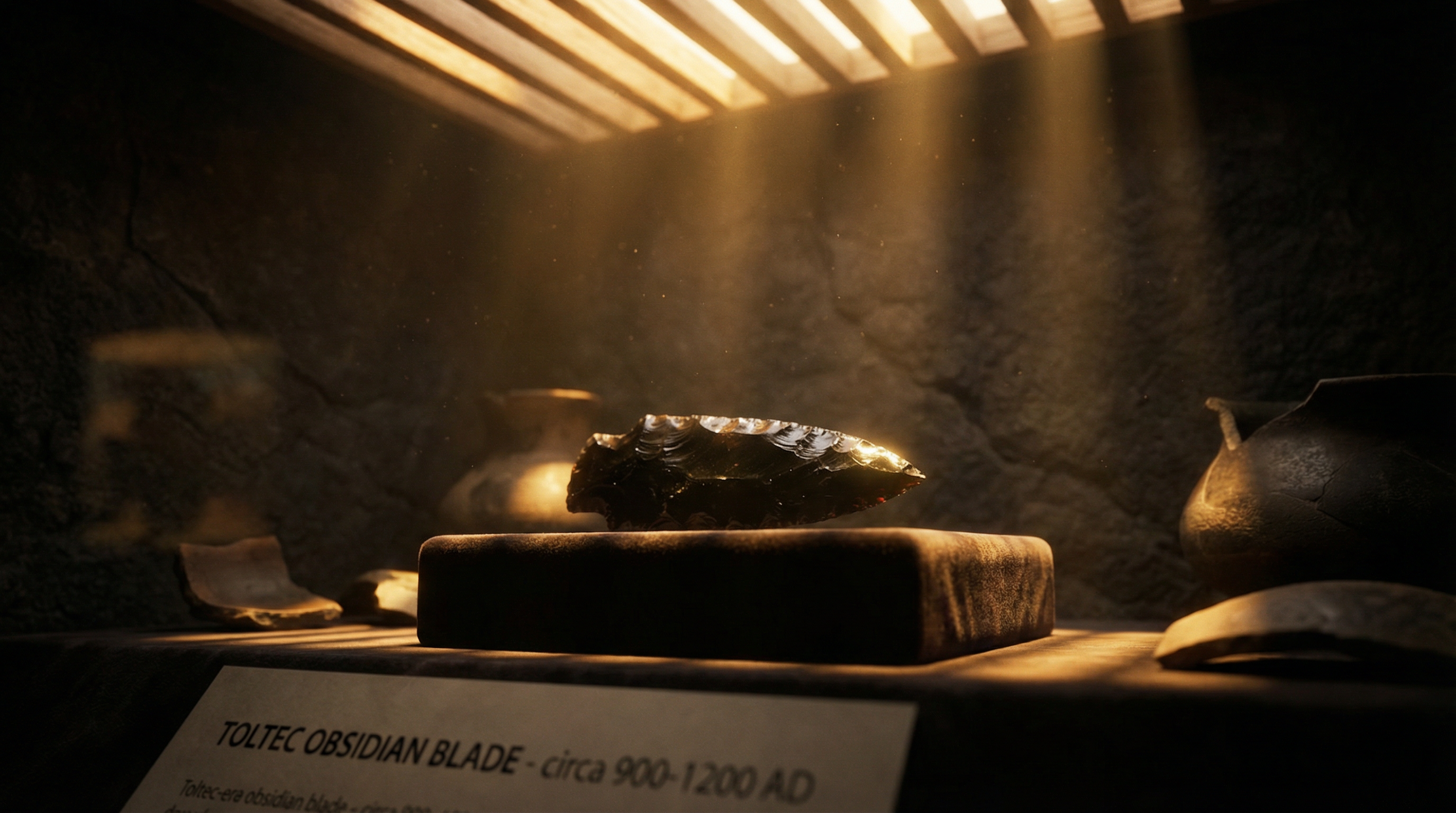
These blades were not metal, but razor-sharp shards of obsidian, a naturally occurring volcanic glass. Obsidian, formed from rapidly cooled lava, possesses a unique molecular structure. Unlike metals, which have a crystalline structure, obsidian is amorphous. When fractured, it breaks along conchoidal (shell-like) lines, producing edges that taper down to an astonishingly fine point. Modern scientific analysis has revealed that these obsidian edges can be as thin as 3 nanometers – that's 500 times sharper than the keenest surgical steel scalpel. To put this into perspective, a human hair is about 100,000 nanometers thick.
The obsidian blades were meticulously flaked and then set into grooves carved along the edges of the wooden club. They were held in place using a natural adhesive, likely a strong resin or bitumen, which provided a secure bond. This construction created a hybrid weapon: a club for blunt force trauma and a sword for devastating cuts. The macuahuitl was designed to inflict deep, wide, and often fatal lacerations, while the underlying wooden structure provided the momentum and durability to withstand repeated impacts. The combination of its club-like weight and razor-sharp edges made it an incredibly effective and terrifying weapon in close-quarters combat.
Competing Theories and Scholarly Debate
While the general understanding of the macuahuitl's construction and effectiveness is well-established, certain aspects continue to fuel scholarly debate. One area of discussion revolves around the precise method of obsidian blade attachment and the durability of these blades in prolonged combat. Some argue that the adhesive, while strong, might have allowed blades to shatter or detach after a few heavy blows, requiring warriors to carry spare blades or even multiple weapons. Others contend that the Aztecs' mastery of flint-knapping and adhesive technology would have ensured a remarkably robust weapon, capable of enduring significant punishment.
Another point of contention is the exact combat application. Was it primarily a cutting weapon, designed for swift, deep slashes, or did its club-like nature mean it was also used for bludgeoning, with the obsidian edges serving as an added, devastating bonus? The historical accounts suggest a combination of both, but the emphasis likely varied depending on the warrior's training and the specific combat situation. Replicas and experimental archaeology have attempted to shed light on these questions, demonstrating the macuahuitl's formidable cutting power but also highlighting the inherent fragility of obsidian compared to metal.
Furthermore, the "decapitated horse" anecdote, while widely cited, is sometimes debated for its literal interpretation. While the macuahuitl undoubtedly inflicted horrific wounds, the complete severance of a horse's head in a single blow is a feat of immense power and precision. Some scholars suggest this might be a hyperbolic account, emphasizing the weapon's destructive potential rather than a common occurrence. However, even if an exaggeration, it speaks volumes about the psychological impact and perceived lethality of the macuahuitl on the Spanish invaders.
Why This Challenges Conventional Historical Narratives
The macuahuitl stands as a powerful counter-narrative to the Eurocentric view of technological superiority that often dominates historical accounts of conquest. It demonstrates unequivocally that pre-Columbian civilizations, despite lacking iron and steel metallurgy, had developed sophisticated material science and engineering solutions that, in some respects, surpassed their European counterparts. The sharpness of obsidian, for instance, remains unmatched by modern steel, even today.
This weapon forces us to reconsider the simplistic notion that the Spanish victory was solely due to superior technology. While steel armor and firearms certainly played a role, the macuahuitl proves that the indigenous warriors were not technologically backward. Instead, they had adapted their available resources – volcanic glass and wood – to create a weapon perfectly suited to their environment and combat strategies. The macuahuitl's effectiveness highlights the ingenuity and scientific understanding of the Aztec civilization, demonstrating a profound knowledge of material properties and their application in practical, devastating ways.
It challenges the idea that "progress" in weaponry is a linear path towards metal. Instead, it showcases a parallel, equally effective, and in some ways, superior path of material development. The macuahuitl is a stark reminder that innovation takes many forms and that different cultures, with different resources, can achieve remarkable technological feats through diverse means.
Conclusion with Lasting Significance
The Aztec Macuahuitl is more than just an ancient weapon; it is a profound testament to the ingenuity and scientific prowess of pre-Columbian civilizations. Its obsidian blades, sharper than any modern surgical scalpel, speak to a mastery of material science that continues to astound and inform us today. While no complete macuahuitl remains, its legend, etched in the accounts of awe-struck conquistadors and the fragments of volcanic glass, continues to resonate.
For those of us at The Forbidden Archive, the macuahuitl serves as a powerful reminder that history is replete with hidden knowledge and forgotten technologies. It challenges us to look beyond conventional narratives and to appreciate the diverse paths of human innovation. The legacy of the macuahuitl is not just one of martial power, but one of intellectual brilliance – a silent, obsidian-edged declaration that ancient civilizations held secrets of materials science that, even in our advanced age, we are still striving to fully comprehend. The macuahuitl endures as a symbol of sophisticated ancient engineering, a weapon born of fire and earth, whose sharpness continues to cut through the mists of time.
Marcus Hale
Independent Researcher & Archive Curator
Marcus Hale is an independent researcher and the curator of The Forbidden Archive. He has spent over a decade studying anomalous ancient technologies, cross-referencing primary excavation reports, museum catalogues, and peer-reviewed journals to document artifacts that mainstream history struggles to explain.
Competing Theories
Obsidian fractures at the molecular level, creating edges 3 nanometers thick — 500 times sharper than surgical steel. The macuahuitl combined this with a club's blunt trauma.
Archive Record
Civilization
Aztec Empire
Time Period
Pre-Columbian
Approximate Date
c. 1300 – 1521 AD
Origin
Central Mexico
Discovered
Mexico, Central America
Current Location
Museo Nacional de Antropología, Mexico City
Dimensions
Approximately 1.2 meters long
Materials
Oak wood, obsidian blades, adhesive