Ancient China · Ancient
Ancient Chinese Acupuncture Meridians
7 min read
Last updated April 4, 2026
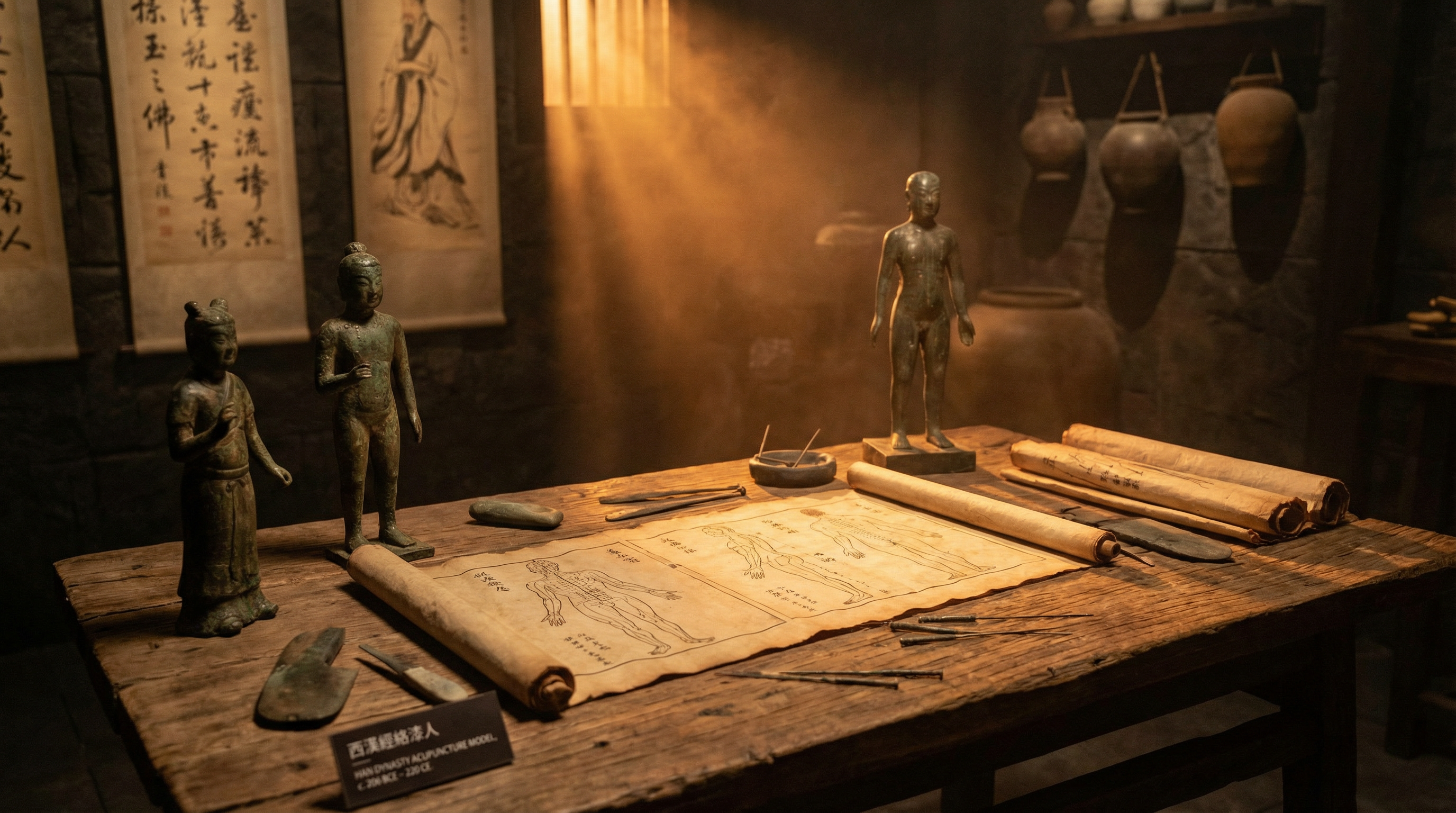
The Huangdi Neijing describes 365 acupuncture points along 12 meridians corresponding to organ systems — a map of the body's energy pathways that modern research is beginning to correlate with fascial planes and nerve pathways.
Choose your reading style:

By Marcus Hale
Independent Researcher & Archive Curator
Category: Medicine & Biology
Civilization: Ancient China
Time Period: Ancient
Short Description: The Huangdi Neijing describes 365 acupuncture points along 12 meridians corresponding to organ systems — a map of the body's energy pathways that modern research is beginning to correlate with fascial planes and nerve pathways.
Materials: N/A — medical knowledge system
Theories: Whether acupuncture meridians represent a physical anatomical system or a functional model of the nervous system remains debated. Some researchers propose that meridians correspond to interstitial fluid channels not visible in standard anatomical dissection.
Significance: Modern imaging studies using MRI and ultrasound have identified connective tissue planes that correspond to traditional acupuncture meridians. Randomised controlled trials have confirmed acupuncture's efficacy for specific conditions beyond placebo.
The Invisible Pathways: Unraveling the Mystery of Ancient Chinese Meridians
Imagine a medical system, developed millennia ago, that charted intricate pathways within the human body – pathways invisible to the naked eye, yet profoundly influential on health and disease. This is the enduring enigma of ancient Chinese acupuncture meridians. For centuries, Western science dismissed these "channels of energy" as mere philosophical constructs, poetic metaphors for an archaic understanding of physiology. Yet, as modern imaging technologies advance and rigorous scientific inquiry is applied, a startling truth is beginning to emerge: these ancient maps, meticulously detailed in texts like the Huangdi Neijing (The Yellow Emperor's Classic of Internal Medicine), may in fact correspond to tangible, anatomical structures. The Forbidden Archive delves into this profound intersection of ancient wisdom and contemporary discovery, exploring how a medical system born in antiquity continues to challenge and expand our understanding of the human body.
Echoes of Antiquity: Historical Background and Discovery Context
The origins of acupuncture, and by extension, the meridian system, are shrouded in the mists of prehistory, with evidence suggesting practices as old as the Neolithic period. However, the foundational texts that codified this intricate medical knowledge emerged during the Warring States period (475–221 BCE) and the Han Dynasty (206 BCE–220 CE). The undisputed cornerstone is the Huangdi Neijing, a monumental work attributed to the mythical Yellow Emperor. This text, particularly its "Suwen" (Basic Questions) and "Lingshu" (Spiritual Pivot) sections, meticulously describes a network of 12 primary meridians, 8 extraordinary meridians, and numerous collateral vessels, along with 365 specific acupuncture points. These points, often likened to wells or gates, were believed to be access points to the body's vital life force, or Qi (pronounced "chee").
The ancient Chinese physicians, without the benefit of modern dissection techniques (which were often culturally prohibited or limited), developed an astonishingly detailed understanding of the body's internal workings through careful observation, palpation, and perhaps, an intuitive grasp of interconnected systems. Their model was not one of isolated organs, but of a dynamic, flowing network where imbalances in Qi flow through these meridians led to illness. The concept of meridians was not merely a theoretical construct; it was the practical framework upon which all diagnostic and therapeutic interventions, from acupuncture to herbal medicine, were based.
Engineering the Invisible: Technical Analysis and What Makes it Remarkable
What makes the meridian system truly remarkable is its predictive power and the sheer complexity of its mapping. The Huangdi Neijing details the precise anatomical locations of 365 points – a number eerily close to the days in a year – and their specific therapeutic applications. Each of the 12 primary meridians is associated with a major organ system (e.g., Lung, Large Intestine, Stomach, Spleen, Heart, Small Intestine, Bladder, Kidney, Pericardium, Sanjiao/Triple Burner, Gallbladder, Liver) and follows a distinct, often symmetrical, pathway across the body. These pathways are not superficial; they are described as running deep, connecting internal organs to the body's surface.
The ancient texts describe the meridians as conduits for Qi and Blood, influencing physiological functions and maintaining homeostasis. The selection of specific points along these meridians was not arbitrary; it was based on a sophisticated understanding of their energetic properties and their interconnectedness. For instance, points on the Lung Meridian might be used to treat respiratory ailments, but also to address emotional imbalances like grief, reflecting a holistic view of mind and body that predates modern psychosomatic medicine by millennia.
The precision of these ancient descriptions, developed without advanced anatomical tools, is truly astounding. How could ancient practitioners accurately map these "invisible" pathways and predict their therapeutic effects with such consistency that the system has endured for thousands of years?
The Unseen Anatomy: Competing Theories and Scholarly Debate
The nature of acupuncture meridians has been a subject of intense debate for centuries. Traditionally, Western medicine, rooted in a reductionist, anatomically verifiable paradigm, struggled to reconcile the meridian concept with known physiological structures. Early skeptics dismissed them as purely metaphorical, lacking any physical basis.
However, modern research is challenging this long-held skepticism. Several compelling theories have emerged:
- Fascial Planes and Connective Tissue: A leading theory proposes that meridians correspond to the body's intricate network of fascia and connective tissue. Fascia, a continuous web of collagen and elastin, envelops muscles, organs, and nerves, creating a body-wide communication system. Studies using MRI, ultrasound, and histological analysis have shown that many acupuncture points and meridian lines lie along these fascial planes, particularly at junctures where connective tissue density is higher, or where nerves and blood vessels penetrate the fascia.
- Neural Pathways: Another theory suggests meridians represent a functional model of the nervous system, particularly peripheral nerves and neurovascular bundles. Many acupuncture points are located near major nerve trunks, and acupuncture's analgesic effects are often explained by its modulation of pain signals in the central and peripheral nervous systems.
- Interstitial Fluid Channels: More recently, some researchers have proposed the existence of "primo-vascular system" or "Bonghan ducts" – a network of microscopic, thread-like structures that transport interstitial fluid and immune cells. While still controversial and difficult to consistently replicate, these channels, if definitively proven, could offer a direct anatomical correlate for meridian pathways, explaining how signals and substances might be rapidly transported throughout the body outside of conventional circulatory or lymphatic systems.
- Bioelectric Phenomena: The concept of Qi as a form of bioelectricity or subtle energy flow has also been explored. Studies have shown that acupuncture points often exhibit lower electrical resistance and higher electrical conductivity compared to surrounding skin, suggesting unique biophysical properties.
The debate is no longer whether acupuncture works (numerous randomized controlled trials have confirmed its efficacy for conditions like chronic pain, nausea, and migraines, beyond placebo effects), but *how* it works, and what the meridians truly represent. The emerging consensus is that it's likely a multi-faceted phenomenon, involving a complex interplay of neurological, fascial, and perhaps even bioelectrical mechanisms.
Rewriting the Body's Blueprint: Challenging Conventional Narratives
The growing scientific validation of the acupuncture meridian system fundamentally challenges conventional historical narratives about ancient medicine and anatomy. For centuries, the prevailing view in the West was that detailed anatomical understanding only began with Greek dissection (e.g., Herophilus and Erasistratus) and later, the Renaissance (e.g., Vesalius). The Chinese, lacking extensive dissection, were presumed to have a less "scientific" or accurate understanding of the body's internal structures.
The meridian system, however, suggests an alternative, equally sophisticated, albeit different, mode of anatomical and physiological mapping. It implies that ancient Chinese physicians developed a functional, systemic understanding of the body's interconnectedness that, in some ways, predates and even parallels modern concepts like myofascial chains and neuro-immune interactions. Their "map" was not one of static organs, but of dynamic pathways of communication and influence. This forces us to reconsider what constitutes "anatomical knowledge" and acknowledge that different cultures developed unique, yet effective, ways of understanding the human form.
It also highlights the limitations of a purely reductionist approach when studying complex biological systems. The ancient Chinese understood the body as an integrated whole, where symptoms in one area could be treated by addressing imbalances in a seemingly distant meridian. This holistic perspective, once dismissed, is now gaining traction in modern integrative medicine.
The Enduring Legacy: Lasting Significance and Future Directions
The ancient Chinese acupuncture meridians stand as a testament to humanity's enduring quest to understand the mysteries of the body. What began as an intuitive, observational medical art, codified in ancient texts, is now becoming a frontier of modern scientific inquiry. The correlation of meridians with fascial planes, nerve pathways, and potentially novel interstitial fluid channels opens up exciting avenues for research into pain management, chronic disease, and even the body's self-healing mechanisms.
The significance of this ancient knowledge extends beyond therapeutic applications. It serves as a powerful reminder that profound insights can emerge from diverse cultural perspectives and methodologies. The "invisible pathways" of the meridians, once a source of skepticism, are now prompting a re-evaluation of our own anatomical maps and challenging us to look beyond the obvious. As we continue to probe the depths of ancient wisdom with the tools of modern science, the Forbidden Archive anticipates even more astonishing revelations about the sophisticated medical knowledge systems that flourished in antiquity, forever altering our perception of history and the human body.
Marcus Hale
Independent Researcher & Archive Curator
Marcus Hale is an independent researcher and the curator of The Forbidden Archive. He has spent over a decade studying anomalous ancient technologies, cross-referencing primary excavation reports, museum catalogues, and peer-reviewed journals to document artifacts that mainstream history struggles to explain.
Competing Theories
Whether acupuncture meridians represent a physical anatomical system or a functional model of the nervous system remains debated. Some researchers propose that meridians correspond to interstitial fluid channels not visible in standard anatomical dissection.


Archive Record
Civilization
Ancient China
Time Period
Ancient
Approximate Date
c. 200 BCE
Origin
China
Current Location
Preserved in Huangdi Neijing (Yellow Emperor's Classic)
Materials
N/A — medical knowledge system