Ancient India · Classical Antiquity
Yoga Sutras Neuroscience
6 min read
Last updated April 4, 2026
Patanjali's Yoga Sutras describe states of consciousness, neural pathways, and mind-body interactions with a precision that modern neuroscience is only beginning to validate.
Choose your reading style:

By Marcus Hale
Independent Researcher & Archive Curator
The Yoga Sutras and Modern Neuroscience: An Ancient Blueprint for the Mind
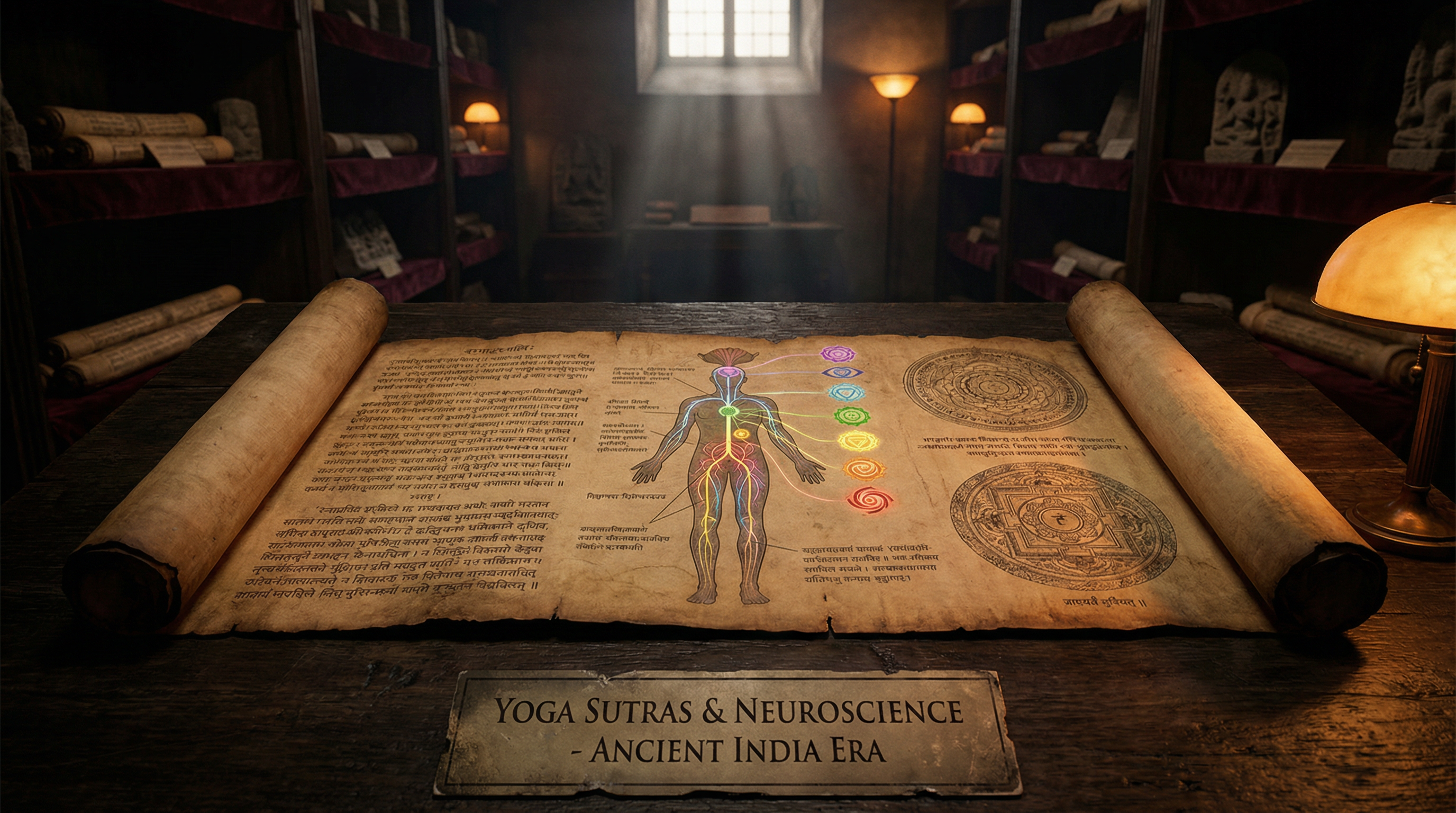
For millennia, the human mind has been an enigma, a complex tapestry of thought, emotion, and perception. While modern science grapples with the intricate wiring of the brain, seeking to decode its deepest secrets, an ancient text from Classical India offers a startlingly precise roadmap, one that predates the very concept of neuroscience by thousands of years. Patanjali's Yoga Sutras, a collection of aphorisms compiled around 400 CE, do not merely describe a philosophical system; they delineate states of consciousness, neural pathways, and mind-body interactions with an astonishing accuracy that contemporary scientific inquiry is only now beginning to validate. This profound textual knowledge system, devoid of advanced instrumentation, somehow managed to chart the inner landscape of the human experience, presenting a challenge to our understanding of ancient intellectual capabilities and the very nature of discovery itself.
Historical Background and Discovery Context
The Yoga Sutras are attributed to the sage Patanjali, though the exact dates of his life and the compilation of the text are subjects of scholarly debate, generally placed between 200 BCE and 400 CE. This period in Ancient India, often referred to as the Classical Age, was a crucible of intellectual and spiritual ferment, giving rise to sophisticated philosophical schools, intricate mathematical systems, and profound insights into human existence. The Sutras themselves are not a narrative but a collection of terse, aphoristic statements, designed to be memorized, chanted, and meditated upon. They form the foundational text of Raja Yoga, or "royal yoga," focusing on mental discipline and meditation. Unlike many ancient texts that describe ritual or mythology, the Yoga Sutras offer a systematic, almost clinical, approach to understanding and mastering the mind. Their "discovery," in a sense, is not of a physical artifact, but a re-evaluation of their profound scientific implications in the light of modern neuroscientific advancements, revealing an ancient understanding of the brain's plasticity and the mind's potential that transcends its historical context.
Technical Analysis and What Makes It Remarkable
What makes the Yoga Sutras truly remarkable is their detailed description of eight limbs or stages of yoga (Ashtanga Yoga), culminating in advanced states of consciousness. These stages, particularly the internal limbs of Dharana (concentration), Dhyana (meditation), and Samadhi (contemplation or absorption), correspond to specific physiological and neurological changes that modern science is now able to observe. The Sutras describe a progressive refinement of attention, leading to a state where the mind becomes one with the object of meditation, transcending ordinary sensory and cognitive processes. This is not merely metaphorical; it implies a profound alteration in brain activity.
For instance, researchers at institutions like Harvard and MIT have documented meditators achieving extraordinary feats of physiological control, such as significantly raising their body temperature in cold environments (Tumo meditation) or drastically reducing their metabolic rate. These abilities, once dismissed as anecdotal or mystical, are now being investigated through rigorous scientific protocols. The Yoga Sutras provide a theoretical framework for these phenomena, describing how sustained mental focus can influence the autonomic nervous system – the very system responsible for involuntary bodily functions like heart rate, breathing, and temperature regulation. The text implicitly suggests that the neural pathways governing these functions are not entirely beyond conscious control, a concept that challenges the traditional Western understanding of the mind-body divide.
Furthermore, the Sutras' descriptions of heightened awareness, altered perception of time, and the dissolution of the ego in advanced meditative states find intriguing parallels in contemporary fMRI studies. These studies on advanced meditators have revealed specific brainwave patterns (e.g., increased gamma wave activity associated with heightened awareness), changes in brain connectivity, and reduced activity in the default mode network (DMN), a set of brain regions active during self-referential thought and mind-wandering. The DMN's quieting is often linked to experiences of ego dissolution and a sense of interconnectedness, states uncannily similar to those described in the Yoga Sutras as leading to profound insight and liberation. The precision with which these ancient texts delineate these states, without any knowledge of neurons, synapses, or brain imaging, is nothing short of astounding.
Competing Theories and Scholarly Debate
While the parallels between the Yoga Sutras and modern neuroscience are compelling, scholarly debate exists regarding the interpretation and extent of these connections. Some scholars argue that attributing modern scientific concepts to ancient texts is a form of anachronism, imposing contemporary frameworks onto a different cultural and intellectual context. They contend that the Sutras are primarily a philosophical and spiritual guide, and any physiological descriptions are incidental or metaphorical rather than literal scientific observations. This perspective emphasizes the dangers of "retrofitting" ancient wisdom with modern scientific validation, potentially distorting the original intent and meaning of the texts.
Conversely, a growing body of researchers, particularly those engaged in contemplative neuroscience, argue that the Yoga Sutras represent a sophisticated "first-person science" of consciousness. They propose that through centuries of systematic introspection and empirical observation (albeit without external instruments), ancient yogis developed a profound understanding of the mind's mechanics. This perspective does not claim that Patanjali had an fMRI scanner, but rather that his observations of internal states and their effects on the body were remarkably accurate and systematic, forming a comprehensive model of consciousness that anticipates many modern discoveries. The debate often revolves around the methodology of ancient inquiry: was it merely philosophical speculation, or a rigorous, albeit internal, form of empirical investigation?
Why This Challenges Conventional Historical Narratives
The convergence of the Yoga Sutras with modern neuroscience profoundly challenges conventional historical narratives about the development of scientific thought. The prevailing view often places the origins of systematic scientific inquiry in ancient Greece or the European Enlightenment, emphasizing empirical observation through external instrumentation and mathematical modeling. The Yoga Sutras, however, present a powerful case for an alternative trajectory of knowledge acquisition – one based on rigorous, systematic introspection and the cultivation of inner awareness.
This challenges the notion that complex understandings of the brain and consciousness could only arise with advanced technology. It suggests that ancient civilizations, particularly in India, possessed methodologies for exploring the internal world with a precision that rivals, and in some aspects even prefigures, modern scientific discoveries. It forces us to reconsider what constitutes "science" and how profound knowledge can be attained. The Yoga Sutras imply that a deep, experiential understanding of neural pathways, autonomic control, and altered states of consciousness was accessible through disciplined mental training, long before the invention of the microscope or the fMRI machine. This paradigm shift invites a re-evaluation of ancient intellectual achievements and their potential contributions to contemporary scientific dilemmas, particularly in fields like consciousness studies and mental health.
Conclusion with Lasting Significance
The enduring legacy of Patanjali's Yoga Sutras lies not just in their spiritual guidance, but in their astonishing prescience regarding the intricate workings of the human mind and body. As modern neuroscience continues to unravel the mysteries of consciousness, it repeatedly finds echoes of its discoveries within these ancient aphorisms. The Sutras stand as a testament to humanity's enduring quest for self-understanding, demonstrating that profound insights into our inner landscape were achieved millennia ago through rigorous self-observation and disciplined practice.
This ancient Indian textual knowledge system is more than a historical curiosity; it is a living blueprint for exploring the frontiers of human potential. Its validation by contemporary scientific research bridges the chasm between ancient wisdom and modern science, suggesting that the path to understanding the mind may not always require increasingly complex external technologies, but rather a deeper, more refined engagement with our own internal experience. The Yoga Sutras remind us that the most profound discoveries may not be found by looking outward, but by turning our gaze inward, where the universe of consciousness awaits its ultimate exploration.
Marcus Hale
Independent Researcher & Archive Curator
Marcus Hale is an independent researcher and the curator of The Forbidden Archive. He has spent over a decade studying anomalous ancient technologies, cross-referencing primary excavation reports, museum catalogues, and peer-reviewed journals to document artifacts that mainstream history struggles to explain.
Competing Theories
The Yoga Sutras describe 8 stages of consciousness with physiological correlates. Researchers at Harvard and MIT have documented meditators achieving body temperature control and metabolic rate reduction consistent with the texts' descriptions.



Archive Record
Civilization
Ancient India
Time Period
Classical Antiquity
Approximate Date
c. 400 CE (compiled)
Origin
Indian subcontinent
Current Location
Preserved in Sanskrit manuscripts
Materials
N/A — textual knowledge system