Inca Empire / Pre-Inca cultures · Medieval
Andean Freeze-Drying Technology
7 min read
Last updated April 4, 2026
Andean cultures developed a freeze-drying process for food preservation using the natural conditions of the high Andes — a technology not replicated industrially until the 20th century.
Choose your reading style:

By Marcus Hale
Independent Researcher & Archive Curator
The Frozen Legacy: Unlocking the Secrets of Andean Food Security
Imagine an empire so vast, so meticulously organized, that it could feed millions across diverse and often harsh landscapes, ensuring food security for decades, even centuries. Now, imagine this feat achieved not with modern refrigeration or industrial processing, but with a technology born from the very environment itself, a process so ingenious it wasn't truly replicated on an industrial scale until the 20th century. This is the story of Andean freeze-drying, a profound testament to the scientific acumen of the Inca and their predecessors. In the dizzying heights of the Andes, where thin air meets biting cold nights and intense daytime sun, ancient peoples unlocked a secret to immortality – for their food, at least. This wasn't magic, but a sophisticated understanding of physics and biology, yielding a product that sustained an empire and continues to fascinate modern scientists. Join us as we delve into the remarkable world of chuño, the freeze-dried potato that defied time and fed an empire.
A Timeless Tradition: Historical Roots of Andean Food Preservation
While the Inca Empire, flourishing from the 13th to the 16th century, is often credited with the most sophisticated application of freeze-drying, the origins of this technology stretch back much further. Archaeological evidence suggests that the practice of processing potatoes into a durable, storable form predates the Inca by millennia, likely emerging with early agricultural communities in the high altiplano of Peru and Bolivia. These early Andean peoples, confronted by the challenges of unpredictable harvests and the need to sustain populations in high-altitude environments, were forced to innovate. The potato, a staple crop, was abundant but perishable. Its transformation into chuño (and its lighter, whiter counterpart, moraya) was not merely a convenience; it was a matter of survival.
Spanish chroniclers, upon their arrival in the Andes in the 16th century, marveled at the vast storehouses, or qollqas, filled with chuño and other preserved goods. These accounts provide invaluable insights into the scale and efficiency of the Inca's food distribution and storage systems. The Inca state meticulously managed agricultural production, collecting surpluses and storing them in these strategically located facilities, often carved into hillsides or built on high, windy plains to maximize natural ventilation and cold. This infrastructure, supported by the freeze-drying technology, allowed the Inca to maintain multi-year food reserves, a crucial buffer against famine, natural disasters, and to provision their armies and administrative centers.
The Engineering of Nature: How Chuño is Made
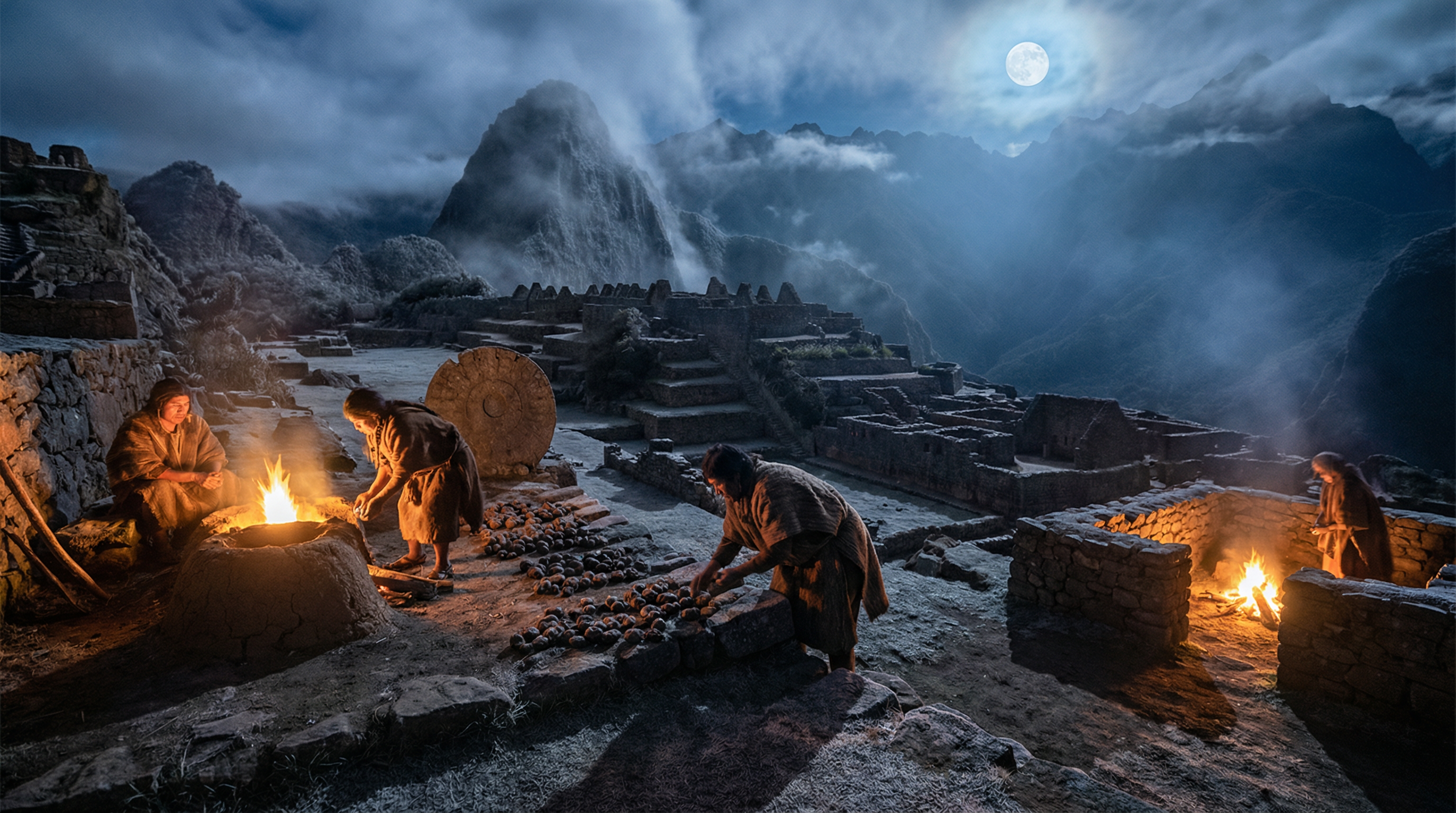
The process of creating chuño is a brilliant example of bio-mimicry and environmental engineering. It leverages the unique climatic conditions of the high Andes: freezing nights, intense daytime solar radiation, and low atmospheric pressure. The traditional method, still practiced in some communities today, unfolds over several days or weeks:
- Spreading and Freezing: Potatoes are spread out on the ground, often on straw mats or open rocky surfaces, at altitudes typically above 3,800 meters (12,500 feet). During the cold, clear nights, temperatures plummet below freezing, causing the water within the potato cells to crystallize.
- Thawing and Trampling: As the sun rises, the ice crystals within the potatoes begin to thaw. Crucially, the cell walls, weakened by the freezing, become permeable. Farmers then walk barefoot over the thawing potatoes, trampling them to expel the now-liquidized water. This mechanical pressing is vital for moisture removal.
- Repetition and Drying: This freeze-thaw-trample cycle is repeated for several days, sometimes up to two weeks. Each night, more water freezes; each day, more is pressed out. The potatoes gradually shrink and blacken, becoming increasingly dense and dry.
- Washing and Final Drying (for Moraya/Tunta): For a whiter, milder product known as moraya or tunta, the partially processed potatoes are submerged in cold, flowing water (often a stream) for several days. This leaches out bitter solanine compounds and helps to further whiten the potato flesh. After washing, they are spread out again to dry completely in the sun and wind, sometimes for weeks, until they are rock-hard and lightweight.
What makes this process truly remarkable is its elegant simplicity and effectiveness. It's a natural form of lyophilization – freeze-drying – where water is removed by sublimation (ice directly to vapor) and mechanical pressing, without the need for heat or complex machinery. The resulting chuño is incredibly stable, resistant to spoilage, and can be stored for decades, even centuries, without significant degradation. It's lightweight, making it easy to transport, and rehydrates readily when soaked in water, providing a nutritious and calorie-dense food source.
Beyond the Potato: Competing Theories and Broader Applications
While chuño from potatoes is the most famous example, Andean freeze-drying wasn't limited to a single crop. Evidence suggests similar techniques were applied to other high-altitude staples. Quinoa, another resilient Andean grain, was likely processed for long-term storage, though perhaps not with the same freeze-thaw-trample intensity due to its different cellular structure. More intriguingly, some scholars propose that meat, particularly camelid meat (llama and alpaca), was also subjected to a form of freeze-drying or a combination of freezing and air-drying to create ch'arki (jerky), a highly durable protein source. The principles of leveraging the cold, dry Andean environment for preservation were broadly understood and adapted.
Scholarly debate often centers on the precise mechanisms of cellular breakdown and water removal. Some argue that the repeated freezing and thawing are paramount, while others emphasize the crucial role of the trampling process in physically expelling water from the compromised cell structures. Modern food scientists have studied chuño production as a model for sustainable, low-energy food preservation, particularly in remote or developing regions. The efficiency of the Inca system, capable of producing vast quantities of chuño, challenges the notion that complex food processing requires advanced industrial infrastructure. It demonstrates a profound empirical understanding of biochemistry and environmental physics.
Rewriting History: Challenging Conventional Narratives of Technology
The Andean freeze-drying technology fundamentally challenges conventional historical narratives that often place the origins of sophisticated food preservation in the modern era, particularly with the advent of canning, refrigeration, and industrial freeze-drying in the 19th and 20th centuries. The Inca and pre-Inca cultures were not merely subsistence farmers; they were advanced agricultural engineers and food technologists. Their ability to harness natural forces to create a product with such an extended shelf life speaks to a level of scientific observation and practical application that is often underestimated in non-Western civilizations.
This technology allowed for the emergence of a complex, centralized state like the Inca Empire, capable of supporting large populations, specialized labor, and extensive public works. Without reliable, long-term food storage, such an empire would have been impossible to sustain. It highlights that technological innovation isn't solely driven by metallurgy or mechanical inventions but can arise from a deep, nuanced understanding of one's environment and its resources. The Andean example forces us to reconsider what constitutes "advanced" technology and to appreciate the diverse paths human ingenuity has taken across the globe.
The Enduring Legacy: A Model for Sustainable Futures
The significance of Andean freeze-drying extends far beyond its historical context. In an era increasingly concerned with food security, climate change, and sustainable practices, the ancient wisdom embedded in chuño production offers valuable lessons. It demonstrates how to minimize food waste, create resilient food systems, and leverage natural resources efficiently. Modern industrial freeze-drying, while highly effective, is energy-intensive. The Andean method, in contrast, is carbon-neutral and relies solely on ambient conditions.
Chuño itself remains a vital food source in many Andean communities, a living testament to its efficacy and cultural importance. It stands as a powerful symbol of human adaptability, ingenuity, and the profound knowledge that can be gleaned from observing and interacting with the natural world. The humble, rock-hard potato, transformed by the Andean sun and frost, reminds us that some of the most extraordinary technological achievements are not found in gleaming factories, but in the timeless traditions of those who learned to thrive in harmony with their environment.
Marcus Hale
Independent Researcher & Archive Curator
Marcus Hale is an independent researcher and the curator of The Forbidden Archive. He has spent over a decade studying anomalous ancient technologies, cross-referencing primary excavation reports, museum catalogues, and peer-reviewed journals to document artifacts that mainstream history struggles to explain.
Competing Theories
The Inca chuño production system was so efficient that the empire maintained multi-year food reserves at strategic locations throughout the Andes. Modern food scientists have studied the process as a model for sustainable food preservation.

Archive Record
Civilization
Inca Empire / Pre-Inca cultures
Time Period
Medieval
Approximate Date
c. 1000–1533 CE
Origin
Andes Mountains, Peru and Bolivia
Current Location
Archaeological sites throughout the Andes
Materials
Potatoes, quinoa, meat