Roman Empire · Ancient
Roman Testudo Formation
7 min read
Last updated April 4, 2026
The Roman tortoise formation — an interlocking shield wall so effective that modern military engineers have tested it and found it can withstand machine gun fire.
Choose your reading style:

By Marcus Hale
Independent Researcher & Archive Curator
Welcome, seekers of ancient truths, to The Forbidden Archive. Today, we delve into a marvel of ancient military engineering, a testament to Roman ingenuity and discipline that continues to confound modern understanding: the Testudo Formation. Imagine a phalanx of hardened warriors, not merely standing shoulder-to-shoulder, but transformed into a living, breathing, armored tank – a collective technology so profoundly effective that its principles resonate even in the age of ballistic weaponry. This isn't just a historical footnote; it's a profound statement on the power of systems engineering, human coordination, and the relentless pursuit of tactical superiority. How did a formation of men, armed with iron shields, achieve a level of protection that modern military engineers at institutions like Sandhurst have found capable of withstanding even machine gun fire? The answers lie in a sophisticated understanding of physics, geometry, and the psychology of collective action.
Historical Background and Discovery Context
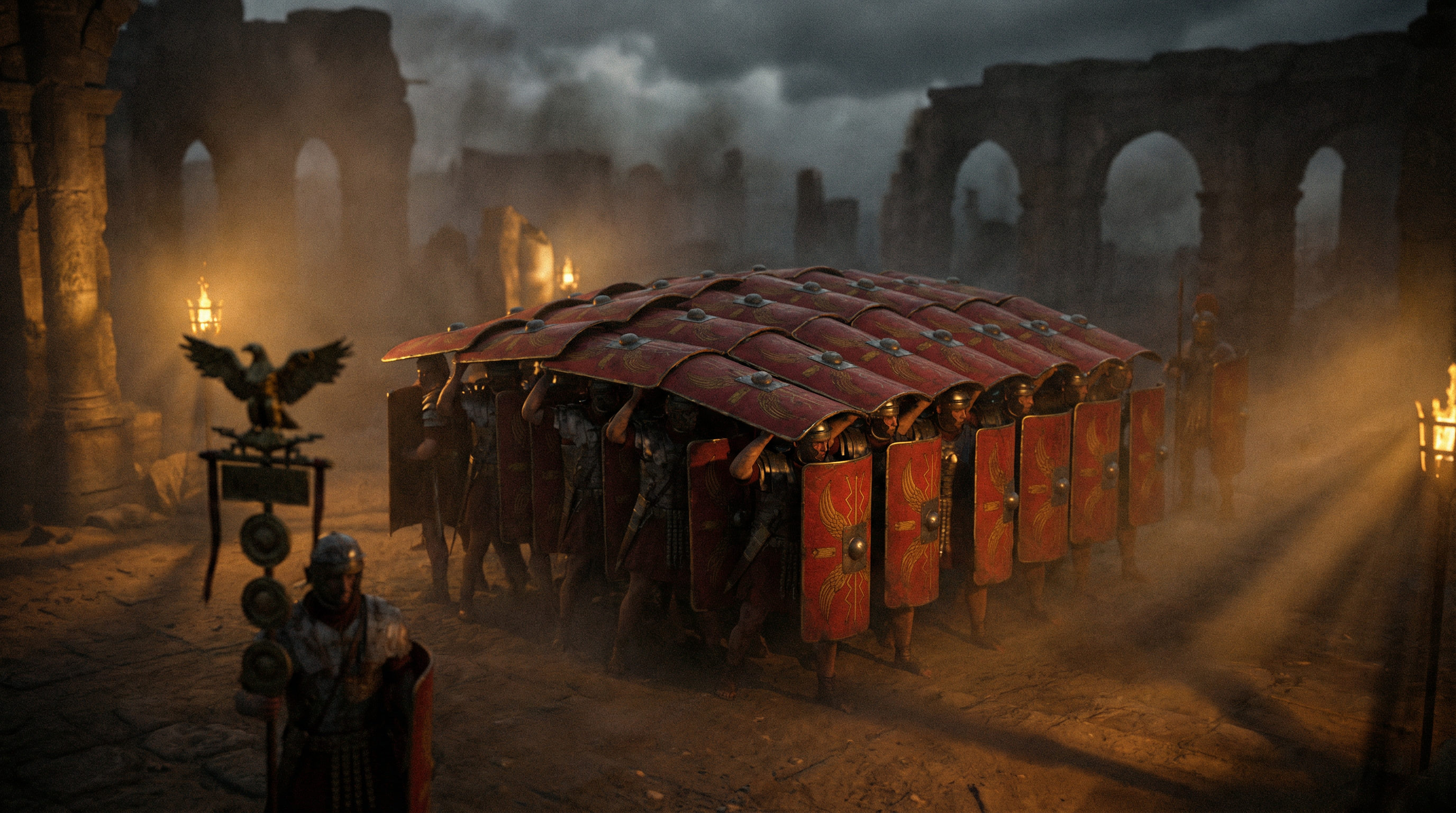
The Roman Testudo, meaning "tortoise" in Latin, emerged as a critical tactical formation during the late Republic and Imperial periods, though its conceptual roots might stretch back further. While not a "discovery" in the archaeological sense of an unearthed artifact, its existence and application are meticulously documented in primary sources from historians like Tacitus, Dio Cassius, and Livy. These accounts describe its use primarily during sieges, where legions needed to advance against fortified positions under a hail of projectiles – arrows, javelins, stones, and even boiling oil. The genius of the Testudo wasn't in its individual components, but in their synergistic arrangement. Each legionary, typically equipped with the iconic rectangular *scutum*, would interlock their shields: those in the front and sides held theirs vertically to protect the flanks, while those in the middle and rear held theirs horizontally overhead, forming a continuous, overlapping roof. This wasn't a spontaneous maneuver; it was a highly trained, disciplined evolution, drilled into every legionary until it became second nature, a fluid transformation from individual soldier to an armored, mobile fortress.
The Testudo wasn't a static defense; it was a method of advance. It allowed legions to approach walls, undermine foundations, or breach gates with a degree of impunity previously unimaginable. Its psychological impact on defenders, witnessing an apparently impervious block of humanity advancing relentlessly, must have been immense. It symbolized Roman resolve, an unyielding force that could absorb the worst an enemy could throw at it and still press forward. Its deployment was not universal; it was a specialized tool for specific, high-risk scenarios, primarily urban warfare and siege operations, where the threat of overhead projectiles was paramount. Yet, its very existence speaks volumes about the Roman military's analytical approach to combat, dissecting threats and devising ingenious, collective solutions.
Technical Analysis and What Makes It Remarkable
At first glance, the Testudo appears deceptively simple: men holding shields. But its true brilliance lies in its underlying engineering principles, a testament to an intuitive understanding of mechanics and force distribution. The primary material, the *scutum*, was typically made of several layers of wood, covered in leather or canvas, with an iron boss (umbo) at the center. While robust, a single *scutum* could be penetrated by a powerful projectile. The Testudo, however, wasn't about individual shield strength; it was about collective structural integrity.
The key to its remarkable resilience lies in its geometry. When shields are interlocked and overlapped, they create a multi-layered, arched structure. Any projectile striking the top or sides would not impact a single shield in isolation. Instead, the force would be distributed across multiple shields, and crucially, across the entire formation. Imagine a series of interconnected arches: a force applied to one point is dissipated through the entire system. This is precisely what happens in a Testudo. The downward force of a projectile hitting an overhead shield is transferred laterally to adjacent shields, and then downwards through the men holding them, and ultimately into the ground. This "load sharing" mechanism is a fundamental principle of modern structural engineering.
Modern military experiments, particularly those conducted at institutions like the British Army's Sandhurst Royal Military Academy, have provided astonishing empirical validation for the Testudo's effectiveness. Recreations using historically accurate materials and formations, subjected to high-velocity projectiles, have demonstrated that the interlocking shield wall can indeed withstand significant impact forces. The geometry effectively deflects and absorbs energy, preventing penetration and minimizing blunt force trauma to the soldiers beneath. This isn't just about deflection; it's about the formation acting as a single, deformable, yet incredibly robust unit. The slight give and flex within the interconnected shields would absorb kinetic energy, much like a modern composite armor system. The Testudo, in essence, was a human-powered, mobile, multi-layered composite armor system, designed to distribute and dissipate impact energy.
Competing Theories and Scholarly Debate
While the general effectiveness of the Testudo is widely accepted, scholarly debate often centers on its precise applications, limitations, and the degree of its invulnerability. Some historians argue that while effective against light projectiles like arrows and javelins, it would have been vulnerable to heavier siege engines or concentrated volleys of large stones, which could potentially collapse sections of the formation. Others counter that the Romans would have adapted its deployment, using it only when appropriate, and that its primary purpose was to mitigate, not entirely eliminate, risk.
Another point of contention is the internal dynamics of the formation. How did soldiers breathe? How did they maintain cohesion and visibility? While the overhead shields provided protection, they also severely restricted situational awareness. This suggests that the Testudo was primarily an offensive maneuver for direct advance, not a long-term defensive posture. Furthermore, the sheer physical exertion required to hold such a formation, especially under fire, would have been immense, highlighting the extraordinary physical conditioning and discipline of the Roman legionary.
There's also debate about the "machine gun fire" claim. While Sandhurst experiments provide compelling evidence of its resilience against significant projectile forces, it's crucial to contextualize. It's unlikely a Testudo could withstand sustained, direct machine gun fire without eventually breaking. However, the experiments likely demonstrate its capacity to absorb *individual* high-velocity impacts, and crucially, how its structural integrity distributes that force, preventing localized catastrophic failure. The key takeaway isn't absolute invulnerability, but an astonishing degree of protection that far exceeded what one might expect from individual shields.
Why This Challenges Conventional Historical Narratives
The Roman Testudo challenges conventional narratives by forcing us to reconsider the sophistication of ancient military technology and engineering. Often, ancient warfare is depicted as rudimentary, relying on brute force and simple weaponry. The Testudo, however, reveals a profound understanding of physics, geometry, and human systems. It wasn't just about individual bravery or weapon quality; it was about the intelligent design of a collective entity.
It also forces us to view ancient armies not just as collections of individuals, but as highly integrated systems. The Testudo is a prime example of a "human machine" – a collective technology where the whole is far greater than the sum of its parts. This systems-engineering approach, where individual components (soldiers with shields) are optimized and integrated to create a superior functional unit, is a concept we often associate with modern industrial and military complexes. The Romans were applying these principles millennia ago, demonstrating a level of abstract strategic and tactical thinking that is often underestimated.
Furthermore, the modern validation of the Testudo's resilience, particularly against forces approaching modern ballistic impacts, bridges the gap between ancient historical accounts and contemporary scientific understanding. It elevates the Roman military from a historical curiosity to a subject of serious engineering and materials science inquiry, proving that their solutions were not just effective for their time, but embody timeless principles of structural integrity and force distribution. It reminds us that "ancient" does not equate to "primitive."
Conclusion with Lasting Significance
The Roman Testudo Formation stands as an enduring testament to the genius of ancient military engineering and the unparalleled discipline of the Roman legion. It was more than just a battle formation; it was a sophisticated, collective technology – a human machine designed to overcome seemingly insurmountable obstacles. Its ability to transform individual soldiers into an armored, mobile unit, distributing impact forces across an entire structure, reveals an intuitive understanding of physics that continues to impress modern engineers.
The lasting significance of the Testudo extends beyond military history. It serves as a powerful reminder that innovation and complex problem-solving are not exclusive to any single era. The Romans, through careful observation, rigorous training, and a systems-level approach, devised a solution that remains remarkably effective even when scrutinized by 21st-century scientific methods. It challenges us to look beyond the superficial, to delve into the underlying principles of ancient achievements, and to recognize the profound intellectual depth that underpinned many of the "mysteries" of the past. The Testudo is not merely a historical curiosity; it is a blueprint for collective resilience, a symbol of human ingenuity, and a compelling argument for the enduring power of disciplined, integrated action.
Marcus Hale
Independent Researcher & Archive Curator
Marcus Hale is an independent researcher and the curator of The Forbidden Archive. He has spent over a decade studying anomalous ancient technologies, cross-referencing primary excavation reports, museum catalogues, and peer-reviewed journals to document artifacts that mainstream history struggles to explain.
Competing Theories
Modern military experiments at Sandhurst have shown the testudo formation can withstand significant projectile fire. Its geometry distributes impact forces across the entire formation.
Archive Record
Civilization
Roman Empire
Time Period
Ancient
Approximate Date
c. 300 BC – 400 AD
Origin
Roman Empire
Discovered
Historical accounts and Trajan's Column reliefs
Current Location
Historical record and archaeological evidence
Materials
Iron shields (scutum), legionary armor