Ancient Spartan · Ancient
Spartan Krypteia Secret Police
6 min read
Last updated April 4, 2026
The Spartan state's secret terror program in which elite young warriors were sent to hunt and kill Helot slaves at night to maintain social control and test military readiness.
Choose your reading style:

By Marcus Hale
Independent Researcher & Archive Curator
Welcome, intrepid explorers of the past, to The Forbidden Archive. Today, we delve into one of the most chilling and enigmatic institutions of the ancient world: the Spartan Krypteia. Far from the gleaming bronze and disciplined phalanxes that typically define Sparta, the Krypteia operated in the shadows, a brutal, clandestine arm of the state designed to maintain an iron grip on a subjugated population. It was a secret police force unlike any other, not just for intelligence gathering, but for state-sanctioned terror and the ultimate test of a Spartan warrior's ruthlessness. Prepare to uncover the dark heart of Sparta's military machine, where the line between soldier and executioner blurred, and the night belonged to the hunters.
Historical Background: The Helot Problem and Spartan Paranoia
To understand the Krypteia, one must first grasp the precarious foundation upon which Spartan society rested. Unlike other Greek city-states, Sparta did not rely on a large citizen population for its agricultural labor. Instead, it enslaved the indigenous populations of Messenia and Laconia, transforming them into a vast underclass known as the Helots. These Helots vastly outnumbered their Spartan masters, perhaps by a ratio of 7:1 or even higher. This demographic imbalance created a constant, gnawing fear within the Spartan elite – the fear of Helot rebellion. This existential threat shaped every aspect of Spartan life, from its rigid social structure to its relentless military training, the Agoge.
Ancient sources, though often biased, provide fragmented glimpses into the Krypteia. Thucydides, in his History of the Peloponnesian War, chillingly recounts an incident where 2,000 Helots, promised freedom for their service in battle, were instead secretly massacred by the Spartans. Aristotle, in his Politics, describes the Krypteia as a state-sanctioned practice where young Spartans would "go out into the countryside, armed with daggers, and kill any Helot they found." Plutarch, in his Life of Lycurgus, offers the most detailed, if sensationalized, account, portraying it as a brutal "secret service" designed to "purge" the Helot population and instill terror. These disparate accounts, while lacking a single, definitive treatise on the Krypteia, paint a consistent picture of a state-sponsored program of violence and intimidation.
Technical Analysis: An Institutionalized Reign of Terror
The "technical specifications" of the Krypteia are not found in material artifacts, but in the chilling mechanics of an institutionalized practice. It was a program of psychological warfare and social control, meticulously woven into the fabric of Spartan military training. The Krypteia was not an ad-hoc vigilante group; it was a state-sanctioned operation, likely overseen by the ephors, Sparta's powerful overseers.
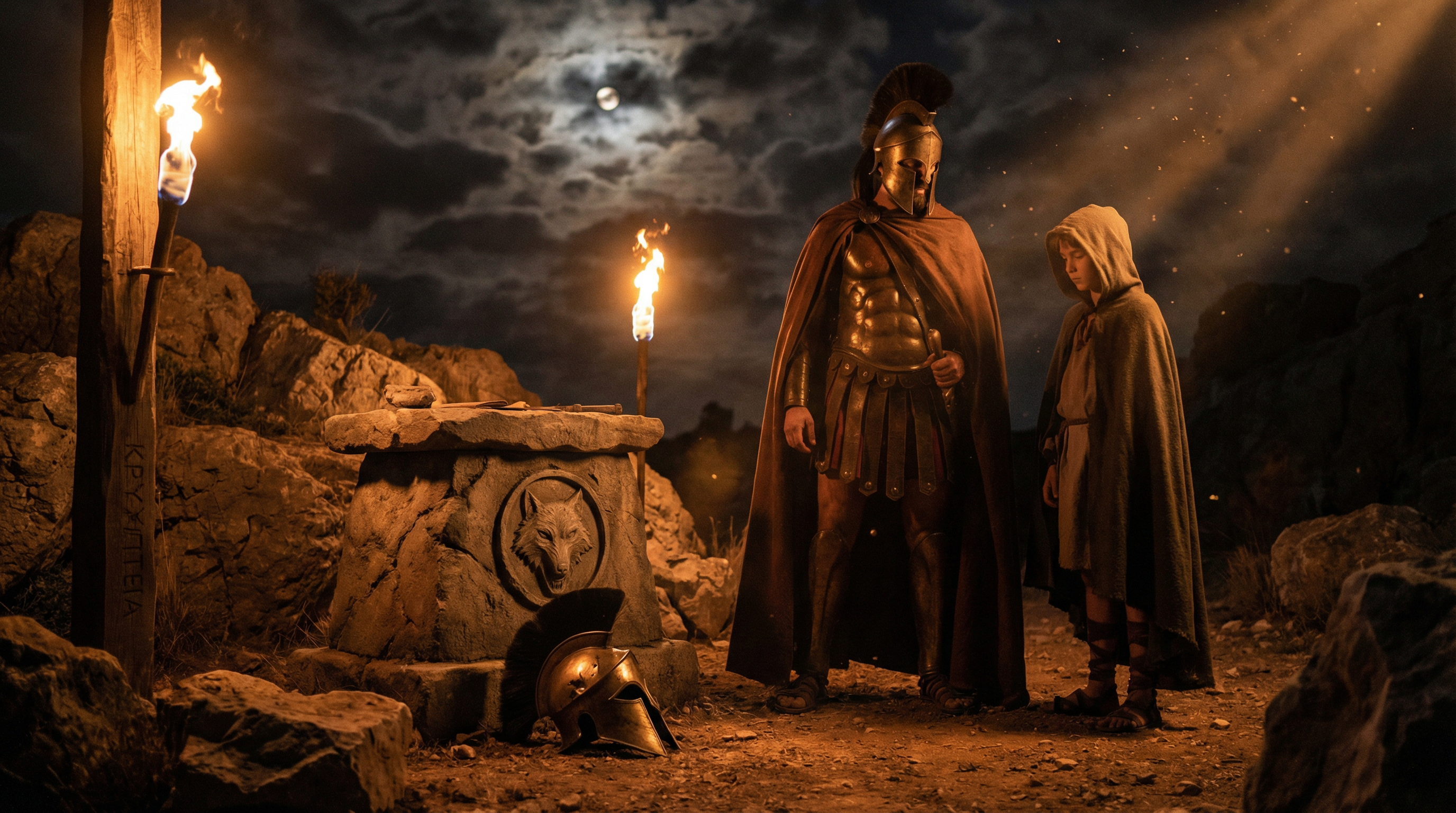
Young Spartan men, having completed the rigorous Agoge, were selected for the Krypteia. These were not raw recruits, but elite warriors, honed by years of brutal training, skilled in stealth, endurance, and lethal combat. They were dispatched into the countryside, often at night, armed with little more than a dagger, and instructed to live off the land, surviving by their wits. Their primary mission: to hunt and kill Helots. This was not random violence; it was targeted, calculated murder, designed to eliminate potential leaders, instill fear, and remind the Helot population of their precarious existence. Any Helot found wandering at night, or deemed too physically robust or assertive, became a target.
What makes the Krypteia truly remarkable, and profoundly disturbing, is its dual purpose. Firstly, it served as a brutal "final exam" for Spartan warriors. It tested their ability to operate independently, to survive in hostile territory, to track, to kill, and to do so without compunction. It was a crucible designed to forge not just soldiers, but utterly ruthless instruments of the state, devoid of empathy for the "other." Secondly, and perhaps more importantly, it was a terror mechanism. The constant threat of the Krypteia, the knowledge that an unseen predator might emerge from the darkness at any moment, served as a powerful deterrent against Helot rebellion. It was a constant, low-level war waged against their own population, ensuring compliance through fear.
Competing Theories and Scholarly Debate
Despite the ancient accounts, the exact nature, scale, and frequency of the Krypteia remain subjects of intense scholarly debate. Some historians, like Paul Cartledge, argue that the Krypteia was a regular, institutionalized practice, a cornerstone of Spartan social control and military training. They point to the consistency of the ancient sources, despite their varying levels of detail, as evidence of its reality and significance.
Other scholars, however, are more cautious. They suggest that the ancient accounts, particularly those from non-Spartan writers, might be exaggerated or even sensationalized propaganda designed to portray Sparta in a negative light. They argue that a constant, widespread campaign of murder would be counterproductive, potentially inciting the very rebellion it sought to prevent. These scholars propose that the Krypteia might have been a less frequent, more targeted operation, perhaps reserved for times of heightened tension or as a response to specific threats. Some even suggest it might have been a rite of passage that involved symbolic violence rather than widespread slaughter, though this interpretation is less widely accepted given the explicit language of the ancient texts.
The lack of direct Spartan records, due to their famously laconic nature and the destruction of much of their literary output, further complicates the picture. We are left to piece together the truth from the perspectives of outsiders, who may have had their own agendas. Nevertheless, the consensus remains that some form of state-sanctioned violence against the Helots, under the guise of the Krypteia, did exist, even if its precise operational parameters are debated.
Challenging Conventional Historical Narratives
The existence of the Krypteia profoundly challenges the romanticized image of Sparta often presented in popular culture – that of a purely honorable, disciplined, and courageous warrior society. It peels back the veneer of martial glory to reveal a darker, more pragmatic, and deeply unsettling reality. Sparta's military supremacy was not solely built on superior training and unwavering courage; it was also predicated on a foundation of institutionalized terror and the brutal subjugation of a vast underclass.
The Krypteia forces us to confront the moral compromises inherent in maintaining power, particularly in a system built on extreme inequality. It demonstrates how a state, even one lauded for its military prowess and civic dedication, could resort to systematic violence against its own population to preserve its social order. This aspect of Spartan history is often overlooked or downplayed, as it complicates the heroic narrative. Yet, it is precisely this uncomfortable truth that offers a more complete and accurate understanding of one of antiquity's most formidable, and feared, civilizations.
Conclusion: A Legacy of Fear and Control
The Spartan Krypteia stands as a chilling testament to the lengths a state will go to maintain control. It was not a weapon of war in the conventional sense, but a tool of internal repression, a psychological weapon wielded in the dead of night. Its legacy resonates far beyond the plains of ancient Laconia, offering a stark historical precedent for state-sponsored terror and secret police forces that would emerge in later totalitarian regimes.
By examining the Krypteia, we gain a deeper, albeit disturbing, insight into the true cost of Sparta's military might. It reminds us that even the most celebrated societies can harbor dark secrets, and that the pursuit of order and dominance can lead to the institutionalization of unimaginable cruelty. The shadow blades of Sparta may have vanished into history, but the questions they raise about power, fear, and the human cost of control continue to echo through the ages, urging us to look beyond the heroic narratives and confront the uncomfortable truths of the past.
Marcus Hale
Independent Researcher & Archive Curator
Marcus Hale is an independent researcher and the curator of The Forbidden Archive. He has spent over a decade studying anomalous ancient technologies, cross-referencing primary excavation reports, museum catalogues, and peer-reviewed journals to document artifacts that mainstream history struggles to explain.
Competing Theories
The Krypteia served dual purposes: psychological terror to suppress Helot rebellion and a brutal final exam for Spartan warriors. Some scholars debate its scale and frequency.
Archive Record
Civilization
Ancient Spartan
Time Period
Ancient
Approximate Date
c. 700 – 371 BC
Origin
Sparta, Greece
Discovered
Historical accounts by Plutarch and Thucydides
Current Location
Historical record only
Materials
N/A — institutional practice