Sui Dynasty / Tang Dynasty China · Medieval
Ancient Chinese Canal System
4 min read
Last updated April 4, 2026
The Grand Canal of China, begun in 486 BCE and expanded to 1,776 km in 605 CE, is the world's longest and oldest canal system, featuring pound locks that predated European lock technology by 600 years.
Choose your reading style:

By Marcus Hale
Independent Researcher & Archive Curator
Category: Architecture & Engineering
Civilization: Sui Dynasty / Tang Dynasty China
Time Period: Medieval
The Silent Flow of Empire: Unveiling China's Grand Canal
Imagine a river, not born of mountains and rain, but of human will and ingenuity, stretching for thousands of kilometers, connecting disparate regions, and feeding an empire. This is not a myth, but the tangible reality of the Grand Canal of China, a colossal feat of engineering that dwarfs many of the ancient world's wonders. Its silent waters have carried the lifeblood of Chinese civilization for centuries, a testament to a level of hydraulic mastery that often goes unacknowledged in the Western historical narrative. How did a civilization, centuries before the European Renaissance, manage to construct and maintain such a vast and complex waterway, complete with technologies that wouldn't appear in the West for another half-millennium? The answers lie within the Grand Canal's meticulously engineered banks, a story of ambition, innovation, and an enduring legacy.
From Humble Beginnings to Imperial Lifeline: A Historical Tapestry
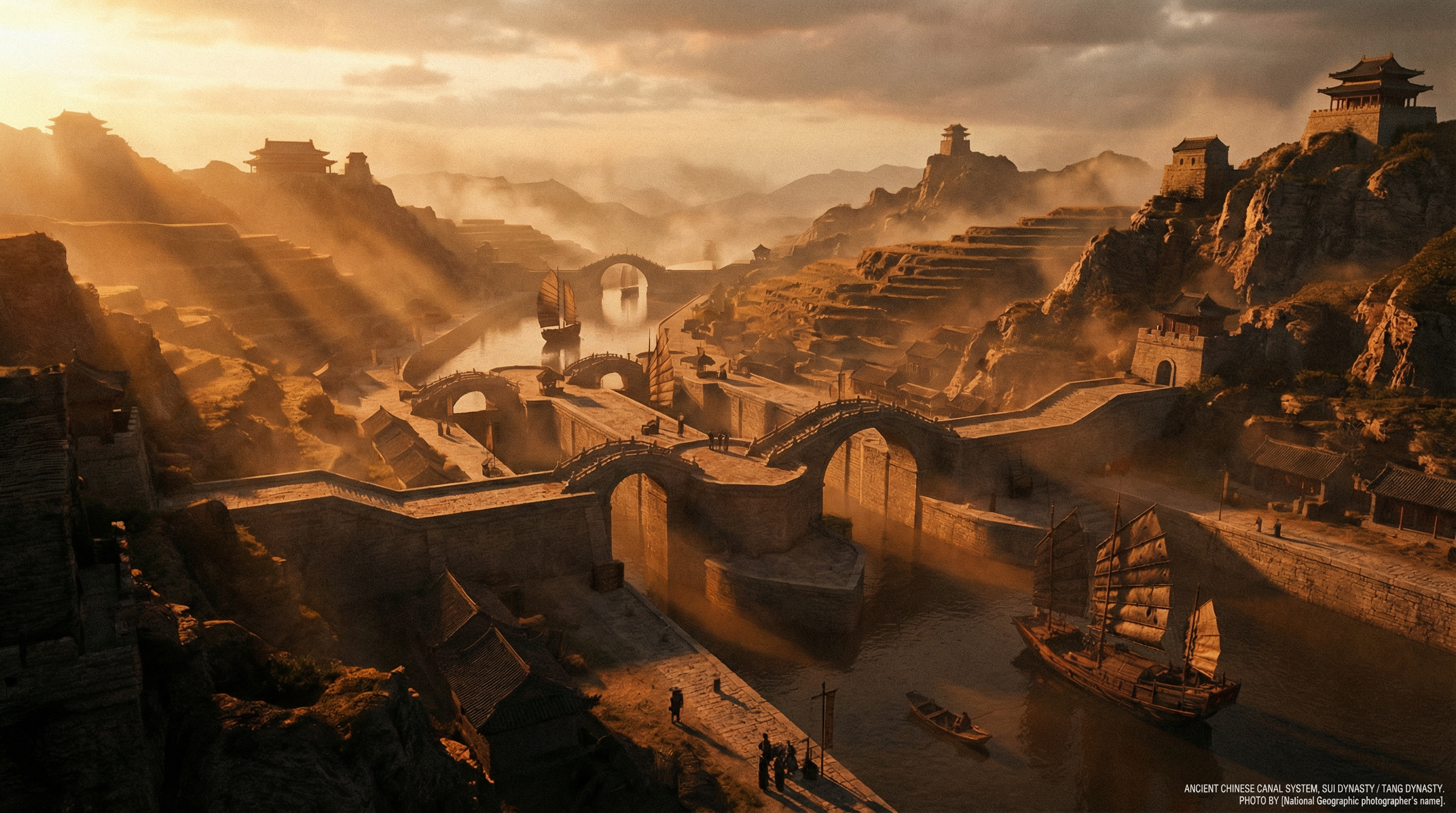
While often associated with the Sui Dynasty's monumental efforts, the origins of the Grand Canal stretch back much further, to 486 BCE. It was then, during the Spring and Autumn period, that King Fuchai of Wu ordered the construction of the Han Gou (Han Canal), connecting the Yangtze River with the Huai River. This early segment laid the groundwork for what would become an unparalleled network. However, it was during the tumultuous yet ambitious reign of Emperor Yang of the Sui Dynasty (604-618 CE) that the Grand Canal truly took its definitive form. Driven by a desire to unify his vast empire, transport grain from the fertile south to the often-famine-stricken north, and facilitate military campaigns, Emperor Yang embarked on an unprecedented expansion program. Millions of conscripted laborers toiled for years, linking existing waterways and digging new channels, ultimately extending the canal to an astonishing 1,776 kilometers by 605 CE. This Herculean undertaking, while contributing to the Sui Dynasty's downfall due to its immense human cost, solidified the canal's role as the economic and logistical backbone of subsequent dynasties, most notably the Tang and Yuan.
The Unseen Genius: Technical Marvels of the Grand Canal
What makes the Grand Canal truly extraordinary is not just its sheer scale, but the sophisticated engineering principles applied to overcome immense geographical challenges. The canal traverses multiple watersheds, requiring ingenious solutions to manage varying water levels and elevations. While earlier sections relied on simple ramp-and-lock systems, the true game-changer arrived in 984 CE with the invention of the pound lock by the Song Dynasty engineer Qiao Weiyue. This innovation, featuring two gates that could be opened and closed to raise or lower water levels in an intermediate chamber, allowed boats to navigate significant changes in elevation with relative ease and efficiency. This technology would not appear in European canals until the 16th century, a staggering 600-year lead. Furthermore, the canal's construction involved cutting through mountains, such as the section near Luoyang, and navigating complex hydrological systems, demanding an advanced understanding of hydraulics, soil mechanics, and water management. The precision required to maintain consistent water flow over such vast distances, preventing silting in some sections and ensuring navigability in others, speaks to a highly developed engineering tradition.
Beyond Simple Digging: Challenging Conventional Narratives
The existence and sustained operation of the Grand Canal, particularly with its advanced pound lock technology, fundamentally challenges the often Eurocentric view of technological progress. For too long, the narrative has positioned Europe as the sole crucible of innovation, with other civilizations playing catch-up. The Grand Canal, however, stands as irrefutable evidence of independent and, in many aspects, superior technological development in medieval China. The sophisticated hydraulic engineering, the ability to manage complex water systems across thousands of kilometers, and the invention of the pound lock centuries ahead of the West, force us to reconsider the timeline and geographical distribution of scientific and engineering breakthroughs. It demonstrates that complex problem-solving and inventive solutions were not the exclusive domain of any single culture, but rather a testament to human ingenuity wherever conditions demanded it.
The Enduring Legacy: A River of Time
The Grand Canal's significance extends far beyond its engineering prowess. It was the primary artery for the transport of grain, particularly rice from the fertile south, to the populous northern capitals, preventing widespread famine and ensuring political stability. It facilitated trade, cultural exchange, and military movements, effectively unifying a vast and diverse empire. Even today, large sections of the Grand Canal remain operational, a testament to its robust construction and enduring utility. It is a living monument, a UNESCO World Heritage site, and a continuous reminder of the profound impact of human endeavor on the landscape and the course of history. The Grand Canal is more than just a waterway; it is a symbol of ancient China's unparalleled engineering ambition, a silent witness to millennia of imperial rise and fall, and a powerful challenge to our understanding of historical technological advancement. Its waters continue to flow, carrying not just cargo, but the echoes of a civilization that mastered the art of shaping the world to its will.
Marcus Hale
Independent Researcher & Archive Curator
Marcus Hale is an independent researcher and the curator of The Forbidden Archive. He has spent over a decade studying anomalous ancient technologies, cross-referencing primary excavation reports, museum catalogues, and peer-reviewed journals to document artifacts that mainstream history struggles to explain.
Competing Theories
The engineering of the Grand Canal, including its management of varying water levels across thousands of kilometres, implies sophisticated hydraulic knowledge. Some sections required cutting through mountains and crossing watersheds.

Archive Record
Civilization
Sui Dynasty / Tang Dynasty China
Time Period
Medieval
Approximate Date
c. 605–618 CE
Origin
China
Current Location
Grand Canal, China (UNESCO World Heritage Site)
Materials
Earth, stone, wood