Ancestral Puebloans · Medieval
Chaco Canyon Astronomical Alignment
7 min read
Last updated April 4, 2026
The great houses of Chaco Canyon are precisely aligned to solar and lunar cycles, with doorways and windows that frame solstice sunrises, equinox sunsets, and the 18.6-year lunar standstill.
Choose your reading style:

By Marcus Hale
Independent Researcher & Archive Curator
Category: Astronomy & Navigation | Civilization: Ancestral Puebloans | Time Period: Medieval
Short Description: The great houses of Chaco Canyon are precisely aligned to solar and lunar cycles, with doorways and windows that frame solstice sunrises, equinox sunsets, and the 18.6-year lunar standstill.
The Whispers of the Cosmos Etched in Stone
Imagine a civilization, centuries before the advent of modern telescopes or complex mathematical instruments, meticulously charting the heavens and then embedding that knowledge into the very fabric of their monumental architecture. This isn't a scene from a science fiction novel, but the astonishing reality of Chaco Canyon, a remote and awe-inspiring landscape in northwestern New Mexico. Here, the Ancestral Puebloans, a people often underestimated in their technological prowess, crafted a ceremonial heartland that doubles as one of the most sophisticated astronomical observatories in the ancient world. The great houses of Chaco are not merely dwellings; they are cosmic calendars, their stone walls, doorways, and windows acting as precise instruments to track the sun, moon, and perhaps even the stars. How did they achieve such precision? What drove this profound connection to the cosmos? The answers are etched in sandstone, waiting to be fully deciphered, offering a tantalizing glimpse into a world where the sacred and the scientific were inextricably intertwined.
Echoes of a Vanished Civilization: Discovery and Context
The story of Chaco Canyon begins long before its "discovery" by European-American explorers in the mid-19th century. For over two millennia, various indigenous groups inhabited the region, but it was during the "Chaco Phenomenon" (roughly 850 to 1250 CE) that the canyon reached its zenith. During this period, the Ancestral Puebloans constructed a series of monumental "great houses"—multi-storied, multi-roomed structures built with extraordinary skill and planning. Sites like Pueblo Bonito, Chetro Ketl, and Hungo Pavi stand as testaments to an organized society with advanced architectural and engineering capabilities. These structures, often reaching four or five stories and containing hundreds of rooms, were not isolated settlements. They were interconnected by an elaborate network of roads, some extending for hundreds of miles, radiating out from the canyon center. Early archaeologists, initially baffled by the scale and sophistication of Chaco, struggled to categorize its purpose. Was it a city, a trade hub, or something far more profound? As detailed surveys and archaeoastronomical investigations began in earnest in the latter half of the 20th century, the true, celestial nature of Chaco Canyon began to emerge, revealing a civilization deeply attuned to the rhythms of the sky.
Architectural Precision: A Celestial Clockwork
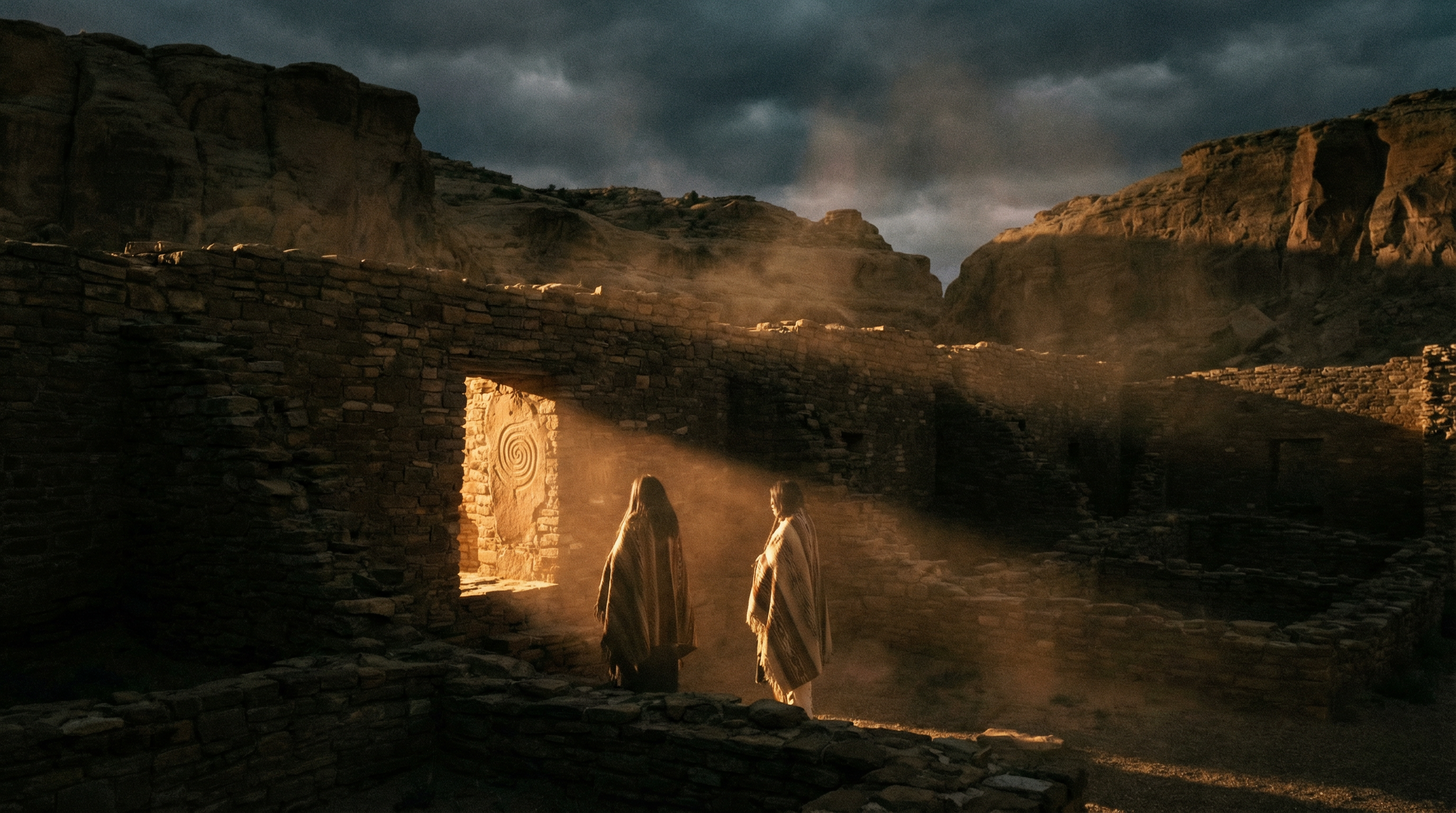
What makes Chaco Canyon truly extraordinary is the undeniable evidence of intentional astronomical alignment embedded within its very construction. The scale of this achievement, considering the available tools and knowledge of the time, is nothing short of breathtaking. Consider Pueblo Bonito, the largest and most extensively studied great house. Its massive D-shaped walls are aligned with an astonishing accuracy of within 0.1 degrees of true north-south. This isn't a coincidence; it speaks to a deliberate and sophisticated understanding of cardinal directions, likely derived from celestial observations. Furthermore, specific architectural features within the great houses act as precise markers for significant celestial events. Doorways and windows are strategically placed to frame the rising sun on the summer solstice, or the setting sun on the equinoxes. These are not random occurrences but carefully engineered sightlines, designed to capture fleeting moments of celestial alignment, transforming the buildings into giant, interactive calendars.
Perhaps the most iconic example of Chacoan archaeoastronomy is the "Sun Dagger" site on Fajada Butte. Discovered in 1977 by artist Anna Sofaer, this remarkable petroglyph consists of two spiral carvings behind three large stone slabs. On the summer solstice, a single "dagger" of light, precisely bisecting the larger spiral, appears as the sun reaches its zenith. On the winter solstice, two daggers frame the spiral, and on the equinoxes, a single dagger pierces the center of a smaller spiral. The precision and consistency of these light and shadow effects, year after year, imply centuries of systematic observation and a profound understanding of solar mechanics. Beyond the sun, Chacoan builders also tracked the moon. The 18.6-year lunar standstill cycle, a complex phenomenon where the moon reaches its extreme northern and southern declinations, also appears to be encoded in Chacoan architecture. Specific alignments within great houses, and even the orientation of some of the great roads, suggest a sophisticated understanding and tracking of this intricate lunar cycle. The sheer audacity of this celestial engineering, using only sandstone and human ingenuity, challenges our conventional understanding of ancient technological capabilities.
Ritual and Roads: Unraveling Chaco's Purpose
While the astronomical alignments are undeniable, the precise function and meaning of Chaco Canyon remain subjects of scholarly debate. One prominent theory posits that Chaco Canyon served as a regional ceremonial center, a sacred heartland for the Ancestral Puebloan people. The astronomical alignments would have played a crucial role in ritual life, dictating agricultural cycles, ceremonial timings, and perhaps even the spiritual connection between the earthly realm and the cosmos. The great houses, with their kivas (circular ceremonial structures), may have hosted gatherings, ceremonies, and pilgrimages from across the vast Chacoan interaction sphere.
Further supporting this theory is the enigmatic Chacoan road system. Unlike typical practical roads that would follow the path of least resistance, many Chacoan roads are remarkably straight, traversing challenging terrain, including steep cliffs and mesas, without deviation. This suggests that their purpose was not purely utilitarian for trade or transport, but rather ritualistic or symbolic. Perhaps they were processional ways, guiding pilgrims and goods to the sacred center, or symbolic pathways connecting various communities to the celestial knowledge held within the canyon. Competing theories also explore Chaco as a major trade hub, a political capital, or even a sophisticated communication network. However, the overwhelming evidence of astronomical precision consistently points to a profound spiritual and intellectual engagement with the cosmos as a primary driver for its development.
Rewriting History: The Genius of the Ancestral Puebloans
The revelations from Chaco Canyon profoundly challenge conventional historical narratives about indigenous societies in North America. For too long, the Ancestral Puebloans, like many other ancient cultures, were often depicted as primitive or lacking the sophisticated scientific and engineering knowledge attributed to Old World civilizations. Chaco Canyon shatters this misconception. The meticulous planning, the precise astronomical alignments, the monumental architecture, and the extensive road network demonstrate a level of social organization, scientific understanding, and engineering prowess that rivals many contemporaneous cultures globally. It forces us to reconsider the intellectual capabilities and cultural achievements of pre-Columbian America, highlighting a rich tapestry of innovation and complex thought.
The Ancestral Puebloans were not merely surviving in a harsh environment; they were thriving, building, and observing the universe with an acuity that continues to astound modern researchers. Their ability to track complex celestial cycles, integrate that knowledge into their built environment, and potentially use it to govern their societal rhythms, speaks to a holistic worldview where science, spirituality, and daily life were seamlessly interwoven. Chaco Canyon stands as a powerful testament to human ingenuity and the universal quest to understand our place in the cosmos, regardless of geographical location or perceived technological limitations.
A Legacy of Light and Shadow
Chaco Canyon remains an active archaeological site and a UNESCO World Heritage site, a place where the past continues to speak to us through the language of stone and light. Its enduring significance lies not just in its architectural grandeur, but in the profound message it conveys about human potential. It reminds us that sophisticated scientific inquiry and deep spiritual connection are not mutually exclusive, and that ancient peoples possessed a wealth of knowledge and understanding that we are only just beginning to fully appreciate. The Ancestral Puebloans, through their celestial blueprint in stone, left a legacy that transcends time, inviting us to look up at the night sky and ponder the same cosmic questions that inspired them to build a civilization aligned with the stars. The mysteries of Chaco are far from exhausted, promising further revelations as new technologies and perspectives continue to illuminate this extraordinary ancient observatory.
Marcus Hale
Independent Researcher & Archive Curator
Marcus Hale is an independent researcher and the curator of The Forbidden Archive. He has spent over a decade studying anomalous ancient technologies, cross-referencing primary excavation reports, museum catalogues, and peer-reviewed journals to document artifacts that mainstream history struggles to explain.
Competing Theories
Chaco Canyon may have functioned as a regional ceremonial centre and astronomical observatory. The road system radiating from Chaco, built straight regardless of terrain, suggests the roads had ritual rather than purely practical functions.

Archive Record
Civilization
Ancestral Puebloans
Time Period
Medieval
Approximate Date
c. 850–1150 CE
Origin
New Mexico, USA
Current Location
Chaco Culture National Historical Park, New Mexico (UNESCO World Heritage Site)
Materials
Sandstone