Neolithic Central Europe · 4900 BCE
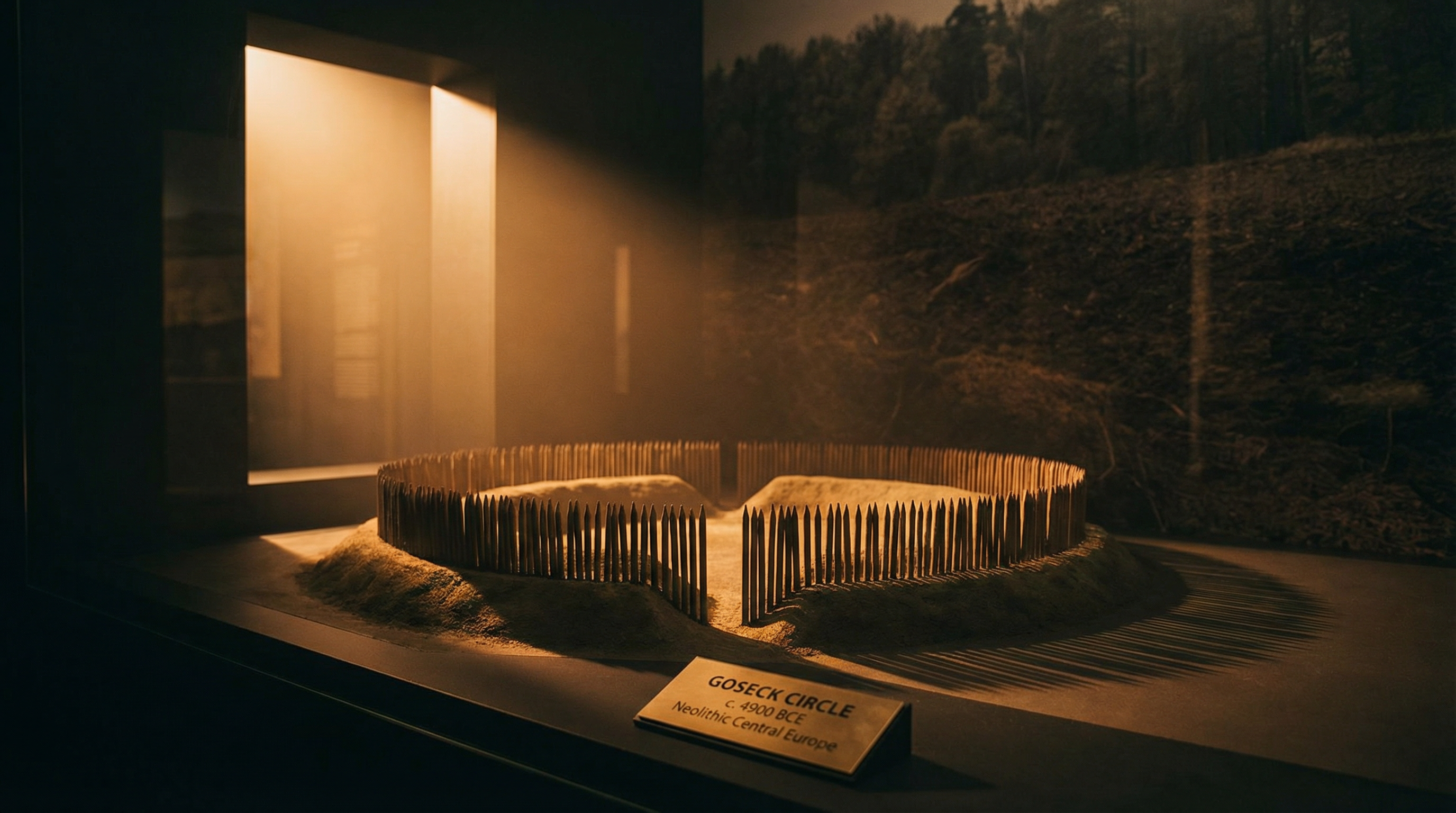
Goseck Circle Solar Observatory
4 min read
Last updated January 24, 2026
The Goseck Circle — built 6,900 years ago — is Europe's oldest solar observatory, with gates precisely aligned to the winter solstice sunrise and sunset, predating Stonehenge by 2,000 years.
Choose your reading style:

By Marcus Hale
Independent Researcher & Archive Curator
On August 1, 1991, aerial photographers flying over a wheat field near Goseck, Germany, noticed a strange circular crop mark measuring 75 meters across. For twelve years, this aerial anomaly remained just that—a curious shadow in the soil. It wasn't until 2003, when archaeologists began extensive excavations, that the true nature of the site emerged from the earth. What they found was a massive Neolithic structure consisting of three concentric ditches and two palisade rings, constructed around 4900 BCE. This discovery fundamentally shifted our understanding of early European astronomy, revealing a level of architectural precision that predates the first stones of Stonehenge by nearly two millennia.
The Geometry of the Winter Solstice
The architecture of the Goseck Circle reveals a profound understanding of solar cycles. The structure features three primary gates—one facing north, one pointing southeast, and one directed southwest. When archaeologists measured the exact alignment of these southern gates, they found a perfect match with the sunrise and sunset of the winter solstice as it would have appeared 6,900 years ago. On the shortest day of the year, an observer standing in the center of the enclosure would see the sun rise exactly through the southeast gate and set directly through the southwest gate.
The precision required to align these wooden palisades is striking. The builders did not simply estimate the sun's path; they calculated it with an accuracy that suggests generations of observational astronomy. The site functioned as a monumental calendar, signaling the turning point of the year when the days would finally begin to lengthen. For a Neolithic agricultural society, predicting this seasonal shift was not merely an academic exercise—it was essential for survival, dictating when to plant crops and when to prepare for the harsh Central European winter.
A Network of Neolithic Observatories
The Goseck Circle does not exist in isolation. It is part of a broader phenomenon known as the Kreisgrabenanlagen, or circular ditch enclosures, found across Central Europe. Over 130 similar structures have been identified in Germany, Austria, and the Czech Republic, all dating to the same roughly 200-year period in the early 5th millennium BCE. This widespread construction suggests a shared cosmological belief system and a sophisticated network of knowledge exchange among early farming communities.
While many of these enclosures feature solar alignments, Goseck remains the oldest and most precisely measured example discovered to date. The rapid spread of this architectural form across hundreds of kilometers implies that the astronomical knowledge required to build them was highly valued and intentionally transmitted. These were not isolated experiments, but rather standardized public works projects that required significant communal effort to construct and maintain.
The Nebra Sky Disc Connection
The astronomical significance of Goseck is further amplified by another discovery made just 25 kilometers away: the Nebra Sky Disc. Forged from bronze and inlaid with gold symbols representing the sun, a crescent moon, and stars (including the Pleiades), the disc dates to around 1600 BCE. While it was created more than 3,000 years after the Goseck Circle was abandoned, the geographical proximity and shared focus on precise solar observation suggest a deep, enduring tradition of astronomy in the region.
Some researchers, such as astronomer Wolfhard Schlosser, argue that the Nebra Sky Disc represents the portable culmination of the observational techniques first developed at monumental sites like Goseck. The angle between the solstice sunrise and sunset at this specific latitude is 82 degrees—a measurement that is physically encoded into the gold arcs on the edges of the Nebra disc. This mathematical continuity across millennia points to a long-standing regional focus on tracking the heavens.
Ritual and Sacrifice at the Center
Beyond its function as a solar calendar, the Goseck Circle served as a focal point for communal rituals, some of which were distinctly violent. Excavations within the inner circle uncovered the remains of ritual fires, animal bones, and human skeletons. Notably, several of the human remains showed signs of decapitation and defleshing, suggesting that human sacrifice may have been a component of the ceremonies held at the site.
These findings complicate the narrative of the site as a purely scientific observatory. For the people of the Stroke-Ornamented Ware culture, astronomy and religion were likely inseparable. The movements of the sun were not just physical phenomena to be measured; they were divine actions to be celebrated, appeased, or influenced through ritual. The winter solstice, representing the death and rebirth of the sun, would have been a moment of intense spiritual significance, potentially requiring the ultimate sacrifice to ensure the return of the light.
The legacy of the Goseck Circle forces us to reevaluate the timeline of human intellectual development in Europe. It stands not merely as an ancient structure, but as a sophisticated instrument of observation that predates many of the most famous megalithic sites in the world. As archaeologists continue to uncover similar enclosures across the continent, the picture of Neolithic society grows increasingly complex, revealing a deep and enduring fascination with the mechanics of the cosmos.
If a farming community in 4900 BCE possessed the engineering skill to build a 75-meter solar calendar and the astronomical knowledge to track the solstice with pinpoint accuracy, what other complex sciences did they master that have simply rotted away in the soil?
Marcus Hale
Independent Researcher & Archive Curator
Marcus Hale is an independent researcher and the curator of The Forbidden Archive. He has spent over a decade studying anomalous ancient technologies, cross-referencing primary excavation reports, museum catalogues, and peer-reviewed journals to document artifacts that mainstream history struggles to explain.
Competing Theories
["Used for agricultural calendar timing","Connected to the Nebra Sky Disc found 25 km away","Part of a network of Neolithic solar observatories across Europe","Used for ritual sacrifice at solstice events"]

Archive Record
Civilization
Neolithic Central Europe
Time Period
4900 BCE
Approximate Date
4900 BCE
Origin
Goseck, Germany
Discovered
Goseck, Saxony-Anhalt, Germany
Current Location
Goseck, Germany (reconstructed)
Dimensions
75 metres diameter
Materials
Wood, earth
Quick Facts
- ▸{"diameter":"75 metres","gates":3,"alignment":"Winter solstice sunrise and sunset","age":"6,900 years","connection":"Nebra Sky Disc found nearby"}.