Ming Dynasty China · Medieval
Great Wall Mortar Analysis
12 min read
Last updated April 4, 2026
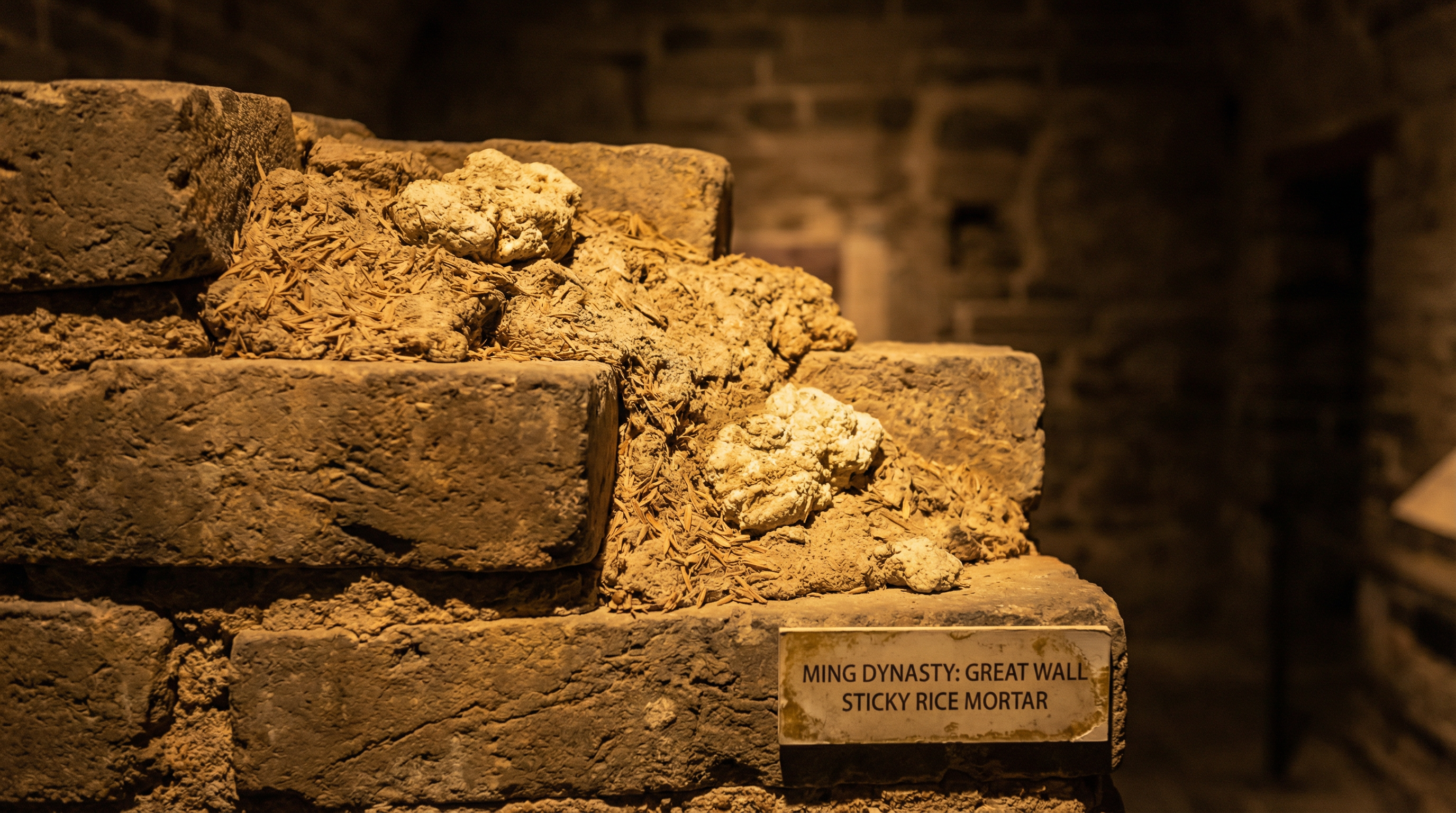
The Ming Dynasty sections of the Great Wall were built using a mortar made from sticky rice and calcium carbonate that is stronger than modern Portland cement and has resisted 600 years of weathering.
Choose your reading style:

By Marcus Hale
Independent Researcher & Archive Curator
Imagine a construction material, crafted centuries ago, that defies the ravages of time, outperforming its modern counterparts in strength and durability. This is not the stuff of science fiction, but the tangible reality embedded within one of humanity's most colossal achievements: the Great Wall of China. For over 600 years, vast sections of the Ming Dynasty wall have stood resolute against wind, rain, and seismic shifts, their bricks and stones bound together by an ancient mortar whose resilience has long baffled engineers and archaeologists alike. What arcane knowledge did the Ming builders possess? The answer, it turns out, lies not in advanced chemistry, but in the humble grain that fed their empire: sticky rice.
The discovery of the "sticky rice mortar" is more than a historical curiosity; it's a testament to ingenious ancient engineering, a material so robust that it continues to challenge our understanding of traditional building techniques. This remarkable adhesive, far from being a simple mixture, represents a sophisticated blend of organic and inorganic components, a secret weapon in the Ming Dynasty's architectural arsenal that allowed them to construct structures of unparalleled longevity. At The Forbidden Archive, we delve into the science behind this enduring mystery, exploring how a staple food became the bedrock of an empire's most iconic defense.
The ingenuity of this ancient mixture lies in its deceptive simplicity. By combining slaked lime with a soup made from sticky rice, the builders created a composite material that was both incredibly strong and highly water-resistant. This combination allowed the mortar to flex during earthquakes and resist the deep freezes of northern Chinese winters, preserving the structural integrity of the wall for centuries longer than would have been possible with conventional materials. The secret was lost to time, only to be rediscovered through modern scientific analysis, revealing a level of sophistication in ancient Chinese engineering that rivals contemporary materials science. It is a story of empirical discovery, where generations of builders observed, tested, and refined their techniques until they achieved perfection.
Historical Background and Discovery Context
The Great Wall, as we largely know it today, is predominantly a product of the Ming Dynasty (1368-1644 CE). While earlier dynasties constructed various defensive barriers, the Ming era saw an unprecedented scale of construction and reinforcement, transforming disparate sections into a formidable, continuous system. It was during this period that the iconic brick and stone sections, often seen in photographs, were erected. The sheer volume of material and labor involved is staggering, but equally impressive is the quality of the construction, particularly the mortar used to bind the millions of bricks and cut stones.
For centuries, the extraordinary strength of the Ming Wall's mortar was observed but not fully understood. Local legends sometimes hinted at unusual ingredients, but scientific investigation only truly began to unravel the mystery in the early 21st century. Researchers, examining mortar samples from various Ming Dynasty structures, including the Great Wall, tombs, and city walls, began to notice a peculiar organic signature. This was not merely a simple lime mortar; there was something else, something that contributed to its exceptional cohesive strength and resistance to weathering. The breakthrough came with sophisticated analytical techniques, which definitively identified the presence of amylopectin, a complex carbohydrate found abundantly in sticky rice.
This discovery wasn't isolated to the Great Wall. Evidence suggests that this sticky rice-lime mortar, or similar organic-inorganic composites, was a widespread construction technique across China for over a millennium, utilized in everything from imperial tombs to pagodas and bridges. The Ming Dynasty, however, seems to have perfected its application on an industrial scale for their monumental defensive works.
The historical context of this discovery is fascinating. The Ming Dynasty was a period of intense military pressure from northern nomadic groups, necessitating the construction of a barrier that was not just long, but virtually impenetrable. The engineers of the time were tasked with creating a structure that could withstand both human assault and the harsh environmental conditions of northern China. Their solution—the sticky rice mortar—was a triumph of empirical science, a testament to centuries of trial and error that culminated in a material perfectly suited to its purpose. The sheer logistics of sourcing, transporting, and preparing the immense quantities of sticky rice required for such a colossal project speak to the highly organized and centralized nature of the Ming state.
It is important to recognize that the use of organic additives in construction was not entirely unique to China. The Romans, for example, famously used volcanic ash and seawater to create their enduring concrete. However, the Chinese approach of using a complex carbohydrate like amylopectin represents a distinct and arguably more sophisticated understanding of polymer chemistry. The fact that this knowledge was developed entirely independently, through empirical observation rather than formal scientific theory, makes it all the more remarkable.
Technical Analysis: The Remarkable Science of Amylopectin
What makes sticky rice mortar so extraordinary? The answer lies in its unique chemical composition and the synergistic interaction between its organic and inorganic components. The primary ingredients were slaked lime (calcium hydroxide, derived from heating limestone) and sticky rice flour or a sticky rice decoction. When mixed with water, the calcium hydroxide reacts with carbon dioxide in the air to form calcium carbonate, the main binding agent in traditional lime mortars. However, the addition of sticky rice introduced a critical organic polymer: amylopectin.
Scientific analysis, employing techniques such as scanning electron microscopy (SEM), X-ray diffraction (XRD), and Fourier-transform infrared spectroscopy (FTIR), has revealed the precise mechanism of action. The amylopectin from the sticky rice acts as a natural superplasticizer and a pore-filler. It interweaves with the calcium carbonate crystals as they form, creating a dense, interlocking matrix. Crucially, the amylopectin molecules effectively fill the microscopic pores and voids that are typically present in traditional lime mortars. This pore-filling action has two profound benefits:
- Enhanced Strength: By reducing porosity, the mortar becomes denser and less prone to internal fracturing, significantly increasing its compressive and tensile strength. Modern tests have shown that sticky rice mortar samples exhibit greater hardness and mechanical strength than many modern Portland cement-based mortars.
- Superior Water Resistance: The filled pores prevent water penetration. In traditional lime mortars, water can seep into these voids, leading to freeze-thaw damage in cold climates and facilitating the growth of microorganisms. The sticky rice additive creates a more impermeable barrier, protecting the wall from the destructive forces of water and ice, and inhibiting biological degradation.
This ingenious combination resulted in a composite material that is not only incredibly strong but also remarkably durable and resistant to environmental degradation, allowing the Ming sections of the Great Wall to endure for centuries with minimal structural compromise. The chemical bond formed between the organic amylopectin and the inorganic calcium carbonate is a prime example of early biomimicry, where human engineers successfully replicated the complex, hybrid structures found in nature to achieve superior performance.
Furthermore, the inclusion of sticky rice provided a unique degree of flexibility to the mortar. Unlike modern concrete, which is rigid and prone to cracking under stress, the sticky rice mortar could absorb minor seismic shocks and shifts in the earth without shattering. This flexibility was crucial in a region prone to earthquakes, ensuring that the Great Wall could flex and adapt to the movements of the ground beneath it, rather than crumbling into dust. The amylopectin essentially acts as a shock absorber at the microscopic level, dissipating the energy of seismic waves and preventing catastrophic failure.
The microstructural analysis of the mortar also reveals a fascinating process of biomineralization. Over time, the amylopectin matrix not only fills the pores but also actively influences the crystallization of the calcium carbonate, guiding it into more stable and tightly packed formations. This means that the mortar actually grows stronger over time, as the chemical reactions continue to mature and solidify the matrix. It is a living material in a sense, constantly adapting and improving its structural integrity.
Competing Theories and Scholarly Debate
While the role of amylopectin is now widely accepted, scholarly debate continues on several fronts. One area of discussion revolves around the precise preparation methods. Was raw sticky rice flour mixed directly into the lime slurry, or was a cooked sticky rice paste or gruel incorporated? Historical texts and archaeological evidence suggest variations, with some indicating the use of a "congee" (rice porridge) or a specific rice paste, which would have gelatinized the starches, potentially enhancing their binding properties.
Another point of contention is the exact proportion of sticky rice to lime. While analyses provide ratios for surviving samples, replicating the optimal mix for different environmental conditions and material types (brick vs. stone) remains a challenge. Furthermore, researchers are exploring whether other organic additives, such as plant extracts or animal products, might have been used in conjunction with sticky rice in certain regions or for specific applications, contributing to localized variations in mortar performance.
The debate also extends to the "rediscovery" of this technique. Was the knowledge continuously passed down, or was it lost and then independently rediscovered by different builders across various dynasties? The widespread use across different periods suggests a continuous, if sometimes localized, tradition of incorporating organic additives into building mortars.
"The use of sticky rice in ancient Chinese mortar is one of the greatest technological innovations of the time, representing a sophisticated understanding of composite materials long before the modern era." - Dr. Bingjian Zhang, Lead Researcher on ancient Chinese mortars.
Some scholars argue that the sticky rice mortar was not a single, monolithic invention, but rather a family of related techniques that evolved over time and across different regions of China. This perspective suggests a dynamic and adaptable engineering culture, one that was constantly refining and improving its methods in response to local challenges and available resources. The variations in mortar composition found in different sections of the Great Wall support this view, indicating a degree of local autonomy and experimentation among the builders.
There is also ongoing research into the socio-economic implications of using a staple food crop for construction. During times of famine or agricultural shortfall, diverting vast quantities of sticky rice to building projects would have been highly controversial and potentially destabilizing. This suggests that the use of sticky rice mortar was likely reserved for the most critical imperial projects, where the need for structural longevity outweighed the immediate nutritional needs of the population. It highlights the immense power and resources commanded by the Ming emperors, capable of prioritizing defense over sustenance on a massive scale.
Challenging Conventional Historical Narratives
The revelation of sticky rice mortar profoundly challenges several conventional historical narratives regarding ancient engineering. Firstly, it dismantles the notion that ancient builders lacked sophisticated material science. The Ming Dynasty engineers, through empirical observation and experimentation, developed a composite material that rivals and, in some aspects, surpasses modern construction materials. This wasn't accidental; it was a deliberate and highly effective engineering solution.
Secondly, it highlights the often-underestimated role of organic chemistry in ancient technologies. We tend to associate advanced material science with industrial processes and synthetic compounds. Yet, the sticky rice mortar demonstrates a profound understanding of natural polymers and their ability to enhance inorganic matrices, centuries before the advent of modern polymer chemistry.
Finally, this discovery underscores the ingenuity born from necessity and resourcefulness. Faced with the monumental task of building an immense defensive structure, and perhaps limited access to certain high-quality mineral binders, Chinese builders turned to readily available agricultural products. This adaptive and innovative approach speaks volumes about their practical intelligence and their ability to leverage local resources to achieve extraordinary engineering feats.
The story of the sticky rice mortar also challenges the Eurocentric view of technological progress, which often places the origins of modern materials science in the West. The Chinese mastery of organic-inorganic composites predates similar developments in Europe by centuries, highlighting a rich and independent tradition of scientific inquiry and engineering innovation in East Asia. This forces a reevaluation of our understanding of global technological history, recognizing the profound contributions of non-Western cultures to the development of modern science and engineering.
Furthermore, it challenges the perception of ancient construction as purely a matter of brute force and massive labor. While the Great Wall undoubtedly required immense manpower, its longevity is equally attributable to the subtle and sophisticated chemical engineering of its mortar. It reminds us that ancient monuments are not just testaments to the power of empires, but also to the brilliance of their scientists and engineers, whose names are often lost to history but whose work endures for millennia.
Conclusion and Lasting Significance
The significance of sticky rice mortar extends far beyond historical curiosity. Its remarkable properties have sparked intense interest in modern conservation and construction. As heritage sites around the world grapple with the challenges of preserving ancient structures, the "bio-mortar" concept offers a sustainable and historically accurate solution. Researchers are actively investigating the use of sticky rice-lime mortar, or synthetic analogues of amylopectin, for the repair and restoration of ancient buildings, ensuring that interventions are compatible with the original materials and methods.
Moreover, the principles behind sticky rice mortar are inspiring new avenues in sustainable construction. The idea of incorporating natural polymers into cement and concrete to enhance strength, durability, and reduce environmental impact is gaining traction. Imagine a future where our modern infrastructure benefits from the wisdom of ancient Chinese builders, creating more resilient and eco-friendly structures.
The Great Wall's sticky rice mortar is more than just an ancient recipe; it's a powerful reminder that true innovation often lies in understanding and harmonizing with the natural world. It stands as a testament to human ingenuity, a silent guardian of history, and a potential blueprint for the future of construction – an unbreakable bond, forged by rice and lime, that continues to defy the relentless march of time.
As we continue to unravel the secrets of the past, discoveries like the sticky rice mortar serve as a humbling reminder of the sophistication and resourcefulness of our ancestors. They challenge our assumptions about the linear progression of technology and invite us to look back with renewed respect and curiosity. The Great Wall of China, bound together by the humble grain of rice, stands not only as a monument to imperial power, but as an enduring testament to the enduring power of human ingenuity. It is a legacy written in stone and starch, a masterpiece of ancient engineering that continues to inspire and instruct us today.
Marcus Hale
Independent Researcher & Archive Curator
Marcus Hale is an independent researcher and the curator of The Forbidden Archive. He has spent over a decade studying anomalous ancient technologies, cross-referencing primary excavation reports, museum catalogues, and peer-reviewed journals to document artifacts that mainstream history struggles to explain.
Competing Theories
The sticky rice mortar formula was used across China for tombs, pagodas, and city walls for over 1,000 years. Researchers are now investigating its use in modern conservation and construction.

Archive Record
Civilization
Ming Dynasty China
Time Period
Medieval
Approximate Date
c. 1368–1644 CE
Origin
Northern China
Current Location
Northern China (UNESCO World Heritage Site)
Materials
Sticky rice mortar, limestone, brick