Northern Wei / Tang Dynasty China · Classical Antiquity
Longmen Grottoes Engineering
5 min read
Last updated April 4, 2026
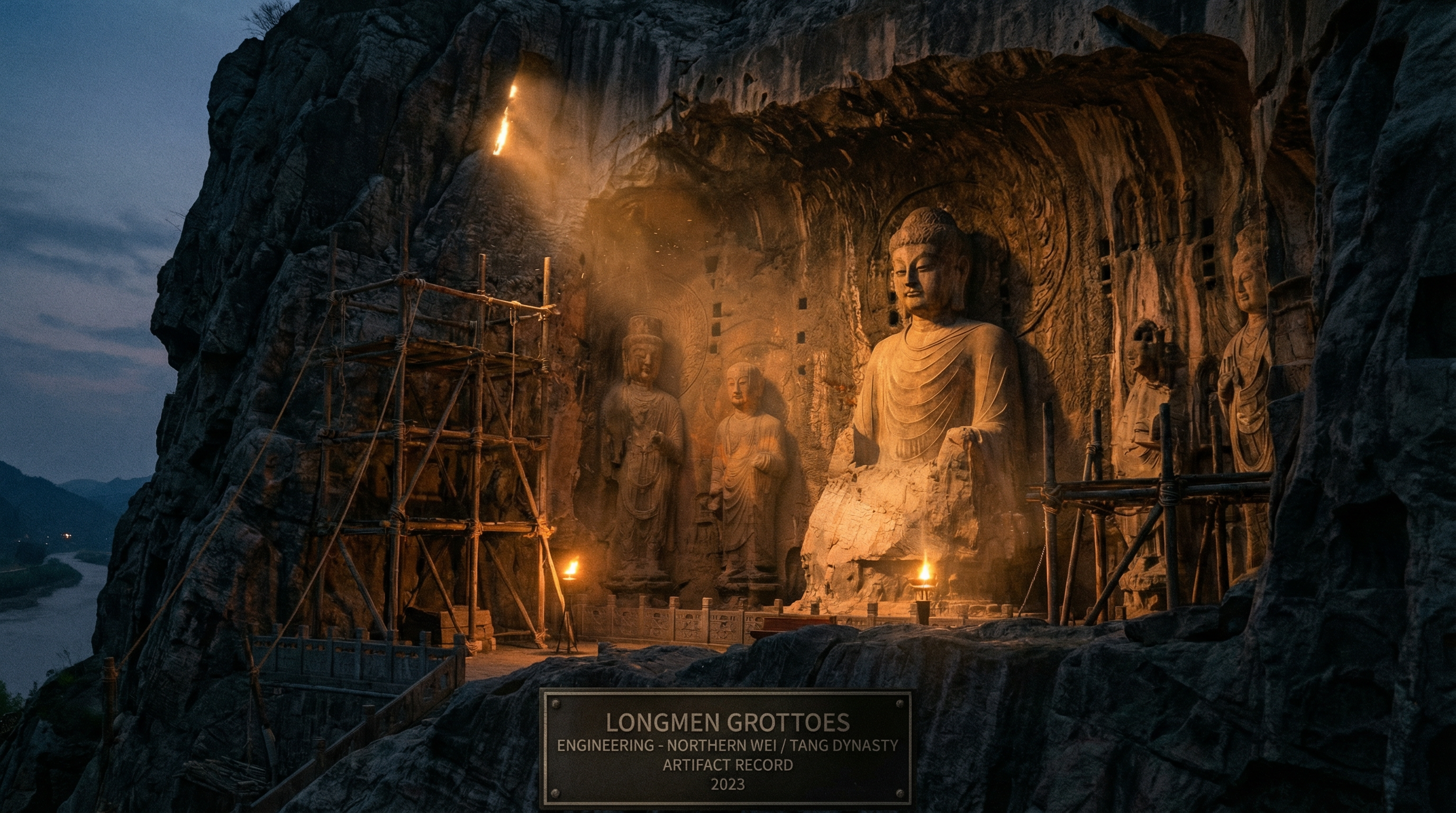
Over 100,000 Buddhist sculptures carved into limestone cliffs over 400 years, including a 17-metre seated Buddha whose proportions were designed to appear correct when viewed from ground level.
Choose your reading style:

By Marcus Hale
Independent Researcher & Archive Curator
Unveiling the Secrets of Longmen: A Mountain Transformed
Along the banks of the Yi River, just south of Luoyang in China’s Henan province, a breathtaking spectacle unfolds. Here, over a span of 400 years, an entire mountain face was transformed into a sacred tapestry of devotion and unparalleled engineering prowess: the Longmen Grottoes. More than 100,000 Buddhist sculptures, ranging from a few centimeters to colossal masterpieces, are carved into the sheer limestone cliffs, bearing silent witness to the spiritual fervor and technical genius of successive Chinese dynasties. But beyond the sheer scale and artistic grandeur lies a deeper mystery, a testament to an enduring legacy of knowledge that defies the turbulent tides of history. How did ancient artisans, across centuries of political upheaval, maintain such consistent standards of craftsmanship and, more astonishingly, embed sophisticated optical corrections into their most monumental creations?
A Legacy Etched in Time: Historical Context and Construction
The story of the Longmen Grottoes begins in 493 CE, during the Northern Wei Dynasty, when Emperor Xiaowen moved his capital to Luoyang. This period marked a flourishing of Buddhist art and architecture, fueled by imperial patronage and a deep spiritual commitment. The initial carvings set a precedent for the centuries that followed, with the Tang Dynasty (618-907 CE) witnessing the most prolific and ambitious phase of construction. Emperors like Gaozong and Empress Wu Zetian poured vast resources into the grottoes, culminating in some of their most iconic and awe-inspiring works. The site continued to be embellished, albeit on a smaller scale, through the Five Dynasties and Ten Kingdoms period, the Song Dynasty, and even into the Ming and Qing dynasties. This continuous, multi-dynastic undertaking, spanning over four centuries, is itself a remarkable feat, suggesting a profound cultural and technical continuity that transcended the rise and fall of empires. The very act of carving into solid rock on such a scale required not only immense labor but also sophisticated planning, scaffolding techniques, and a deep understanding of geology and structural integrity.
The Colossus of Fengxian Temple: A Masterclass in Perspective
While the Longmen Grottoes boast an astonishing array of sculptures, the undisputed crown jewel, and perhaps the most compelling evidence of advanced engineering, is the monumental Vairocana Buddha at Fengxian Temple. Carved during the Tang Dynasty under the patronage of Empress Wu Zetian, this seated Buddha stands an astonishing 17.14 meters (over 56 feet) tall, flanked by equally imposing bodhisattvas, arhats, and guardians. What makes this particular sculpture so extraordinary, beyond its sheer size, is its subtle yet profound optical design. When viewed from ground level, the Buddha's proportions appear perfectly natural and harmonious. However, closer inspection reveals a fascinating anomaly: the head of the Vairocana Buddha is disproportionately large in relation to its body. This deliberate exaggeration is not an artistic oversight but a sophisticated application of perspective correction, designed to counteract the foreshortening effect that occurs when viewing a tall object from below. The artists understood that without this adjustment, the head would appear too small and the figure distorted from the viewer's vantage point. This is a technique independently developed in classical Greek sculpture, notably in the Parthenon, where columns and statues were subtly angled and curved to appear straight and perfectly proportioned from a distance.
The Enduring Enigma: Transmission of Knowledge and Scholarly Debate
The existence of such advanced perspective correction at Longmen raises intriguing questions. How was this complex understanding of optics and human perception transmitted across generations of artisans, especially during periods of political instability and dynastic change? Was there a formalized system of apprenticeship, master-disciple relationships, or even written treatises that preserved this technical knowledge? Some scholars argue for a continuous, albeit informal, transmission of practical skills and aesthetic principles within artisan guilds. The sheer consistency of style and technical proficiency across centuries supports this idea, suggesting a robust system for passing down specialized knowledge. Others ponder whether there might have been external influences or independent rediscovery of these principles. The parallels with Greek architectural and sculptural techniques are striking, but direct contact and influence remain largely speculative. The debate often centers on whether such complex mathematical and optical understanding was explicitly codified or implicitly understood through generations of practical experience and observation. Regardless, the evidence at Longmen strongly suggests a profound and sustained commitment to technical excellence and a sophisticated understanding of how to manipulate form and space to achieve desired visual effects.
Challenging the Narrative: Beyond Simple Devotion
The engineering marvels of the Longmen Grottoes, particularly the perspective correction of the Vairocana Buddha, challenge conventional historical narratives that often compartmentalize ancient civilizations. It demonstrates that ancient Chinese artisans were not merely skilled craftsmen following traditional patterns, but sophisticated engineers and artists who possessed a deep understanding of physics, optics, and human perception. This level of technical and artistic integration elevates the Longmen Grottoes beyond a simple religious monument; it stands as a testament to a highly developed intellectual tradition that could conceptualize and execute projects of immense scale and intricate detail. It compels us to reassess the capabilities of ancient societies and acknowledge the potential for advanced scientific and mathematical understanding to be embedded within artistic and religious practices, often overlooked by modern observers focused solely on the aesthetic or spiritual aspects. The continuous transmission of such complex knowledge across 400 years, despite wars and regime changes, also speaks to the resilience and enduring power of cultural and technical legacies, suggesting a societal infrastructure capable of preserving and propagating specialized expertise through profound historical shifts.
A Lasting Legacy: The Enduring Whisper of Stone
Today, the Longmen Grottoes stand as a UNESCO World Heritage site, drawing millions of visitors who marvel at its beauty and scale. But for those who look beyond the surface, the grottoes offer a deeper revelation. They are not merely a collection of ancient sculptures but a monumental archive of human ingenuity, a testament to the enduring power of faith, and a profound demonstration of ancient engineering prowess. The silent, watchful gaze of the Vairocana Buddha, perfectly proportioned despite its immense height, whispers across the centuries, reminding us that the ancients possessed a profound understanding of their world, capable of integrating art, religion, and advanced technical knowledge into breathtaking masterpieces. The Longmen Grottoes continue to challenge our perceptions of ancient capabilities, urging us to look closer, to question assumptions, and to appreciate the sophisticated minds that carved not just stone, but an enduring legacy of human brilliance into the very fabric of the earth.
Marcus Hale
Independent Researcher & Archive Curator
Marcus Hale is an independent researcher and the curator of The Forbidden Archive. He has spent over a decade studying anomalous ancient technologies, cross-referencing primary excavation reports, museum catalogues, and peer-reviewed journals to document artifacts that mainstream history struggles to explain.
Competing Theories
The scale and precision of the Longmen carvings, executed over 400 years by successive dynasties, implies a continuous transmission of technical knowledge and aesthetic standards across political upheavals.
Archive Record
Civilization
Northern Wei / Tang Dynasty China
Time Period
Classical Antiquity
Approximate Date
c. 493–907 CE
Origin
Luoyang, Henan, China
Current Location
Longmen, Henan, China (UNESCO World Heritage Site)
Materials
Limestone