Solanki Dynasty · Medieval
Stepwell Architecture of Gujarat
6 min read
Last updated April 4, 2026
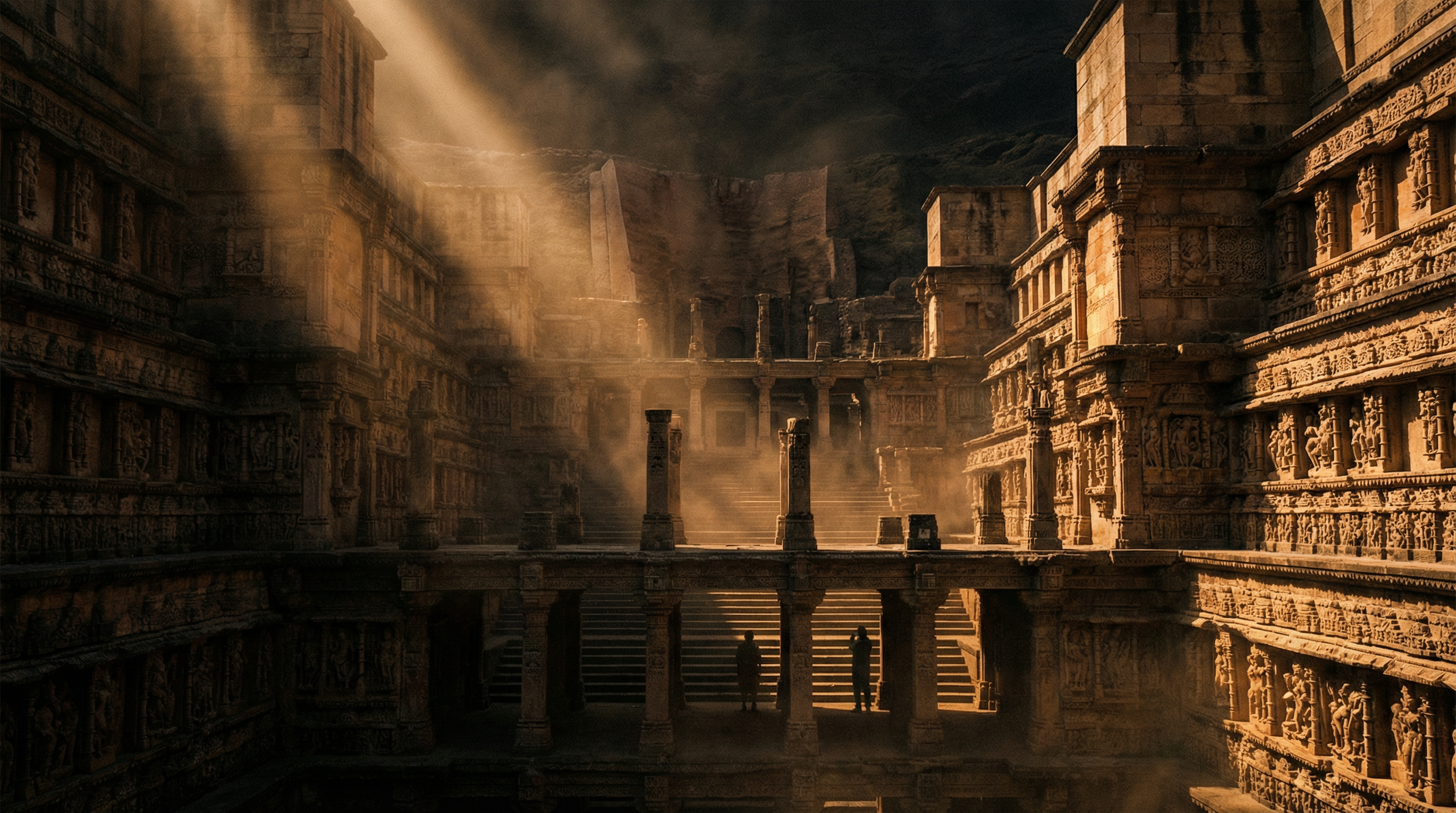
Rani ki Vav is a 7-storey inverted temple stepwell with 500 principal sculptures and 1,000 minor ones, built as a memorial and demonstrating engineering precision that has survived 900 years of seismic activity.
Choose your reading style:

By Marcus Hale
Independent Researcher & Archive Curator
Introduction: Descending into the Earth's Cool Embrace
Imagine a world where water, the very essence of life, was not merely a resource to be collected, but a sacred entity to be worshipped, celebrated, and accessed through structures of breathtaking beauty and engineering genius. In the arid landscapes of Gujarat, India, such a world flourished, leaving behind a legacy that continues to baffle and inspire. We speak of the stepwells, or 'baoris,' subterranean architectural wonders that plunge deep into the earth, revealing intricate carvings, complex hydraulics, and a profound understanding of natural forces. Among these, the Rani ki Vav stands as a testament to an ancient civilization's mastery – a 7-storey inverted temple, a memorial to a king, and a marvel of precision that has defied the ravages of time and seismic activity for over 900 years. How did a medieval civilization, without modern tools or theories, construct such resilient and sophisticated structures? The answers lie buried within their cool, stone depths, inviting us to descend and uncover their secrets.
Historical Background: A Queen's Lament and a Dynasty's Legacy
The story of Gujarat's stepwells is inextricably linked with the Solanki Dynasty, a powerful lineage that ruled parts of western India from the 10th to the 13th centuries. This period was marked by significant architectural and artistic achievements, often driven by religious devotion and civic pride. The most celebrated example, the Rani ki Vav (Queen's Stepwell), located in Patan, Gujarat, was commissioned in the 11th century by Queen Udayamati in memory of her deceased husband, King Bhimdev I. Far from being a mere utilitarian water source, it was conceived as an elaborate subterranean temple dedicated to Vishnu, reflecting the king's divine status and the queen's enduring love. For centuries, these stepwells served as vital lifelines in a region prone to droughts, providing not just water for drinking and irrigation, but also cool refuges from the scorching sun, social gathering places, and sites for religious rituals. Many, like Rani ki Vav, eventually succumbed to the silting effects of the nearby Saraswati River, becoming buried and forgotten until their rediscovery and restoration in the mid-20th century, revealing their hidden splendor to the modern world.
Technical Analysis: Engineering a Subterranean Symphony
What makes the stepwell architecture of Gujarat, particularly Rani ki Vav, so extraordinary is its unparalleled blend of artistic grandeur and engineering prowess. This isn't merely a hole in the ground; it's a meticulously planned, multi-level structure carved almost entirely from sandstone, without the use of mortar. The sheer scale is astounding: seven distinct levels descending into the earth, culminating in a deep well shaft. Adorning its walls are over 500 principal sculptures and more than 1,000 minor ones, depicting deities, celestial beings, apsaras, and scenes from Hindu mythology, transforming a functional structure into a veritable art gallery. But beyond the aesthetics lies the true marvel: its structural integrity. For 900 years, this underground edifice has withstood numerous major earthquakes, a testament to an understanding of seismic resilience that predates modern civil engineering. The interlocking nature of the stone blocks, the strategic placement of load-bearing elements, and the inherent stability of a subterranean structure all contribute to its remarkable endurance. Furthermore, the stepwell's geometry ensures that the water within remains at a constant, refreshingly cool temperature, regardless of the searing external heat. This suggests an intuitive grasp of thermodynamics and fluid dynamics, allowing the designers to create a microclimate within the earth, a natural air-conditioning system millennia before its invention.
Competing Theories and Scholarly Debate: More Than Just a Well?
While the primary function of stepwells as water sources is undeniable, scholarly debate persists regarding their full spectrum of uses and the depth of knowledge possessed by their builders. Some researchers argue that the acoustic and thermal properties of stepwells were not merely accidental byproducts but intentionally engineered features. The resonant qualities of the enclosed spaces, for instance, could have been utilized for chanting, music, or spiritual ceremonies, enhancing the ritualistic experience. The consistent cool temperatures, as mentioned, point to an advanced understanding of passive cooling, but some theories extend this to suggest a deliberate creation of therapeutic environments. Were these spaces also used for specific healing practices or meditative retreats? Another fascinating area of discussion revolves around the symbolic significance. As "inverted temples," descending into the earth rather than rising towards the sky, stepwells might represent a journey into the underworld, a connection to the divine feminine (often associated with water and fertility), or a metaphorical descent into self-discovery. The intricate iconography certainly supports a rich symbolic layer, suggesting that these structures served ritual, social, and engineering functions simultaneously, each aspect interwoven into a holistic design philosophy.
Challenging Conventional Historical Narratives: A Lost Science?
The existence and enduring resilience of structures like Rani ki Vav fundamentally challenge conventional historical narratives about the technological capabilities of medieval civilizations. The precision in stone masonry without mortar, the sophisticated understanding of structural dynamics to withstand seismic activity, and the apparent mastery of passive thermal regulation all point to a level of scientific and engineering acumen often attributed only to later periods or other cultures. How did the Solanki Dynasty engineers achieve such feats? Was there a lost body of knowledge, a sophisticated tradition of practical science that has largely been overlooked or underestimated? The ability to design and construct a multi-storey underground structure that remains stable for centuries in an earthquake-prone zone, while simultaneously creating a naturally climate-controlled environment, suggests more than just empirical trial and error. It hints at a theoretical framework, perhaps an indigenous form of architectural physics or material science, that allowed for such remarkable achievements. The stepwells compel us to reconsider the intellectual sophistication of ancient Indian civilizations, suggesting a deeper, more nuanced understanding of their scientific and technological contributions to human history.
Conclusion: The Enduring Legacy of Subterranean Splendor
The stepwell architecture of Gujarat, epitomized by the magnificent Rani ki Vav, stands as a profound testament to human ingenuity, artistic expression, and an intimate connection with the natural world. These subterranean marvels are more than just ancient wells; they are inverted temples, seismic-resistant fortresses, and passive climate control systems, all sculpted from the earth itself. They challenge our assumptions about medieval engineering, hinting at a forgotten legacy of scientific understanding and architectural brilliance. As we stand at the precipice of these deep, cool chambers, we are not merely observing ancient ruins; we are stepping into a living legacy, a silent narrative of a civilization that understood the profound interplay between utility, beauty, and resilience. The stepwells of Gujarat beckon us to look deeper, to question what we think we know, and to appreciate the enduring power of human innovation that continues to resonate from the cool, dark depths of the earth.
Marcus Hale
Independent Researcher & Archive Curator
Marcus Hale is an independent researcher and the curator of The Forbidden Archive. He has spent over a decade studying anomalous ancient technologies, cross-referencing primary excavation reports, museum catalogues, and peer-reviewed journals to document artifacts that mainstream history struggles to explain.
Competing Theories
The acoustic and thermal properties of stepwells suggest their designers understood fluid dynamics and thermodynamics. Some researchers argue stepwells served ritual, social, and engineering functions simultaneously.
Archive Record
Civilization
Solanki Dynasty
Time Period
Medieval
Approximate Date
c. 1063 CE
Origin
Patan, Gujarat, India
Current Location
Rani ki Vav, Patan, Gujarat (UNESCO World Heritage Site)
Materials
Sandstone, no mortar