Tiwanaku Culture · Classical Antiquity
Tiwanaku Pumapunku Precision
6 min read
Last updated April 4, 2026
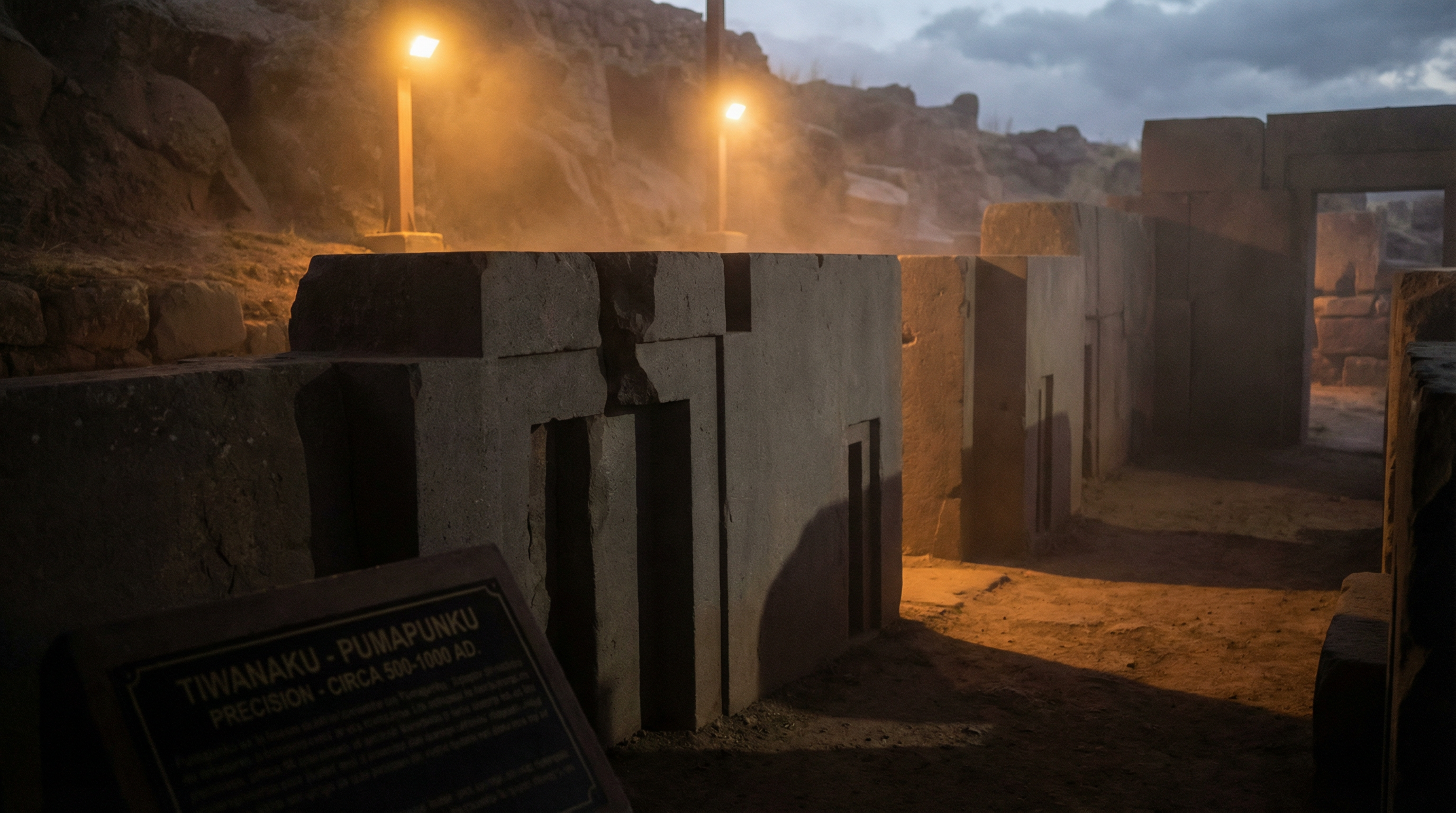
The Pumapunku site contains H-shaped stone blocks weighing up to 131 tonnes, cut with machine-like precision to tolerances of 0.1mm, featuring interlocking joints that require no mortar.
Choose your reading style:

By Marcus Hale
Independent Researcher & Archive Curator
Welcome to The Forbidden Archive, where we delve into the most perplexing enigmas of our ancient past. Today, we journey to the high plains of Bolivia, to a site that defies conventional understanding and whispers of a forgotten mastery: Pumapunku. Nestled within the vast complex of Tiwanaku, Pumapunku stands as a testament to an engineering prowess that, by all accounts, should not have existed in the classical antiquity of the Andes. Imagine colossal stone blocks, some weighing over a hundred tonnes, not merely stacked, but intricately interlocked with a precision that rivals modern machining. This isn't crude megalithic construction; this is an art form in stone, a silent challenge to our assumptions about ancient technology and human ingenuity.
Historical Background and Discovery Context
The Tiwanaku culture, flourishing between approximately 500 and 1000 CE, was a dominant pre-Incan civilization in the Andean region. Its capital, Tiwanaku, located near the southern shore of Lake Titicaca, was a sprawling ceremonial and administrative center. Pumapunku, meaning "Gate of the Puma," is a large temple complex within the Tiwanaku site, distinguished by its unique and highly sophisticated stonework. While the exact purpose of Pumapunku remains debated – perhaps a temple, a ceremonial platform, or even an astronomical observatory – its architectural remains speak volumes about the capabilities of its builders.
Archaeological investigations at Tiwanaku began in earnest in the late 19th and early 20th centuries, revealing a civilization of remarkable artistic and organizational skill. However, it was the sheer scale and precision of the stonework at Pumapunku that truly captivated researchers. Unlike other Andean sites, where cyclopean masonry often involves irregularly shaped stones fitted together, Pumapunku presents a different paradigm. The site, now largely in ruins, appears to have been deliberately dismantled or suffered catastrophic damage, leaving behind a bewildering array of perfectly cut and precisely shaped blocks scattered across the landscape, like pieces of a giant, ancient puzzle.
Technical Analysis and What Makes It Remarkable
The true marvel of Pumapunku lies in its extraordinary stonework. The complex is constructed primarily from two types of stone: red sandstone and andesite. While the red sandstone blocks are impressive in their size, it is the andesite that truly astounds. Andesite is an extremely hard volcanic rock, second only to diamond in its resistance to abrasion. Yet, the Tiwanaku artisans worked this intractable material with an almost impossible finesse.
Consider the 'H-blocks,' iconic to Pumapunku. These multi-ton andesite blocks are not just massive; they are carved with intricate, geometric recesses and protrusions designed to interlock seamlessly without the need for mortar. The surfaces are incredibly flat, and the angles are consistently perfect right angles. Measurements have revealed tolerances as fine as 0.1mm – a level of precision that would challenge even modern stone masons equipped with power tools. Furthermore, many blocks exhibit perfectly straight, deep grooves, uniform drill holes, and polished surfaces that suggest the use of sophisticated grinding and cutting techniques.
The sheer weight of these blocks adds another layer of mystery. Some of the largest andesite blocks weigh an estimated 85 tonnes, while the largest red sandstone blocks reach an astonishing 131 tonnes. These colossal stones were quarried from sites up to 90 km away, across challenging terrain, and transported to Pumapunku. The Tiwanaku people had no wheeled vehicles, no draft animals capable of moving such loads, and no known advanced lifting equipment. The logistics of quarrying, shaping, transporting, and then precisely placing these monolithic components represent an engineering feat that remains largely unexplained.
Competing Theories and Scholarly Debate
The enigma of Pumapunku has naturally given rise to various theories, broadly categorized into two camps: conventional archaeological explanations and alternative, more speculative interpretations.
Conventional Explanations: Mainstream archaeology posits that the Tiwanaku people achieved this remarkable stonework through immense human labor, ingenious leverage, and the use of primitive tools. It is suggested that they used stone hammers (dolorite or hematite) for rough shaping, and then employed sand, water, and possibly harder stone abrasives for grinding and polishing. Ropes, ramps, and rollers made from logs are theorized for transportation and placement. Experimental archaeology has attempted to replicate some of these techniques, demonstrating that with enough time, manpower, and ingenuity, it is theoretically possible to achieve certain levels of precision. However, replicating the exact uniform drill holes, razor-sharp internal angles, and the sheer scale of consistent precision across hundreds of blocks remains a significant challenge for these methods.
Alternative Theories: A growing number of researchers, often outside the traditional academic framework, argue that the precision observed at Pumapunku goes beyond what is achievable with the tools and methods attributed to the Tiwanaku culture. They point to the machine-like cuts, the microscopic tolerances, and the evidence of drill holes that appear to require rotary tools, suggesting the use of an advanced, perhaps lost, technology. These theories often propose the use of unknown metal alloys, ultrasonic cutting, or other forms of precision machinery that have not been identified archaeologically. While these ideas are often met with skepticism by mainstream scholars due to a lack of direct evidence for such tools, they highlight the profound difficulty in explaining Pumapunku's precision through conventional means alone.
Why This Challenges Conventional Historical Narratives
Pumapunku's stonework directly challenges several deeply ingrained assumptions about ancient civilizations. Firstly, it questions the linear progression of technological development. The level of engineering and architectural sophistication displayed at Pumapunku appears to be an anomaly for its time period, seemingly leapfrogging centuries of gradual innovation. It suggests a potential "lost art" or a highly specialized knowledge that either vanished or was never widely disseminated.
Secondly, it forces us to reconsider the capabilities of pre-Columbian societies. While we acknowledge their vast achievements in astronomy, agriculture, and social organization, the mechanical precision at Pumapunku introduces a dimension of technical expertise that is often reserved for post-industrial societies. If the Tiwanaku people achieved this with only stone, bone, and copper tools, it implies an understanding of physics, mechanics, and material science that is far more advanced than generally credited.
Finally, the sheer scale of the undertaking, coupled with the precision, raises questions about the societal organization and resources required. To quarry, transport, and meticulously shape hundreds of multi-ton blocks with such exactitude would have demanded an unparalleled level of planning, coordination, and sustained effort over decades, if not centuries. This speaks to a highly centralized and powerful civilization, capable of mobilizing vast human resources for monumental projects.
Conclusion with Lasting Significance
Pumapunku stands as an enduring enigma, a monumental riddle carved in stone. Whether its precision was achieved through an unimaginable application of primitive methods or through a technology yet to be understood, its existence compels us to look beyond our preconceived notions of ancient capabilities. It is a powerful reminder that history is not a closed book, but a constantly unfolding narrative, full of mysteries waiting to be deciphered.
The legacy of Pumapunku is not just in its ruins, but in the questions it continues to provoke. It challenges archaeologists, engineers, and historians to think more critically, to question assumptions, and to remain open to the possibility that our understanding of ancient human achievement is still incomplete. As we continue to explore and analyze this incredible site, Pumapunku will undoubtedly continue to inspire awe and fuel the quest for knowledge, reminding us that the past holds secrets far more profound than we often dare to imagine.
Marcus Hale
Independent Researcher & Archive Curator
Marcus Hale is an independent researcher and the curator of The Forbidden Archive. He has spent over a decade studying anomalous ancient technologies, cross-referencing primary excavation reports, museum catalogues, and peer-reviewed journals to document artifacts that mainstream history struggles to explain.
Competing Theories
Conventional explanations involve stone and bone tools, ramps, and human labour. Alternative researchers argue the precision of the cuts implies advanced tool technology not yet identified archaeologically.
Archive Record
Civilization
Tiwanaku Culture
Time Period
Classical Antiquity
Approximate Date
c. 536–600 CE
Origin
Tiwanaku, Bolivia
Current Location
Tiwanaku Archaeological Site, Bolivia (UNESCO World Heritage Site)
Materials
Andesite, red sandstone