
Norse/Viking · Medieval
The Vinland Map Viking America
6 min read
Last updated April 11, 2026
A world map allegedly from the 15th century showing Viking exploration of North America decades before Columbus — but ink analysis has cast doubt on its authenticity.
Also in This Category


Choose your reading style:

By Marcus Hale
Independent Researcher & Archive Curator
Introduction
Imagine a map, painstakingly drawn on ancient parchment, depicting lands across the vast Atlantic. Now imagine that map, dating to the mid-15th century, clearly shows a landmass west of Greenland, labeled "Vinlanda Insula" – Vinland Island. This isn't a cartographic fantasy; it's the central enigma of the Vinland Map, an artifact that, if authentic, would fundamentally rewrite the history of European knowledge of the Americas, placing Viking America on the world stage decades before Columbus set sail. Discovered in 1957 and acquired by Yale University, this single sheet of vellum has ignited one of the most enduring and passionate debates in historical scholarship, pitting meticulous scientific analysis against the allure of a groundbreaking historical revelation. Is it the ultimate proof of pre-Columbian exploration, or a masterfully crafted modern deception? The answer remains elusive, shrouded in ink, parchment, and academic contention.
Historical Context
The story of Norse voyages to North America is not new. Icelandic sagas like the Saga of Erik the Red and the Saga of the Greenlanders, recorded in the 13th and 14th centuries, vividly recount the westward journeys of Leif Erikson and his kin around 1000 CE. These narratives describe encounters with indigenous peoples, attempts at settlement in a land rich with grapes and timber (hence "Vinland"), and eventual retreat due to hostile encounters. Archaeological evidence, most notably the discovery of a Norse settlement at L'Anse aux Meadows in Newfoundland, Canada, in the 1960s, conclusively confirmed the sagas' claims, establishing a definitive Norse presence in North America around 1000 CE.
However, while the sagas and archaeology proved the fact of Norse presence, they offered little insight into whether this knowledge persisted in European intellectual circles or influenced later cartography. Most medieval world maps, including the influential Mappa Mundi tradition, depicted a world confined to Europe, Asia, and Africa. The concept of a landmass far to the west, beyond Greenland, was largely absent from the mainstream cartographic consciousness of the late Middle Ages. This is precisely why the Vinland Map, with its unambiguous depiction of "Vinlanda Insula," caused such a sensation.
Technical Analysis
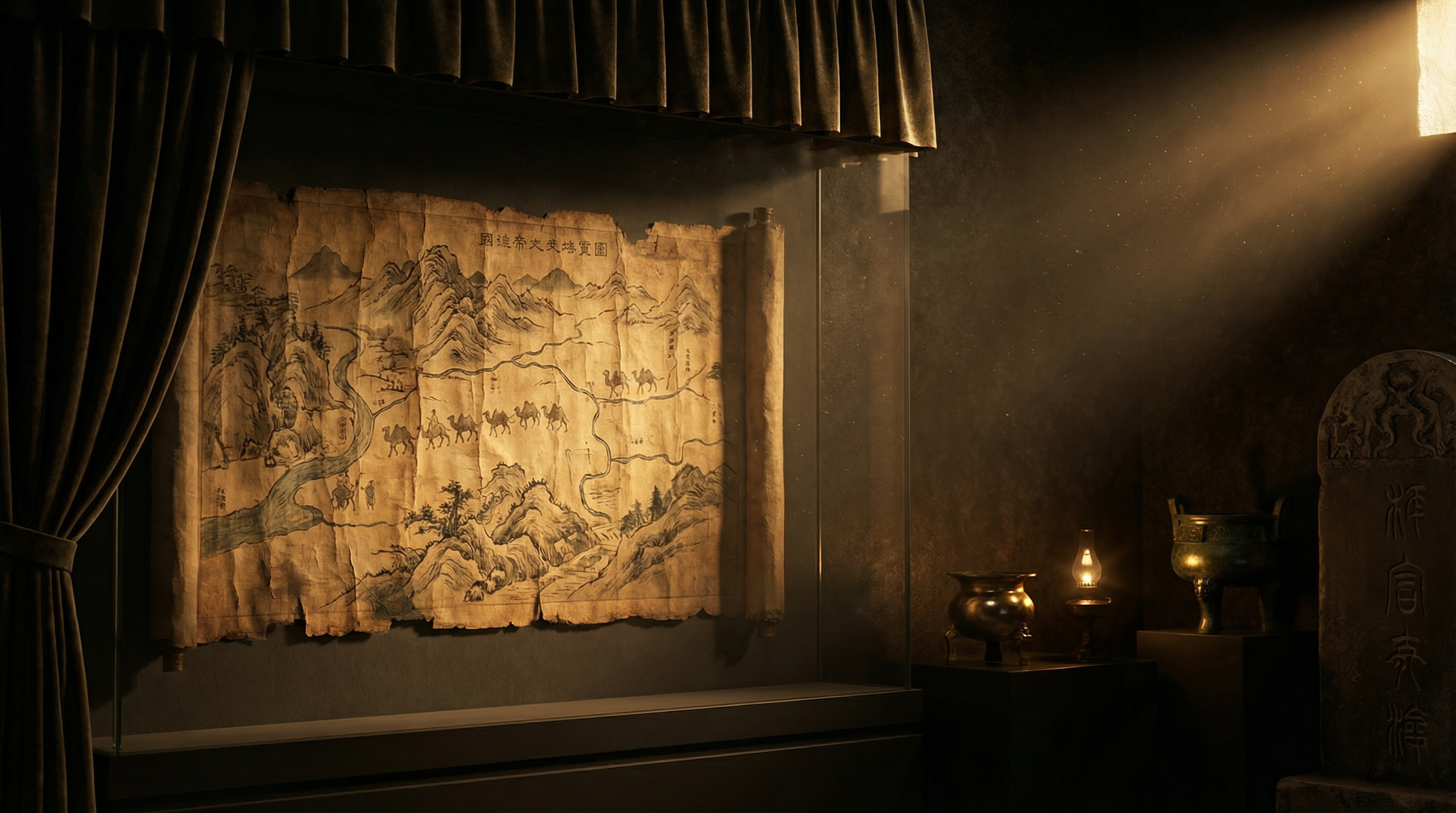
The Vinland Map is a single bifolium of vellum measuring approximately 28 x 40 cm, bound with other medieval texts, including the Hystoria Tartarorum (History of the Tartars) and a fragment of the Speculum Historiale by Vincent of Beauvais. It purports to be a world map from the mid-15th century, specifically dated to around 1440 CE by its proponents. Its most striking feature is the inclusion of a large island labeled "Vinlanda Insula," situated west of Greenland, along with detailed Latin annotations describing the Norse voyages.
The map's authenticity hinges primarily on the composition of its ink. Initial analyses in the 1970s, led by McCrone Associates, identified anatase, a crystalline form of titanium dioxide, in the yellow lines of the map's ink. Anatase was not known to be used as a pigment or ink additive until the 1920s, leading many to conclude the map was a modern forgery. This finding dealt a severe blow to the map's credibility.
However, the debate was far from over. Subsequent analyses, particularly in the 2000s and 2010s, employed more advanced, non-destructive techniques like Raman spectroscopy and X-ray fluorescence (XRF). These studies, notably by researchers at the British Museum and the University College London, confirmed the presence of anatase but also found significant amounts of iron and sulfur, consistent with iron gall ink, a common medieval ink. Some argued that the anatase might be a natural contaminant in the iron gall ink, or perhaps a component of an early 20th-century restoration attempt rather than the original drawing.
Then, a pivotal study published in 2021 by Raymond Clemens and Marie-Christine Enshaian at Yale University, utilizing XRF and other techniques, delivered what many consider the most definitive blow yet. Their analysis concluded that the ink used for the map's lines, including the "Vinlanda Insula" and other geographic features, contains a high concentration of titanium and iron, but crucially, the ink lines are primarily composed of titanium dioxide, with very little iron. This composition is inconsistent with medieval iron gall ink and strongly suggests the use of a modern titanium-based pigment, likely dating to the 20th century. Furthermore, they found that the parchment itself, while genuinely medieval, showed no evidence of having been written on with medieval ink before the modern titanium-based ink was applied.
Competing Theories
The scientific findings have solidified two primary theories:
-
The 20th-Century Forgery: This is the dominant view, especially after the 2021 Yale study. Proponents argue that the map was meticulously crafted in the mid-20th century, likely between 1920 and 1950, to capitalize on the growing interest in Norse exploration of North America. The forger would have used genuine medieval parchment and bound it with authentic medieval texts to lend credibility. The motivation could have been financial gain or an elaborate academic hoax. The presence of modern titanium dioxide in the ink is the strongest evidence for this theory.
-
The Genuine Medieval Artifact (with later alterations/contamination): This theory, now less widely accepted, suggests the map is genuinely medieval, perhaps an authentic example of Norse cartography or a later medieval European map incorporating knowledge of Norse voyages. Proponents of authenticity often argue that the anatase could be a natural impurity in medieval ink, a result of early 20th-century conservation efforts (e.g., to "enhance" faded lines), or even a unique medieval ink formulation not yet fully understood. However, the latest analyses indicating the primary composition of the ink is titanium dioxide, rather than a contaminant, significantly weakens this argument.
Modern Significance
Despite the strong evidence for forgery, the Vinland Map continues to hold a peculiar significance. It serves as a powerful cautionary tale in historical and archaeological research, highlighting the critical importance of rigorous scientific analysis in authenticating artifacts. It also underscores the enduring human desire for "lost histories" and the allure of discoveries that challenge established narratives.
Furthermore, the map, even if a forgery, reflects the genuine historical fact of Viking America. The L'Anse aux Meadows discovery unequivocally proved pre-Columbian exploration by the Norse. The map, therefore, taps into a real historical truth, even if its own existence is a fabrication. It forces us to consider how such knowledge might have been transmitted and whether other, undiscovered medieval maps might genuinely exist, depicting the lands across the Atlantic.
Conclusion
The journey of the Vinland Map, from its dramatic unveiling to its meticulous scientific dissection, mirrors the broader human quest to understand our past. While the scientific evidence overwhelmingly points to a 20th-century origin for its cartographic lines, the map’s initial promise – a tangible link to Viking America and a testament to early Norse cartography – continues to fascinate. It reminds us that history is not static; it is a dynamic field where new discoveries, and sometimes elaborate deceptions, constantly challenge and reshape our understanding.
What other hidden maps, genuine or otherwise, might still lie undiscovered, waiting to challenge our perceptions of ancient knowledge and exploration?
Marcus Hale
Independent Researcher & Archive Curator
Marcus Hale is an independent researcher and the curator of The Forbidden Archive. He has spent over a decade studying anomalous ancient technologies, cross-referencing primary excavation reports, museum catalogues, and peer-reviewed journals to document artifacts that mainstream history struggles to explain.
Want More Discoveries Like This?
Get new investigations on ancient mysteries delivered to your inbox. Free, no spam.
📖 Take the Archive With You
Enjoyed this mystery? The full ebook covers 50 Ancient Mysteries in depth — lost technologies, suppressed histories, and artifacts that shouldn't exist. 300+ pages, instant PDF download.
Competing Theories
Genuine medieval map proving pre-Columbian Norse exploration vs. 20th century forgery
Archive Record
Civilization
Norse/Viking
Time Period
Medieval
Approximate Date
1440 CE (claimed)
Discovered
Found in 1957, provenance disputed
Current Location
Beinecke Rare Book Library, Yale University
Materials
Parchment, iron gall ink