
Chinese Ming Dynasty · Ming Dynasty
The Zheng He Navigation Charts
6 min read
Last updated April 11, 2026
Admiral Zheng He's treasure fleet of 300 ships explored from China to Africa with navigation charts of astonishing accuracy — some researchers claim they mapped the Americas and Antarctica.
Also in This Category


Choose your reading style:

By Marcus Hale
Independent Researcher & Archive Curator
Uncharted Waters: Decoding the Enigma of Zheng He's Navigation Charts
Imagine a fleet of colossal ships, some five times the length of Columbus's Santa María, carrying thousands of sailors and vast treasures, embarking on voyages that dwarfed any European expedition for centuries. This wasn't a fantasy, but a historical reality orchestrated by China's Ming Dynasty, led by the legendary Admiral Zheng He. From 1405 to 1433 CE, his treasure fleet traversed the Indian Ocean, reaching the coasts of Africa and beyond. Central to these unprecedented journeys were the Zheng He Navigation Charts, artifacts of astonishing precision that continue to fuel debate and wonder. Were these simply maps for known routes, or do they hint at a far grander, more audacious scope of Chinese exploration than history typically records?
A Maritime Empire's Blueprint: Historical Context
The early Ming Dynasty, under Emperor Yongle, was a period of immense ambition and outward-looking policy. After consolidating power, Yongle sought to project China's might and establish tributary relations across the known world. He commissioned seven grand expeditions, entrusting their command to Zheng He, a Muslim eunuch of Hui descent. These voyages were unlike anything seen before or since, until the industrial age. Each fleet comprised hundreds of ships, including the colossal "treasure ships" (Bao Chuan), estimated to be up to 120-137 meters (400-450 feet) long and 50-60 meters (160-200 feet) wide, carrying up to 1,000 people. For comparison, Columbus's flagship was a mere 17 meters (56 feet).
These expeditions, collectively known as the Zheng He voyages, visited over 30 countries and regions, from Southeast Asia to the Persian Gulf, and down the East African coast. They exchanged gifts, established diplomatic ties, and collected exotic goods and animals, including giraffes and zebras. To navigate such vast distances and return safely, sophisticated navigational tools and, crucially, highly accurate charts were indispensable. The surviving Zheng He Navigation Charts are fragments of this monumental undertaking, offering a glimpse into the advanced state of Ming Dynasty navigation.
Precision on Parchment: Technical Analysis
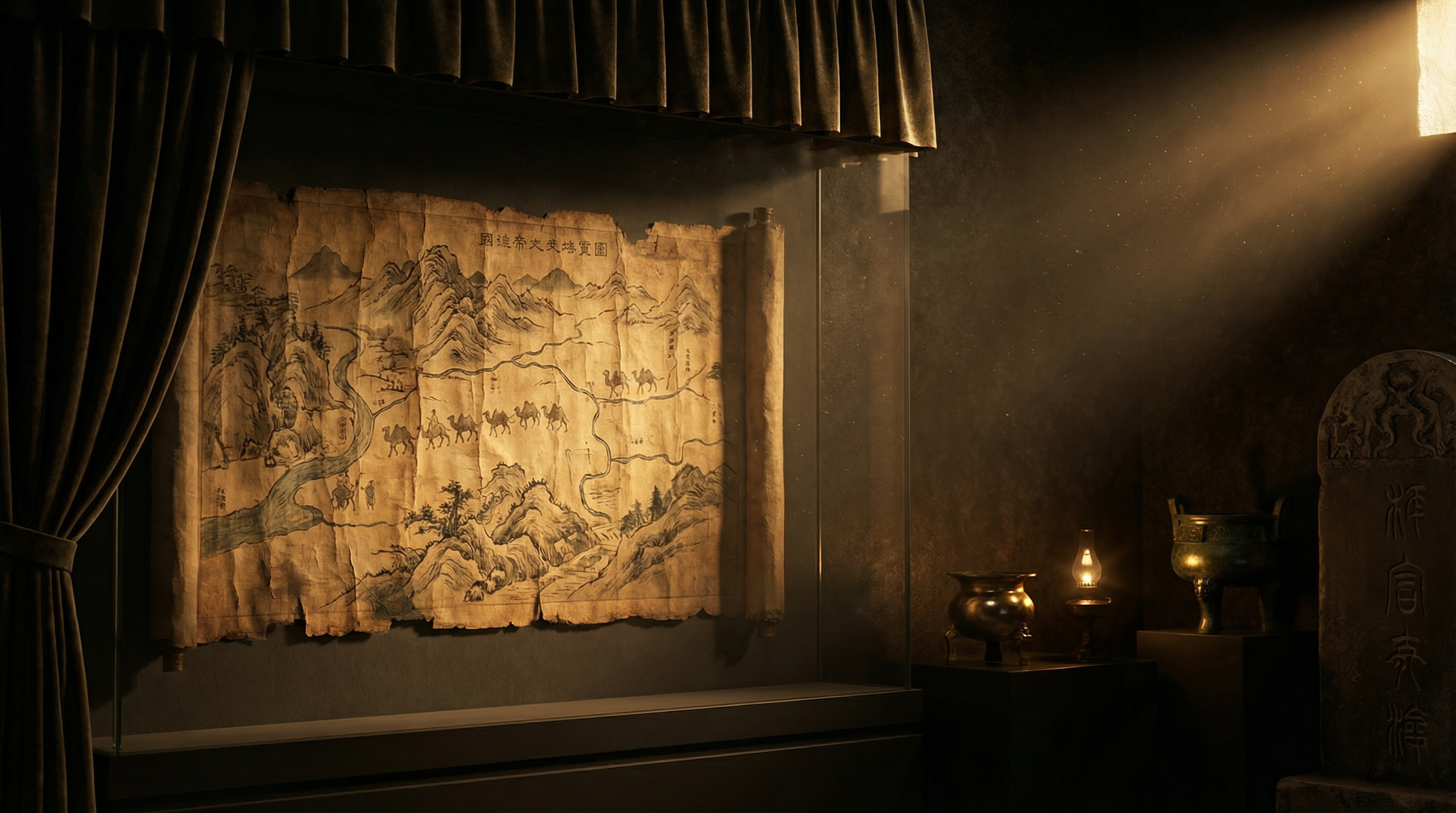
The extant Zheng He Navigation Charts, primarily compiled into the "Mao Kun Map" within the Wubei Zhi (Treatise on Armament Technology) published in 1621, are remarkable for their detail and methodology. These charts are not conventional Mercator projections but rather a series of strip maps, depicting coastlines, islands, and sea routes in a linear fashion. They utilize a system of "star-gauges" (xingcha) and "direction-needles" (zhenlu), essentially compass bearings, combined with estimated distances.
The charts meticulously record over 500 place names, many of which can be accurately identified today, stretching from Nanjing to the Strait of Hormuz and down to the East African coast. They indicate depths, reefs, anchorages, and even prevailing winds and currents. A key feature is the use of a grid system, where distances are measured in geng (a watch, approximately 2.4-3 hours of sailing) and directions are given using a 24-point compass. This combination allowed for precise dead reckoning. The accuracy of these charts, particularly for the Indian Ocean routes, is astounding, demonstrating a profound understanding of maritime geography and astronomical navigation. For instance, the detailed depiction of the coastlines of Sumatra, Sri Lanka, and the Arabian Peninsula aligns remarkably well with modern cartography. This level of detail underscores the advanced capabilities of Chinese exploration during this era.
Beyond the Horizon: Competing Theories
While the historical consensus acknowledges the treasure fleet's reach into the Indian Ocean and East Africa, the Zheng He Navigation Charts have become a focal point for more audacious claims.
Standard Indian Ocean Navigation: The mainstream view, supported by the majority of historical and cartographic evidence, is that the charts accurately depict the routes taken by Zheng He's fleet through the Indian Ocean. Scholars like J.V.G. Mills have meticulously analyzed the charts, confirming their utility for navigation within this known sphere. The precision, while impressive, is consistent with centuries of Chinese and Arab maritime knowledge of these waters.
Circumnavigation of the Globe & Mapping the Americas/Antarctica: A more controversial theory, popularized by Gavin Menzies in "1421: The Year China Discovered America," posits that Zheng He's fleets not only circumnavigated the globe but also discovered and mapped the Americas, Australia, and even Antarctica, decades before European explorers. Proponents of this theory point to certain anomalies on the Mao Kun Map, such as landmasses that could be interpreted as parts of the Americas or other continents, and suggest that the accuracy of some world maps from the 16th century (like the Piri Reis map) might stem from earlier Chinese sources. They argue that the Chinese had the technology and motivation for such voyages. However, these claims are largely dismissed by mainstream historians and cartographers due to a lack of direct, unambiguous evidence. The "anomalies" are often seen as misinterpretations, artistic license, or errors common in early cartography, rather than definitive proof of transatlantic or circumpolar voyages. No physical artifacts or conclusive textual evidence of Chinese presence in the Americas or Antarctica from this period have ever been found.
Maps Copied from Earlier Civilizations: Another theory suggests that parts of the Zheng He charts, particularly those depicting distant lands, might have incorporated knowledge gleaned from earlier civilizations, such as Arab or Persian traders, who had extensive networks across the Indian Ocean. While the Chinese certainly exchanged knowledge with other maritime cultures, the unique stylistic and methodological elements of the Zheng He charts suggest they were primarily original Chinese compilations, albeit potentially incorporating information from diverse sources.
A Legacy of Exploration: Modern Significance
The Zheng He expeditions and their associated navigation charts represent a zenith of Chinese exploration and technological prowess. They stand as a testament to an era when China was the undisputed maritime superpower, capable of projecting its influence across vast distances. The sheer scale and sophistication of the treasure fleet, particularly the advanced Ming Dynasty navigation techniques, offer invaluable insights into pre-modern naval capabilities.
In a global context, Zheng He's voyages challenge Eurocentric narratives of exploration, demonstrating that ambitious, long-distance maritime endeavors were not exclusive to the West. The charts themselves are priceless historical documents, providing a window into the geographical understanding and cartographic methods of 15th-century China. They continue to inspire awe and debate, reminding us that history often holds more complexities and unanswered questions than we might initially assume.
Conclusion
The Zheng He Navigation Charts are more than just ancient maps; they are a profound legacy of human ingenuity and ambition. While their most extraordinary claims remain unproven, their undeniable accuracy for the Indian Ocean routes speaks volumes about the advanced capabilities of Ming Dynasty China. They invite us to ponder the true extent of ancient knowledge and the myriad ways civilizations connected across the globe. What other secrets might these intricate lines and symbols hold, waiting for future generations to decipher?
Marcus Hale
Independent Researcher & Archive Curator
Marcus Hale is an independent researcher and the curator of The Forbidden Archive. He has spent over a decade studying anomalous ancient technologies, cross-referencing primary excavation reports, museum catalogues, and peer-reviewed journals to document artifacts that mainstream history struggles to explain.
Want More Discoveries Like This?
Get new investigations on ancient mysteries delivered to your inbox. Free, no spam.
📖 Take the Archive With You
Enjoyed this mystery? The full ebook covers 50 Ancient Mysteries in depth — lost technologies, suppressed histories, and artifacts that shouldn't exist. 300+ pages, instant PDF download.
Competing Theories
Standard Indian Ocean navigation vs. circumnavigation of the globe vs. maps copied from earlier civilizations
Archive Record
Civilization
Chinese Ming Dynasty
Time Period
Ming Dynasty
Approximate Date
1405-1433 CE
Discovered
China
Current Location
Various Chinese archives and museums
Materials
Paper, ink, silk